If you are sourcing frying pans wholesale, the three specifications that drive most returns are the base material, the base thickness, and the coating. Decide those three before you compare prices, and most other problems — warped bases, peeling coatings, pans that fail the induction test — never reach your warehouse. A frying pan is a simple product, but a wholesale order multiplies every small defect by a thousand units, so the spec sheet matters more than the sample photo.
This guide covers the material options you will see from suppliers, what “gauge” and base thickness mean in practice, the coating types that matter for retail, and the questions to ask before you place your first cookware wholesale order.
What “gauge” and base thickness mean in practice
Suppliers describe pan bottoms in millimetres, not gauges. A 2.0 mm base is a budget pan, 2.5 mm is mid-range, and 3.0 mm or more is a premium pan with better heat distribution and less warping. The number matters because a thin base heats unevenly and can warp on an induction hob, which is the most common complaint in online reviews of cheap pans.
For aluminum frying pans, the whole pan is usually one stamped piece, so base thickness and wall thickness are the same number. For stainless steel pans, many suppliers use a multi-layer base: a magnetic stainless layer on the outside for induction, an aluminum disc in the middle for heat spreading, and stainless inside for the cooking surface. When a supplier says “3-ply base” or “encapsulated base,” ask for the thickness in millimetres — the marketing phrase alone does not tell you the performance.
Frying pan materials you will see from suppliers
| Material | Base thickness (typical) | Induction | Weight feel | Typical use in a retail range |
|---|---|---|---|---|
| Aluminum, non-stick coated | 1.8–2.5 mm | Usually no (unless magnetic base added) | Light | Budget and mid-range bestsellers |
| Aluminum, hard-anodized | 2.5–3.0 mm | Usually no | Medium | Mid-range, better durability |
| Stainless steel with aluminum base | 2.5–3.0 mm base | Yes | Medium-heavy | Mid to premium, professional look |
| Carbon steel | 1.5–2.5 mm | Yes | Light | Chef-style pans, wok-adjacent lines |
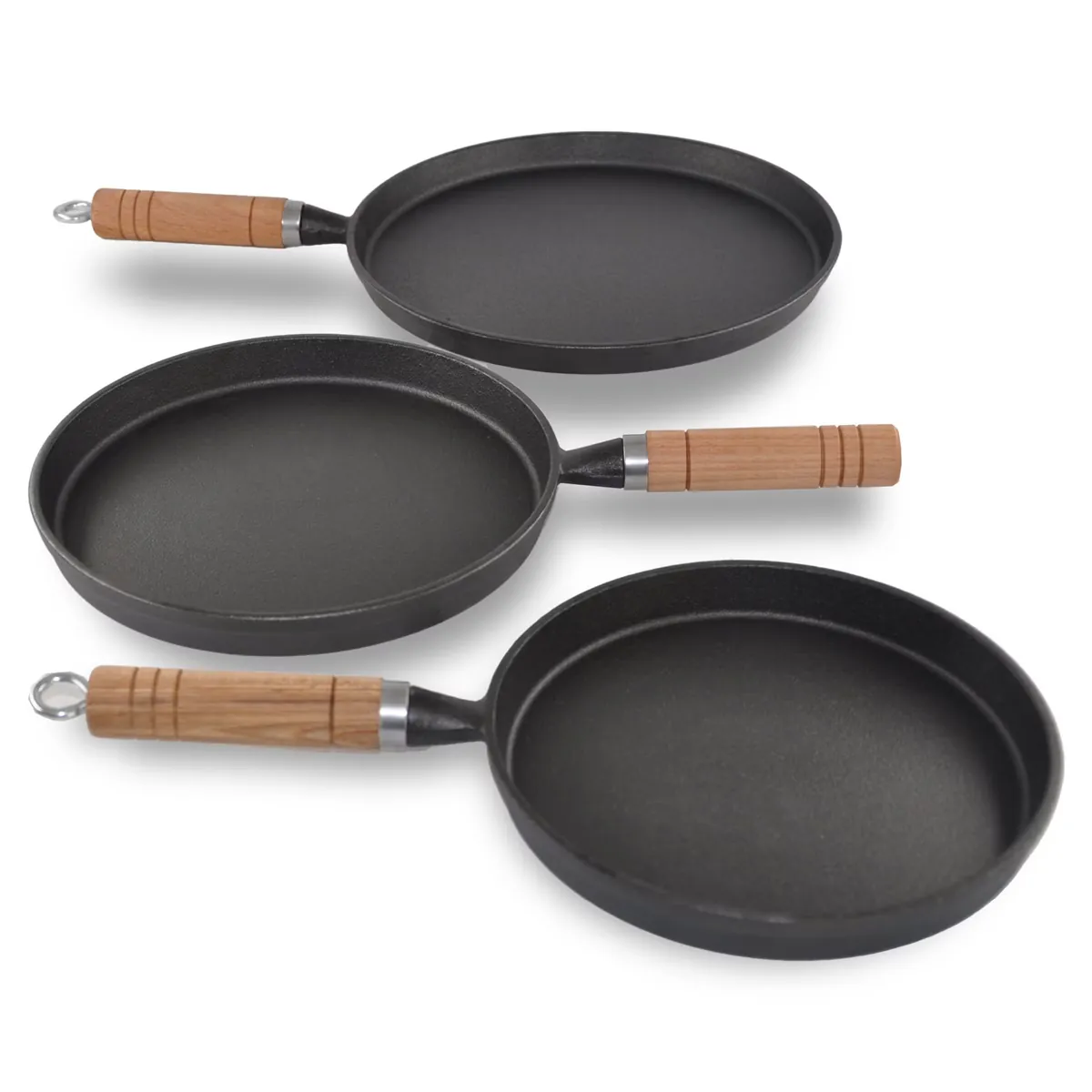
| Cast iron | Heavy, not expressed as gauge | Yes | Very heavy | Premium, specialty cooking |
If your market is mostly induction hobs, check every line for magnetic compatibility. A surprising number of budget aluminum pans cannot be used on induction, and customers only discover this after delivery. If induction compatibility is a must, you will need either stainless pans or aluminum pans with a magnetic base disc — both cost more than plain aluminum.
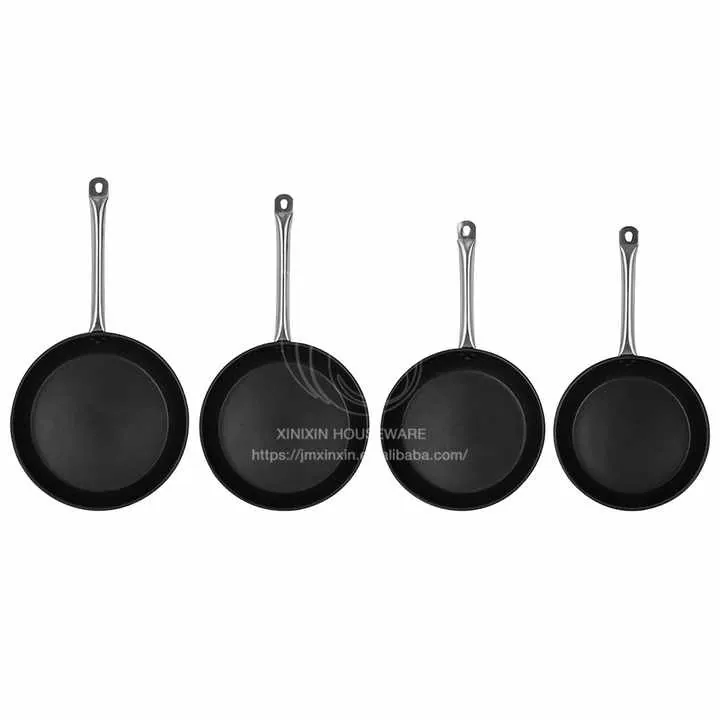
Coating types in a wholesale context
Most frying pans sold today have a non-stick coating. The two broad families you will meet are PTFE-based coatings (marketed under brand names like Teflon, which is a brand, not a material) and ceramic or mineral-based coatings. Both can be labelled “PFOA-free” by suppliers; if that claim matters for your market, ask for the test report rather than accepting the label.
Ceramic coatings are usually marketed as more environmentally friendly and are often preferred by buyers who want to avoid PTFE entirely. The trade-off is durability: ceramic non-stick typically wears faster than a good PTFE coating, which matters for customers who use metal utensils or stack pans roughly. In practice, the coating brand and the number of layers matter more than the marketing name. Ask the supplier which coating brand they use and what warranty they offer against peeling.
Uncoated pans — stainless, carbon steel, cast iron — are a smaller but steady niche. They have no peeling risk, but they need either a seasoning layer or good technique, so they suit a more experienced buyer. Many ranges keep one uncoated option at the top end for that reason.
Handles, rivets and oven safety
Handle material changes the cost and the customer experience. Bakelite or phenolic handles keep pans light and cheap but usually cannot go in the oven above about 180 °C. Stainless handles are oven-safe and look premium but conduct heat, so pans need a covered grip or a helper handle. Check how the handle is attached: riveted handles are stronger and common on mid-range pans, while some budget pans use spot welding that can loosen.
Oven-safe claims are another frequent source of returns. If your listing says “oven-safe up to 200 °C,” confirm that the handle, coating and lid (if any) all survive that temperature. Ask for the factory’s test method and put the temperature on the packaging.
Packaging and protection
Frying pans arrive scratched if the packing is wrong. Standard export packing is a clear PVC sleeve or shrink film over the pan, sometimes with a cardboard collar, packed into an export carton. For retail-ready programs, ask whether the supplier can print a colour carton with your brand — most can, and it changes the MOQ and the cost per unit. Confirm the carton weight as well; a carton that is too heavy for one worker to lift creates problems in your own warehouse.
MOQ, sampling and lead time
For stock frying pan designs, first-order MOQs usually start around 500–1,000 pieces per model, with 2,000+ common for coated pans that run on a dedicated coating line. Custom sizes, custom packaging or a branded coating raise the minimum. Sampling typically takes 1–3 weeks after you approve the spec; production for a standard order commonly runs 25–40 days. These are typical ranges, not guarantees — confirm the numbers with the supplier for your specific model.
Checklist before you order
1. Base thickness in mm, in writing. Ask for the spec sheet, not the description.
2. Induction compatibility. Test the sample on an induction hob, or require a written guarantee.
3. Coating brand and warranty. Which coating, how many layers, and what happens if it peels.
4. Handle and rivet type. Oven-safe rating and attachment method.
5. Export packing. Sleeve, collar, carton weight, and whether retail packaging is an option.
6. Sample test. Fry an egg and cook a steak on the sample; check for hotspots with a thin layer of oil.
If you do not want to negotiate these details with several factories yourself, a sourcing partner can shortlist pans that already pass these checks. Browse our full product catalogue or the broader kitchenware range and send your target sizes and coating preference for a quote.
FAQ
What is the minimum order quantity for wholesale frying pans?
For stock designs, first orders usually start around 500–1,000 pieces per model. Coated pans on a dedicated line, custom sizes or branded packaging push the minimum higher. Confirm the exact MOQ with the supplier for each model.
What base thickness should I choose for a frying pan?
2.0 mm is a budget pan, 2.5 mm is a common mid-range choice, and 3.0 mm or more is premium. Thicker bases distribute heat more evenly and resist warping on induction hobs, which reduces returns from customers with modern cooktops.
Are ceramic non-stick pans better than PTFE pans?
Neither is universally better. Ceramic coatings are often preferred by buyers who want to avoid PTFE, but they typically wear faster. A good PTFE coating usually lasts longer. What matters is the coating brand, the number of layers and the factory’s warranty — ask for the test report rather than relying on the marketing label.
Why do my cheap frying pans warp on induction hobs?
Thin bases and sudden temperature changes are the usual cause. A pan with a base below about 2.0 mm is more likely to warp, and empty-pan heating makes it worse. Choosing a thicker base or a multi-layer stainless base reduces the problem.
Final recommendation
Build your frying pan range around one strong non-stick aluminum line for volume, one stainless line with an induction-compatible base for the mid-market, and optionally one uncoated option (carbon steel or cast iron) for the top end. Verify base thickness, coating, induction compatibility and packaging on the sample before you scale up.
Ready to compare frying pan suppliers? Send us your target sizes, coating and price range through the contact page, and our sourcing team will match your spec to suitable production lines with samples available before you commit.