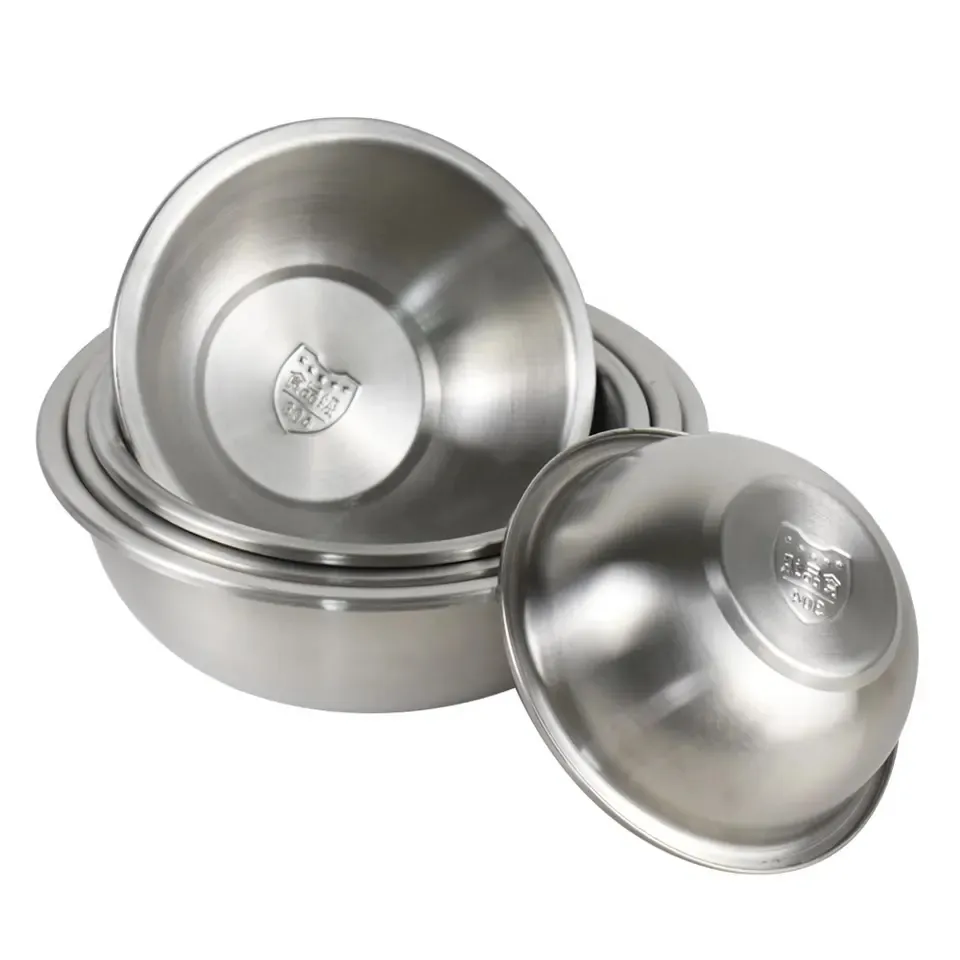
For stainless steel cookware wholesale, two specs decide most of the outcome: construction (tri-ply versus disc bottom) and grade (304 or 316 versus 201). Get those two right and the rest — gauge, lids, handles, induction base — falls into place. This guide explains what each spec changes in the kitchen and on the shelf, and which checks to run before you commit to a container.
Tri-Ply vs Disc Bottom: How Heat Is Distributed
Stainless steel alone conducts heat poorly, so cookware is built with an aluminum or copper layer. Tri-ply construction sandwiches a full aluminum core between two stainless layers across the whole pan, giving even heat across the walls and base. Disc bottom construction bonds a stainless or aluminum disc only to the base, which is cheaper and heats evenly on the bottom but not up the walls. For most retail programs, tri-ply is the premium story and disc bottom is the value story. Neither is wrong — the choice depends on your price point and your customer’s expectations.
| Spec | Tri-ply | Disc bottom |
|---|---|---|
| Heat distribution | Even across base and walls | Even on base, less on walls |
| Production cost | Higher | Lower |
| Typical price point | Mid-premium | Budget to mid |
| Weight | Heavier | Lighter |
| Best retail fit | Premium sets, chefs | Everyday sets, promotions |
The pattern above is typical; confirm the actual layer structure and disc size with the factory because specifications vary.
Stainless Grades: 304, 316 and 201 for Cookware
Grade describes the alloy, not the quality of the finished pan. 304 stainless (roughly 18/8 chromium-nickel) is the common cookware grade with good corrosion resistance and a neutral food-contact profile. 316 adds molybdenum for extra corrosion resistance, which suits coastal environments and some commercial use but costs more. 201 stainless is a lower-cost grade with less nickel; it works for budget lines but is more prone to corrosion in demanding conditions. For wholesale cookware, 304 is the usual recommendation, with 316 as an option where corrosion resistance is a selling point and 201 reserved for very price-sensitive programs.
For wholesale programs, our stainless steel product range covers cookware, bowls and tableware, and the cookware product range shows the full material mix we supply.
Also check the finishing of the steel: brushed exterior finishes hide fingerprints and are common in retail, mirror finishes look premium but show marks, and the interior finish should be smooth enough to clean easily. Confirm the finish spec per SKU in writing.
Gauge, Lids and Handles
Three construction details complete the picture. Gauge is the thickness of the steel — thicker bases resist warping and hold heat better, but add weight and cost; confirm the base and body thickness separately, because a thick base on a thin body is a common compromise. Lids are usually glass with a stainless rim or all-stainless; glass lets the customer watch cooking but adds breakage risk in transit, so confirm the lid packaging. Handles are typically stainless, bakelite or silicone-wrapped; stainless handles stay cool only with good design, and loose handles are the fastest way to generate safety complaints. Ask how handle attachment is tested.
Induction Compatibility and Base Design
If your market uses induction cooktops, the pan base must be magnetic. Tri-ply pans are naturally induction-compatible when the outer layer is magnetic stainless. Disc bottom pans need a magnetic disc bonded to the base. Do not assume compatibility from a photo: ask for the induction test result and, if you can, test the sample on an induction hob. Confirm this before mass production, because a non-compatible batch is a total write-off for the affected market.
Supplier Checks for Stainless Cookware
Run the same supplier checks you would for any cookware line, with a few stainless-specific additions. Ask for the grade certificate or mill test report for the steel, confirm the layer structure and disc size in the spec, and check the welding and handle rivets on the sample. Test a pre-production sample for flatness after heating, induction compatibility, and lid fit. Also confirm the packaging method for glass lids and the carton spec, because stainless cookware is heavy and the packing line decides how much arrives intact. Ask the factory which finishing process they use for the interior, because the choice between mirror polish and brushed finish changes both the look and the cleaning behavior that end customers complain about.
Packaging and Shipping Notes for Stainless Cookware
Stainless cookware is heavy, and the packing line decides how much of the container arrives undamaged. Confirm the inner packing for lids — glass lids need individual protection — and check whether pans are nested with protective sheets between them to avoid scratching the polished surfaces. Ask for the carton weight and dimensions per set, because heavy sets change the freight calculation and the carton strength requirement. For retail programs, confirm whether the cartons are retail-ready with printed artwork or plain export cartons for local repacking, and request a packing photo from the production line before the container loads. A small investment in inner packing protects the premium look that stainless cookware is sold on. Finally, plan the final inspection around the visible claims: scratches on polished surfaces, lid fit, handle tightness and the presence of protective film on the interior. Those four checks cover the complaints that stainless cookware buyers actually raise, and they are all visible in a simple pre-shipment photo report.
Quick check: Is 304 always better than 201?
For most retail cookware, yes, because 304 has better corrosion resistance and a stronger food-contact profile for the price. But 201 is still used in budget lines where the price point is the deciding factor. Match the grade to the market and the expected use, not to a marketing claim.
FAQ: Stainless Steel Cookware Wholesale
What is the best stainless steel grade for wholesale cookware?
304 is the usual recommendation for retail cookware because it balances corrosion resistance, food-contact performance and cost. Use 316 for premium programs where extra corrosion resistance is a selling point, and 201 only for very price-sensitive lines.
What is the difference between tri-ply and disc bottom?
Tri-ply sandwiches an aluminum core across the whole pan for even heat in the base and walls. Disc bottom bonds a disc to the base only, which is cheaper and heats evenly on the bottom. Choose by price point and customer expectation.
Do I need a grade certificate for stainless cookware?
It is good practice to ask for the mill test report or grade certificate for the steel. Confirm that the report covers the grade you specified and that the finished product matches it.
Why does induction compatibility matter?
An induction cooktop only works with magnetic bases. If the pan is not induction-compatible and your market uses induction, the product simply will not heat. Confirm the test on the sample before mass production.
Final Recommendation
Specify the construction and grade in writing, then verify with samples. Tri-ply and 304 is the safe premium default; disc bottom and 304 covers the value range; 201 is a budget decision that needs a clear target market. Test the sample for induction, flatness and handle strength, and confirm the glass lid packing before you load.
If you are sourcing stainless steel cookware wholesale and want a factory-side review of your spec, send us your target sizes, construction and quantities. We reply with material options, sample plans and lead-time estimates. Request a quote or contact us directly via WhatsApp — a real sourcing specialist will respond.