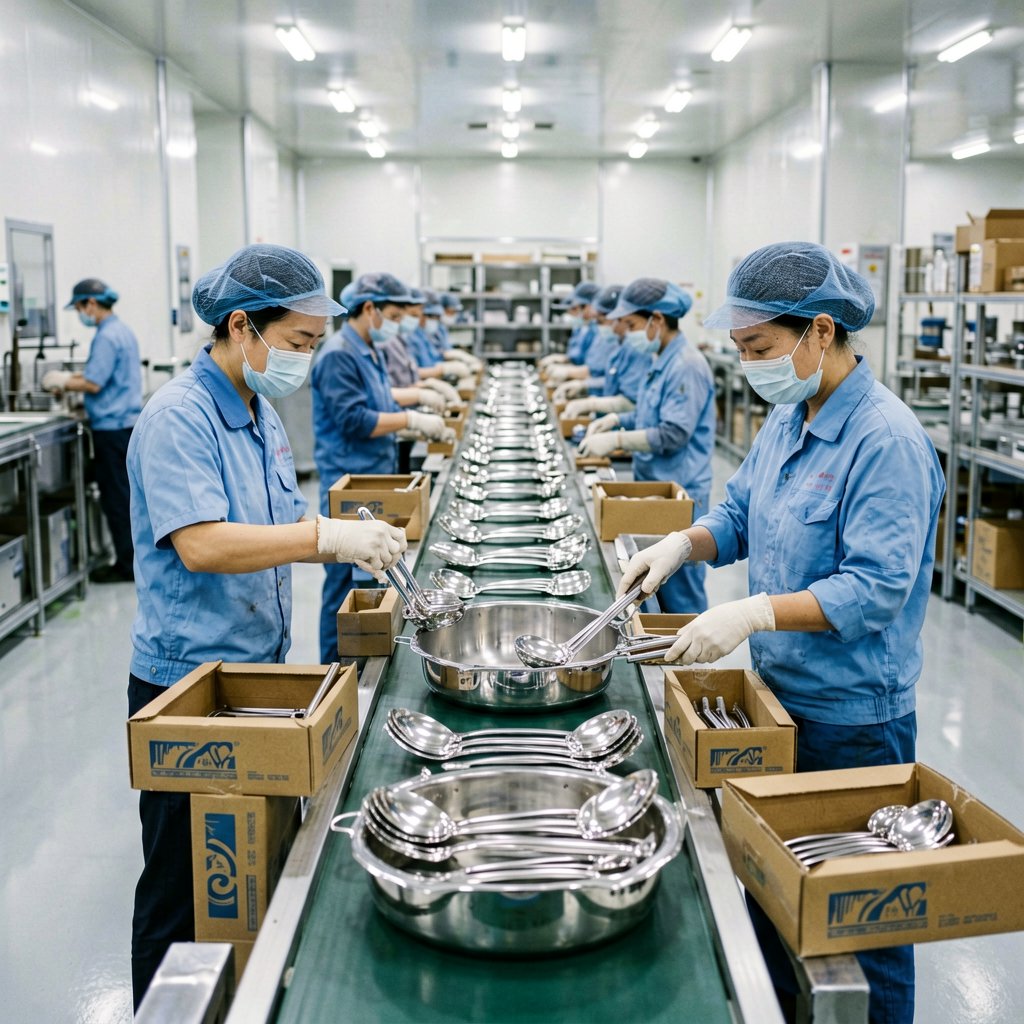
A document check tells you what a supplier claims; a factory audit tells you what they actually do. For a first kitchenware order, audit four areas — production floor, coating or finishing area, QC lab and warehouse — and collect the documents first so the visit has a checklist instead of a tour. This guide explains what to look for in each area, which red flags matter, and how to run a remote audit when you cannot travel.
Before the Audit: Documents to Collect
Ask for the same documents you would check in any sourcing process: business license, export experience summary, product test reports, and any certifications the factory holds. The point of collecting them before the audit is to turn the visit into a verification exercise. If a document is missing, note it as an open item and follow up after the visit. Do not accept a document as proof of capability — a factory can hold a certificate and still run a sloppy production line. The audit is where the claims get tested.
| Audit area | What to check | Red flag |
|---|---|---|
| Documents | License, export record, test reports, certifications | Missing or expired core documents |
| Production floor | Organization, equipment condition, material storage | Cluttered floor, unlabeled materials |
| Finishing / coating | Dust control, coating records, curing logs | No process records, rushed curing |
| QC lab | Instruments present and used, inspection records | Lab exists but no records |
| Warehouse | Stock condition, packing line, FIFO practice | Mixed batches, damaged cartons |
The red flags are patterns, not proof of a problem on their own; investigate anything unusual in person.
Production Floor: What Good Looks Like
A well-run floor is organized enough that a visitor can see the flow from material to finished piece. Check whether raw materials are labeled and stored separately by grade, whether the equipment is clean and maintained, and whether work-in-progress moves in a logical order. You do not need to understand every machine; you need to see that the factory has control over its process. If the floor looks chaotic during an announced visit, imagine what it looks like during a rush order. Take photos of each area with a timestamp and label them, so the audit report is easy to compare against the next visit.
Before you audit, decide which categories the supplier will cover for you. Our kitchenware product range and full product catalogue are useful references for matching the audit checklist to the products you plan to order.
Finishing and Coating Area: The High-Risk Zone
For cookware, bakeware and utensils, the coating and finishing area is where quality is won or lost. Check dust control — coating lines need a clean environment — and ask to see the coating process records: what was coated, when, at what temperature, for how long. Ask how curing times are tracked and whether records are kept per batch. A factory that cannot show batch records for its coating line cannot prove consistent quality, and inconsistent coating is the leading cause of cookware returns.
QC Lab and Incoming Inspection
A real QC lab has instruments and uses them. Look for the basics: calipers or gauges for dimensions, a thickness gauge if the factory coats products, and simple test equipment for the category. More important than the instruments is the record: ask to see recent inspection records, not a policy document. Check whether incoming materials are inspected before production and whether finished goods are inspected before packing. The best sign is a factory that shows you a rejected batch and explains what failed and why — that is a factory that actually controls quality.
Warehouse and Packing Line
The warehouse answers two questions: what state do the goods arrive in, and how are they packed. Check whether stock is stored off the floor, labeled and separated by batch. Watch the packing line long enough to see whether the packing spec is followed — inserts placed, cartons sealed, labels aligned. For fragile items such as glass bakeware or tableware, the packing line is the difference between a clean arrival and a damage claim. Ask to see a recent packing photo or video of the SKU you plan to order, and check whether the warehouse keeps a first-in-first-out practice for raw materials and finished stock. A warehouse that cannot tell you which batch is oldest is a warehouse that cannot manage freshness-sensitive materials such as silicone and adhesives.
Remote Audit: When You Cannot Visit
If travel is not possible, run a structured remote audit instead of trusting photos. Ask the factory for a live video walkthrough of the four areas on a checklist, with a time-stamped call so it cannot be a pre-recorded show. Request batch records for a recent production run, inspection records from the QC lab, and a packing video of your target SKU. A remote audit is weaker than an on-site visit, but it still separates factories that can produce evidence from factories that can only produce promises. Combine it with a pre-production sample from the same batch to close most of the gap. Whichever method you use, put the checklist in writing before the audit starts, so both sides agree on what will be checked and what counts as a pass.
After the Audit: Turning Findings Into an Action Plan
An audit only pays off if the findings become a written action plan. List every open item — missing document, unclear process record, unlabeled material — with a deadline and a responsible person on the factory side. For the items that matter most, ask for photo evidence when they are resolved. Then use the plan as the starting point for the next audit: a factory that closes its open items between visits is improving; a factory that ignores them is not. Keep the audit report and the action plan in the same order file as the quotes and the approved sample, so every future order starts from the same baseline instead of from a new round of promises.
Quick check: How long should a first factory audit take?
Plan at least half a day for the four core areas, plus time to review documents and take photos. A rushed one-hour tour can be arranged by any factory; a serious audit is a structured exercise with a written report.
FAQ: Kitchenware Supplier Factory Audit
Do I need to audit every factory I source from?
Audit before the first order with any new factory, and re-audit when you change product categories or when quality problems appear. Existing suppliers with a strong track record can be audited less often.
What if the factory refuses a visit?
Treat a refusal as a strong signal. Some factories limit visits for valid reasons, but a first-order partner should be able to explain the policy and offer an alternative such as a remote audit with documentation.
Can I use a third-party inspection instead of a visit?
Yes. A third-party pre-shipment inspection is a good complement to the audit, especially for QC at the finished-goods stage. Keep the audit as your supplier-level check and the inspection as your order-level check.
What documents should the audit produce?
A written audit report with photos per area, a list of open items, and the factory’s response plan. Keep it with the order file so the next order starts from the same baseline.
Final Recommendation
Choose a kitchenware supplier on evidence, not on price or promises. Collect the documents, audit the four core areas, verify the coating records, and combine the visit with a pre-production sample. A factory that can show you its process — including its rejects — is a factory you can build a program on.
If you are evaluating kitchenware suppliers and want a factory-side review before your audit, send us your target products and quantities. We reply with sourcing notes, audit support options and lead-time estimates. Request a quote or contact us directly via WhatsApp — a real sourcing specialist will respond.