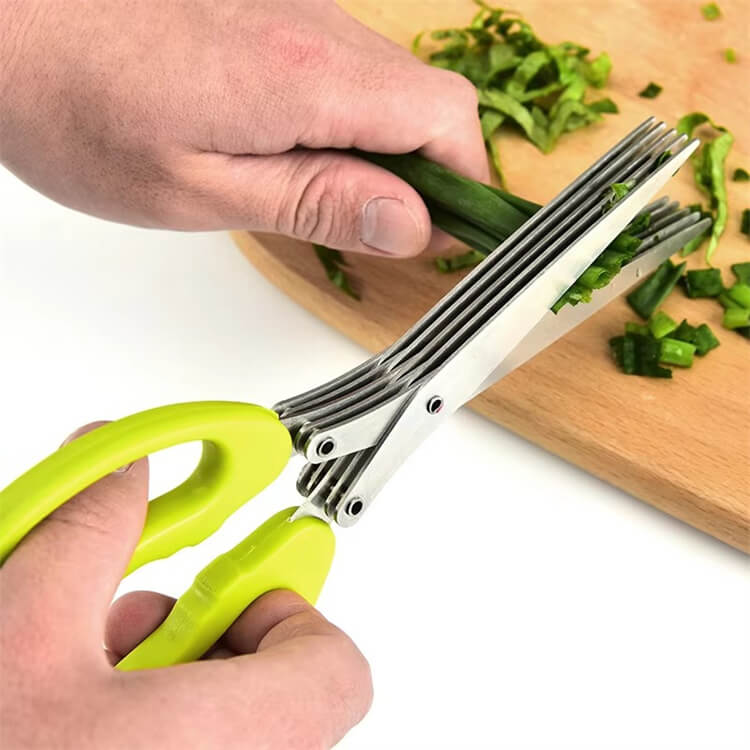
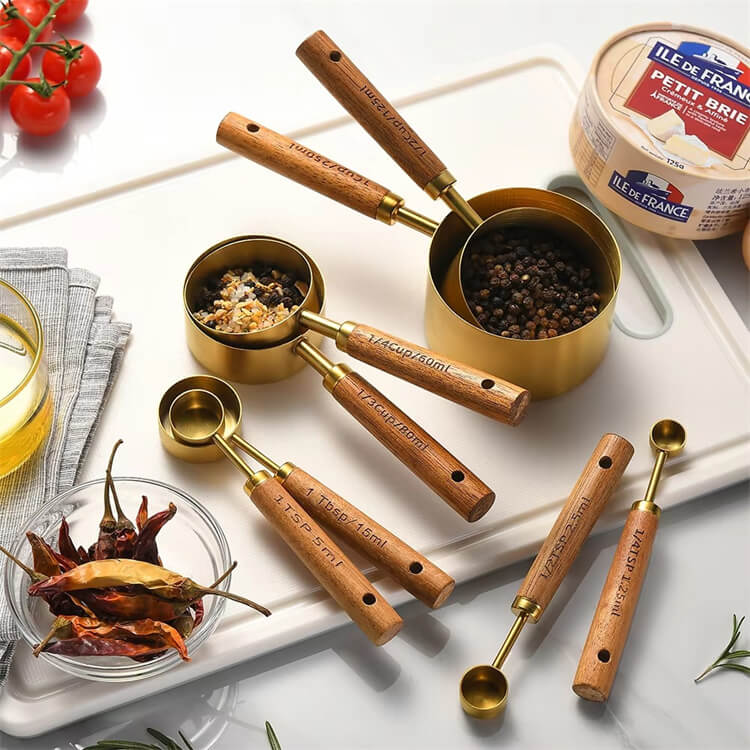
US retailers are restocking kitchen gadgets with a different basket than they did two seasons ago: multi-purpose tools that replace single-purpose SKUs, silicone and stainless over plastic, and items that photograph well for social channels. If you are planning a wholesale order, the mix that sells now is narrower and more deliberate than the old “one of everything” gadget program.
Which kitchen gadget categories are moving in US retail
The clearest signal in current orders is consolidation. Retailers are cutting slow lines and asking suppliers for multi-function versions of proven tools — herb scissors that double as choppers, peelers with dual blades, measuring sets with wood handles that sit on an open shelf instead of inside a drawer. Gadgets that solve one narrow task are harder to justify at wholesale because they take shelf space and give back one use case.
Another consistent theme is material. Stainless steel bodies with silicone grips, silicone brushes with removable heads, and wooden-handle measuring tools are appearing in more line sheets than plain plastic versions. These read as higher quality at roughly the same price point, which matters for retailers competing with mass-market house brands.
Practical items that earn repeat mention: garlic crushers, herb scissors, measuring spoons and cups, zesters, milk frothers, meat claws, and baking-focused helpers like silicone brushes and fine-mesh baskets. These are the categories importers keep reordering because sell-through is steady and margins hold.
How to build a gadget assortment that repeats
Start with the top three to five proven movers
Your first container should not be a catalogue. Pick the three to five gadgets that already sell in your market, order them in depth, and add one or two experimental SKUs with small quantities. A supplier that can handle mixed loads and adjust per-SKU quantities will make this practical; one that insists on large minimums per design is harder to test with.
Match the price band to the channel
Dollar stores and mass channels want simple tools with strong durability claims at the lowest landed cost. Specialty kitchen retailers and online sellers want design, finish quality, and packaging that supports a higher ticket. Know which band your target retailer buys in before you ask for samples, because the same factory can usually produce both — but not with the same spec.
What to check when sourcing gadgets wholesale
| Check | Why it matters | What to confirm with supplier |
|---|---|---|
| Material grade | Stainless 201 vs 304, silicone food-grade vs general purpose | Grade number, material certificate, food-contact test report |
| Finish quality | Rough edges and thin plating cause returns | Sample inspection, edge and seam check before production |
| Packaging | Retail-ready display vs bulk carton changes cost and shelf behavior | Blister, hang tag, retail box, or plain polybag options |
| MOQ per SKU | Assortment testing needs small per-SKU quantities | Minimum per design and whether mixed models are allowed |
| Lead time | Restock timing for seasonal peaks | Production days plus QC and loading schedule |
Seasonal timing for gadget orders
Gadget sales cluster around gifting seasons — Q4 in particular — but the buying decision happens months earlier. US retailers typically place gift-season orders in the second quarter for delivery before October. If you miss that window, the next natural slot is spring kitchen renewal promotions, where practical tools and bakeware accessories both perform. Ordering to a calendar instead of reacting to demand keeps your container costs predictable.
Sampling and testing before you commit
Gadget programs fail on two predictable points: the sample looks better than the production piece, and the packaging does not survive the shelf. A structured sampling round fixes both. Order one to three samples per candidate SKU from the shortlist, then check them against a simple pass/fail list before discussing quantities.
Sample check list for gadgets
- Feel the handle and grip — loose parts and thin silicone are return drivers.
- Check the finish on seams and edges; burrs and uneven plating show up in retail packaging.
- Confirm the actual material grade, not just the sales description — ask for the certificate or a clear grade marking.
- Open and close moving parts repeatedly; hinges, springs and blades fail early on cheap builds.
- Verify packaging dimensions against your shelf plan and carton fit.
This round costs little compared with a full production run, and it tells you which factory is giving you honest specs. A supplier who resists sending production-equivalent samples is a warning sign before you place a larger gadget order.
Avoiding the common gadget sourcing mistakes
The mistakes repeat across importers, and they are cheap to avoid once you see the pattern. First, buyers treat the sample as the spec: they approve a beautifully finished sample, then production arrives with a slightly different plastic texture or a lighter silicone wall. The fix is to write the material and dimension tolerances into the order, not just approve a physical sample. Second, buyers under-order packaging. A gadget that sells at retail needs packaging that survives a distribution center, and blister cards and hang tags have their own lead times — usually two to four weeks on top of production.
Third, buyers forget that gadget trends move fast. A tool that is trending this quarter may be a slow mover in nine months, so keep the first order small enough to test sell-through. Fourth, buyers ignore the carton efficiency: a gadget with an awkward shape costs more to ship than its weight suggests. Ask the supplier for the carton dimensions and pieces-per-carton early, and compare it against your freight estimate before you commit to a large quantity.
Finally, do not let a supplier substitute materials without written approval. The switch from stainless 304 to 201, or from food-grade silicone to general-purpose silicone, is invisible in a photo and very visible in a customer complaint. Every material change should come to you as a formal deviation with a price impact before production starts.
Putting the trend list to work in your next order
Use this article as a checklist when you brief suppliers: name the three to five gadget categories you want, state the material and finish expectations, and request a per-SKU MOQ with mixed-model options. Ask for carton dimensions and unit weight in the same RFQ, so your freight estimate is based on data instead of guesses. If the supplier offers best sellers with existing tooling, you save the tooling cost entirely — that is often the fastest route to a first profitable container of kitchen gadgets wholesale.
FAQ
What kitchen gadgets have the best wholesale margins?
Multi-purpose stainless steel tools with silicone details — herb scissors, garlic crushers, zesters, and brush sets — usually hold better margins than single-function plastic items because the material story supports a higher retail price. Confirm the exact margin math with your pricing and freight costs.
What is the typical MOQ for kitchen gadgets from a Chinese factory?
MOQs usually range from a few hundred to a few thousand pieces per design, depending on whether the item uses standard parts or custom tooling. Some suppliers allow mixed-model orders with a total quantity across styles. Confirm with each supplier because minimums vary by factory and product.
Are silicone kitchen gadgets food safe?
Food-grade silicone is a distinct material from general-purpose silicone. Check for test reports based on food-contact rules in your target market, such as FDA 21 CFR 177.2600 or EU food-contact frameworks, and confirm the specific standard with the supplier before ordering.
Final recommendation
Build the assortment around proven multi-purpose tools, verify material and finish on samples, and keep per-SKU minimums low enough to test new designs. If you are ready to plan a kitchen gadget wholesale order, request a quote on the kitchenware product range or contact our sourcing team with your target market and quantity.