Most kitchen knife OEM buyers spend the whole conversation on blade steel, then discover the real quality differences in the handle — how it is attached, what it is made of, and whether it stays solid after months of use. A knife with a good blade and a weak handle becomes a return, and returns are where wholesale margins disappear. When you brief a kitchen knife manufacturer, handle construction deserves as much attention as the steel grade.
Full tang vs partial tang: the first question
Tang describes how far the blade metal extends into the handle. Full tang means the steel runs the entire length of the handle; partial tang means it stops partway. Full tang is heavier, stronger, and the standard for professional knives. It is also more expensive to manufacture because it uses more steel and more precise handle assembly.
| Feature | Full tang | Partial tang |
|---|---|---|
| Strength | Higher — blade and handle act as one piece | Lower — the joint carries the load |
| Balance | Better, more blade-forward balance | Can feel handle-heavy |
| Weight | Heavier | Lighter |
| Manufacturing cost | Higher | Lower |
| Typical use | Chef knives, professional lines | Budget sets, some utility knives |
For an OEM kitchen knife line, decide the tang type first because it drives the whole construction spec.
Handle materials and their trade-offs
Wood handles
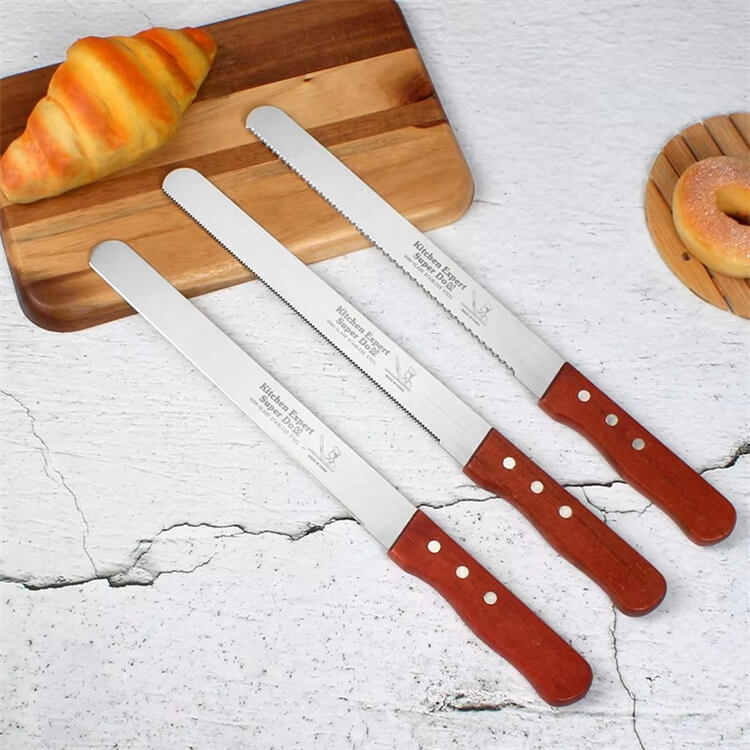
Wood gives a classic look and a warm grip. It requires sealed, food-safe finishing and careful treatment of the joint where the blade meets the handle, because moisture gets trapped there and can loosen the fit. Walnut, pakkawood, and treated beech are common choices in OEM programs.
Plastic and composite handles
Polypropylene and ABS handles are light, cheap, and easy to clean — the standard for budget sets. The weak points are the rivet or weld joint and the seam line where the two halves meet, which can harbor bacteria if not sealed well.
Stainless steel handles
Full-metal handles are durable and easy to sanitize, but they get slippery when wet and add weight. They are more common in commercial kitchens and gift sets than in everyday home lines.
Rubber and silicone coated handles
Coated handles improve grip and soften the feel. The coating must be securely bonded to the handle body; a loose coating is a fast return trigger.
Rivets and assembly quality
Rivets hold the handle scales to the tang. Check the rivet material — stainless rivets resist corrosion better than plated steel — and the fit around each rivet. Loose or proud rivets are visible in the first week of use. In glued or molded handles, ask how the manufacturer prevents the blade from shifting inside the handle over time, and whether the design allows for thermal expansion in the dishwasher.
Balance and weight distribution
A knife’s balance affects how it feels in the hand more than any spec sheet number. For an OEM line, request a sample and check the balance point: a well-balanced chef knife pivots comfortably near the bolster or handle junction. Weight distribution depends on the tang, bolster design, and handle material, so changing any one of them changes the feel of the whole line.
Writing the handle spec into your OEM brief
A clear OEM brief removes most of the guesswork at the factory. For the handle, include: tang type, handle material and finish, rivet or assembly method, handle length and profile, and the target balance. Add the durability requirement — for example, the handle must stay secure after repeated dishwasher cycles and normal chopping use. Also state the food-contact requirement for the handle material, since some wood treatments and coatings are not suitable for direct food contact.
| Handle spec item | What to specify | Why it matters |
|---|---|---|
| Tang type | Full or partial | Strength, weight, manufacturing cost |
| Material | Wood type, composite, metal, coated | Grip, durability, price position |
| Rivets | Material and finish | Corrosion resistance, visible quality |
| Assembly | Glued, molded, or riveted joint | Blade stability over time |
| Balance | Balance point or weight target | Hand feel and customer satisfaction |
Send the same brief to every manufacturer you shortlist. Comparing identical specs across suppliers is the only honest way to compare prices, and it makes the sample round meaningful.
How handle choices change the retail story
Handle material is not only engineering — it is part of the product story you sell to retailers. Wood handles photograph well and support a natural or premium positioning. Composite handles keep the price accessible and suit dishwasher-friendly lines. Full-metal handles appeal to professional buyers who want easy sanitizing. When you plan a knife line for a specific channel, the handle choice should match the message: a gift set can justify a wood handle, while a value 12-piece set usually needs the cost control of composite.
That is why the sample round matters more for knives than for most kitchenware. The same blade shape with a different handle material feels like a different product, and your buyer will judge the line by the sample in hand, not by the spec table. Order two samples if your budget allows — one to test in the kitchen, one to keep as the reference for production approval.
Planning the handle line across a knife set
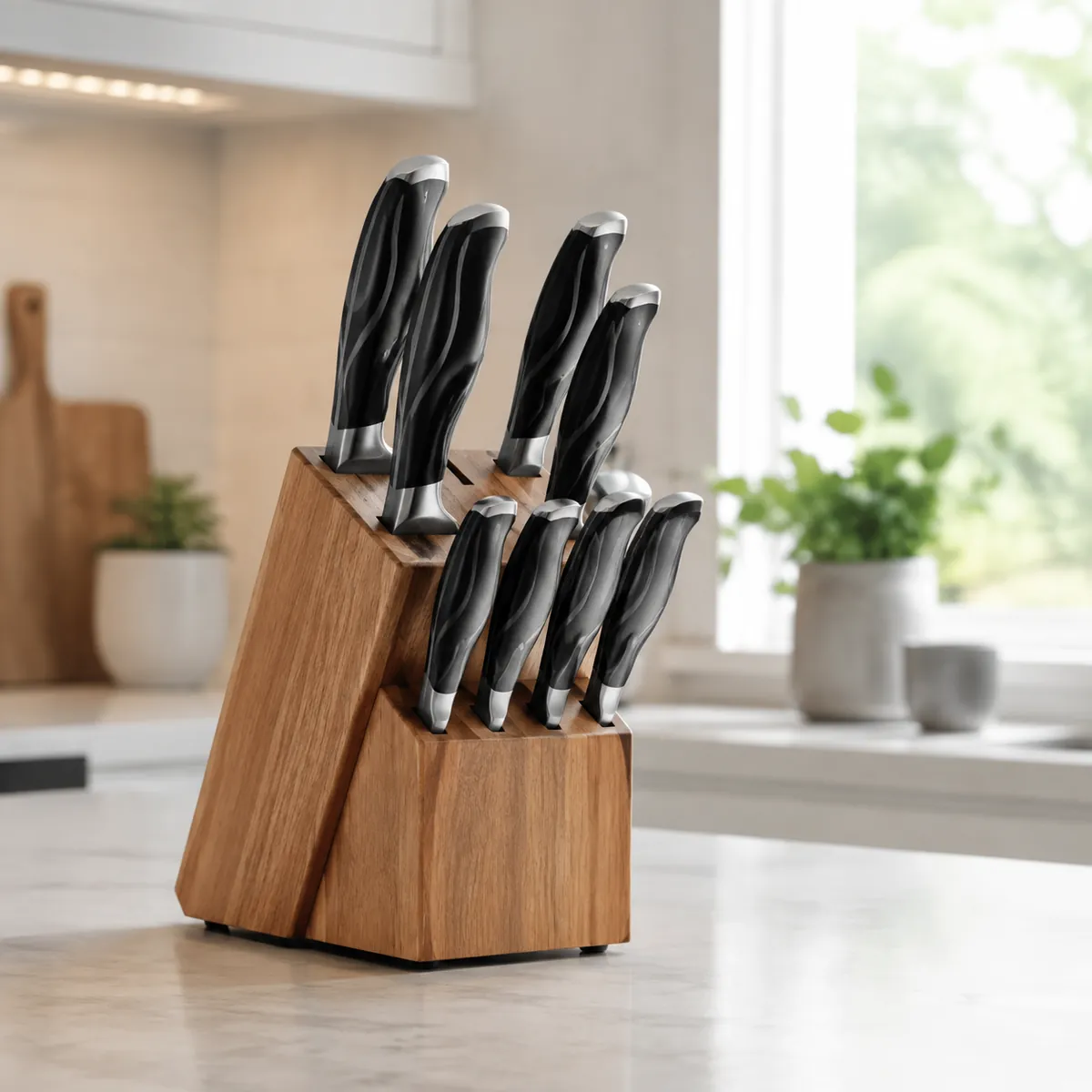
When you OEM a knife set rather than a single knife, the handle design must stay consistent across pieces or the set looks mismatched on the shelf. Decide the handle material and profile once, then apply it to every piece in the set — chef knife, utility, paring, bread, and carving knives. Consistency also simplifies spare parts and packaging photography.
Set programs usually include a display box or block, which adds its own specs: slot dimensions must match each knife’s handle and blade geometry. Send the block or box drawing to the manufacturer with the knife drawings so the fit is checked before tooling starts, not after the first sample arrives.
FAQ
What does full tang mean in a kitchen knife?
Full tang means the blade metal runs the entire length of the handle. It makes the knife stronger and better balanced, but it uses more steel and costs more to produce. It is the standard for professional and higher-end kitchen knives.
What is the best handle material for an OEM kitchen knife?
There is no single best material — wood suits classic and premium lines, composite materials suit budget sets, and stainless or coated handles fit commercial use. Choose based on your target price point, market, and the durability you promise customers.
How do I check handle quality on a sample?
Check the rivet fit and material, the seam of molded handles, the tightness of the blade-to-handle joint, and the balance point in your hand. Repeated washing and drying of the sample can reveal joint and coating issues quickly.
Final recommendation
Specify the tang type, handle material, rivet material, and balance target in your OEM brief, and verify them on the sample before production. To start a kitchen knife OEM project, contact our sourcing team or review the tableware and cutlery range for reference lines.