The fastest way to make a wooden chopping board OEM order look generic is to ignore the details that separate a shelf product from a commodity: juice grooves, handle shapes, edge profiles and care labels. Two boards made from the same wood and same thickness can feel completely different in a customer’s hand, and those physical details are exactly what your private label will be judged on at retail.
This guide covers the design features to specify when you order wooden chopping boards from an OEM factory — what each feature does, which combinations sell well, and what to confirm in the sample before production.
Start with the basics: size, thickness and wood
Before the design details, lock down the physical frame. Board size is driven by your target use: small boards for cheese and serving, medium boards for daily chopping, large boards for carving and butchering. Thickness affects weight and stability — thicker boards feel premium but cost more in material and freight. Wood choice (bamboo, acacia, rubberwood, walnut or other species) changes color, hardness and price, and it should be confirmed against the wood types and finish options your OEM already runs.
| Feature | What it does | Specify in RFQ |
|---|---|---|
| Juice groove | Catches juices from meat, fruit and vegetables | Depth, distance from edge, full or partial groove |
| Handle | Carry point and hanging option | Cutout handle, T-bar, or none; hanging hole size |
| Edge profile | Feel, durability and look of the rim | Square, rounded, beveled or routed profile |
| Surface finish | Food-safe protection and appearance | Sanding grit, oil or wax treatment, sealed or unfinished |
| Care label | Retail compliance and customer guidance | Washing, oiling and warranty instructions |
Juice grooves: the feature customers actually notice
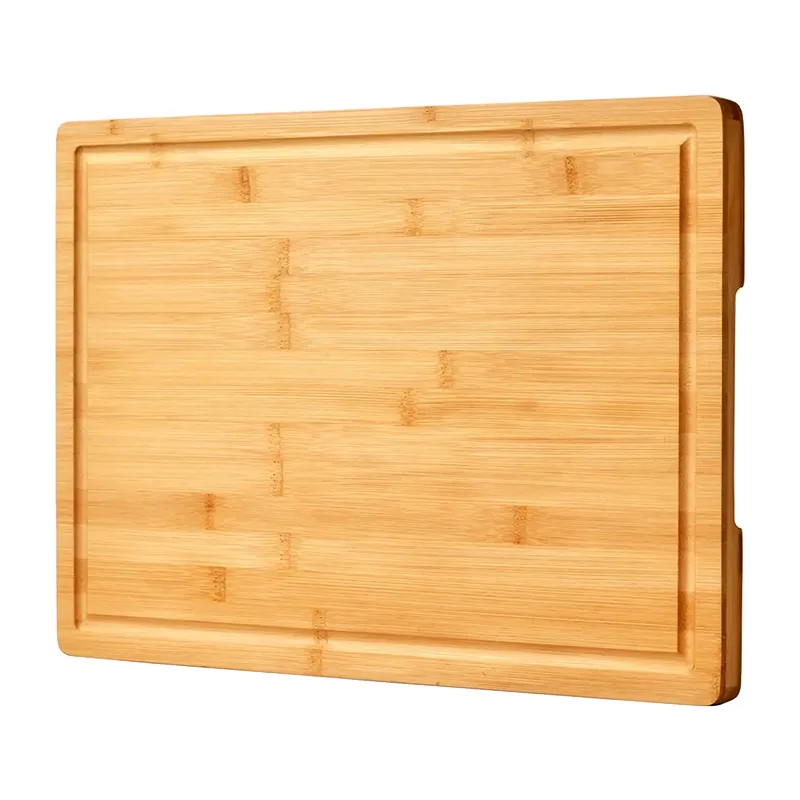
A juice groove is a routed channel around the board that stops liquids from running onto the counter. For meat boards it is close to essential; for bread and cheese boards it is optional. Specify the groove depth and position — a shallow groove looks neat but holds little liquid, while a deep groove near the edge can weaken the rim on thin boards.
If your line includes a serving board, decide whether you want a groove at all. Many serving boards sell better with a clean, flat surface because customers use them for display, not for carving. One common pattern is to offer a chopping board with a groove and a matching serving board without one — two SKUs that share wood and finish but serve different purposes.
Groove depth interacts with board thickness, so confirm both together. On a thin board, a deep groove leaves less material under the channel and the board can warp or crack over time. Factories usually have standard groove depths per board thickness — ask what they run and test the sample with a real cutting session rather than judging only from photos.
Handles: cutout, T-bar or none
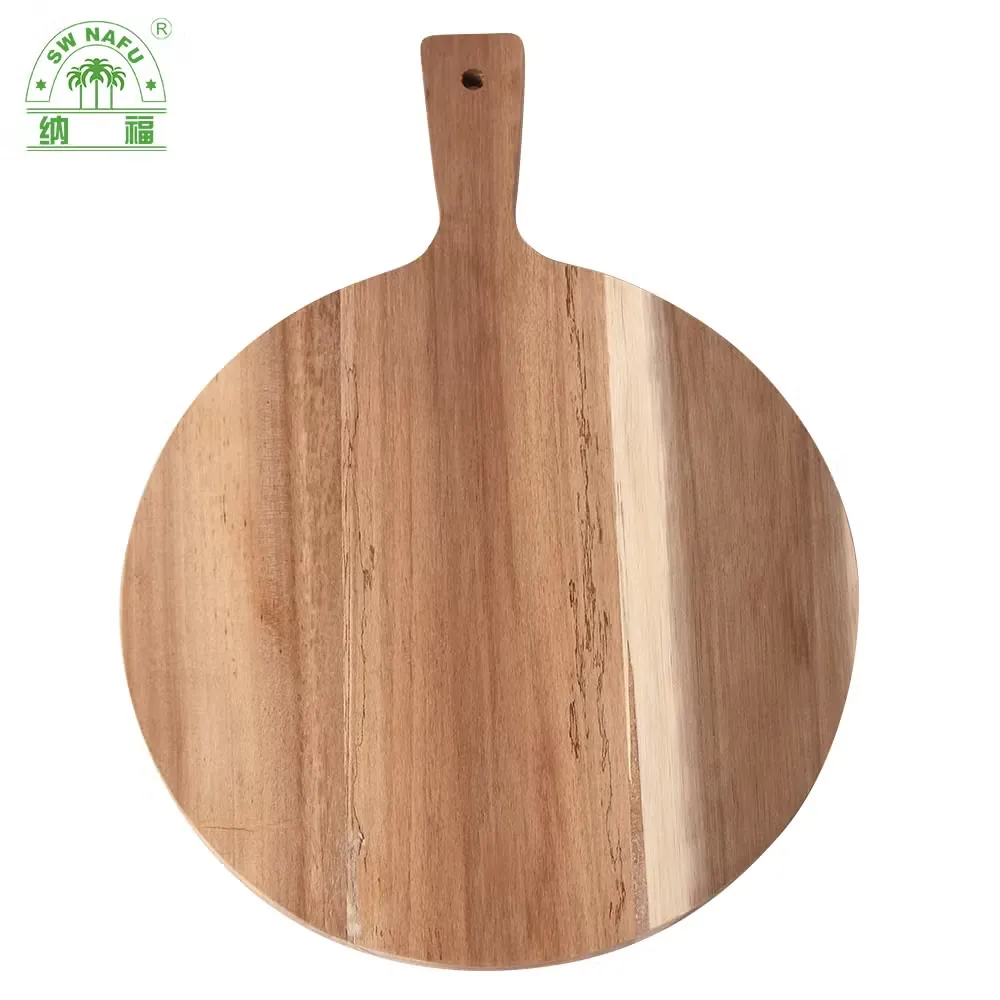
Handle design changes both function and production cost. A cutout handle is a shaped opening in the board — simple, cheap and easy to hang. A T-bar or shaped handle is routed into the side profile, which looks more finished but adds a machining step. Some boards have no handle at all and rely on the edge profile for grip.
Also decide on hanging holes. A single drilled hole near the top lets customers store the board on a hook; two holes or a slot can serve the same purpose with a different look. If your retail packaging shows the board hanging, make sure the hole position matches the packaging photo — a mismatch between product and box art is a common source of customer complaints.
Should every board in my line have the same handle?
Not necessarily. Many lines use one handle style per size tier: no handle on small serving boards, a cutout handle on medium boards, and a T-bar on large carving boards. Consistent wood and finish keep the line coherent while each size stays functional.
Handle placement is part of the design brief too. A centered cutout works for hanging and carrying but may sit under the food zone on a large board. Side handles leave the cutting surface clear but change the board’s footprint in packaging. Sketch the handle position on the product drawing and confirm it in the sample — a handle that looks fine in a photo can feel wrong in the hand.
Edge profiles and surface finish
The edge profile determines how the board feels at the rim. A square edge is crisp and modern but can be uncomfortable to grip; a rounded edge feels softer and is the most common choice; a beveled edge adds a subtle design line and reduces the visual thickness. Ask the factory which profiles they run regularly — custom routing is possible but usually means extra tooling time.
Surface finish is about protection as much as looks. Most wooden boards are sanded to a specified grit and then treated with a food-safe oil, wax or combination. The treatment affects water resistance and appearance, and it must be food-safe for a product that touches food. If your brand wants a “natural unfinished” look, understand that the board will need customer care — that is exactly what the care label is for.
Color consistency between boards is a retail detail that buyers often miss until the first batch arrives. Wood is a natural material, so tone varies between species, batches and even boards in the same run. Ask the factory how they manage color sorting, and set an acceptable range in the spec — for example, boards in one carton should be visually matched. This matters most for branded lines where the product photo sets an expectation.
Care labels and retail packaging
Wooden boards fail at retail most often because customers treat them like plastic. A clear care label reduces returns: hand wash, dry upright, oil periodically, avoid dishwasher and soaking. Confirm with your OEM whether the label is printed on the packaging, a sticker on the board, or an insert — and check that the language matches your target market.
Packaging also needs a decision on protection: boards scratch and warp in transit if they shift inside the carton. Ask for the carton and inner-pack plan in the quotation — a slightly higher packaging cost that keeps boards clean is cheaper than a damaged-goods claim.
For a broader look at the categories you can pair with wooden boards in one order, the kitchenware products page and the full product overview list complementary kitchen items that share the same packaging and freight setup.
FAQ
What is the best juice groove depth for a chopping board?
There is no universal number — a common range is roughly 3–6 mm depending on board thickness and wood, but confirm with your factory and test the sample. The groove must hold liquid without weakening the rim.
Are oiled boards or unfinished boards better for retail?
Pre-oiled boards look better on the shelf and are easier for customers to start using, but they need clear care instructions. Unfinished boards require more customer effort and usually need a strong care label to avoid complaints.
Can I mix handle styles within one OEM order?
Yes. Mixing handle styles across sizes is common, and it does not necessarily increase cost if each style is already in the factory’s standard tooling. Confirm per-SKU pricing in the quotation.
Design details are decided in the sample round, not in the shipping container. Send your board specification through the contact page — dimensions, groove, handle, edge and finish — and request pre-production samples before you commit to the full run.