Sustainability has become a routine question in cookware sourcing, but most buyers ask it the wrong way. Asking a cookware manufacturer “are you sustainable?” produces a brochure answer. Asking “which materials, which coatings, which packaging, and which documents prove it?” produces a conversation you can act on. For EU buyers especially, the pressure is no longer just reputational: packaging rules are tightening, large customers are asking for due diligence data, and retailers are building supplier scorecards that include environmental criteria. This guide explains what sustainability actually means in a cookware factory context, what to verify, and how to separate real programmes from green claims.
What sustainability means in cookware manufacturing
Cookware is a hard-goods category, so its environmental footprint is concentrated in three places: raw materials, energy-intensive processes, and packaging. A factory that wants to reduce impact works on all three, and each one is verifiable in different ways.
Raw materials dominate the picture. Stainless steel cookware carries a large embedded footprint from mining and steelmaking, but stainless is also highly recyclable and can be produced with significant recycled content. Aluminium cookware has a lower-energy production path for the metal itself when recycled input is used, while cast iron and carbon steel are simpler products with long service lives. The honest starting point is a material-by-material conversation, not a single sustainability claim.
Processes matter too: anodising, coating application, drying ovens and polishing all consume energy and water. A factory with solar panels or efficient drying lines has a measurable story to tell, but the buyer rarely gets to verify this without a factory audit. In practice, the verifiable signals are the materials, the coating chemistry, the packaging and the documents.
Materials: the verifiable part of the claim
When a buyer asks about sustainable materials, three verifiable factors matter: recycled content, material recyclability at end of life, and the absence of restricted substances.
Recycled content is the easiest claim to check on paper. Stainless steel suppliers can state the percentage of recycled input in a grade, and aluminium foundries routinely use recycled ingot. Ask the cookware manufacturer for the material certificate from its steel or aluminium supplier, and check whether the stated recycled content covers the current production batch. It is a supply-chain document, not a marketing phrase.
Recyclability at end of life is a design question. Stainless steel is valuable as scrap, so stainless cookware is genuinely recyclable in most markets. Cast iron and carbon steel are also recyclable, though coatings and bonded bases complicate separation: a pan with an aluminium-clad stainless base is harder to recycle than a single-metal pan. Non-stick coatings sit at the weak end of the recyclability story because the coating must be stripped before the metal can be recycled, and PTFE coatings in particular complicate disposal in some regions. None of this makes coated cookware wrong — it makes the recyclability claim more honest when it is stated with these limits.
Restricted substances are the compliance layer. EU REACH restricts substances of very high concern, and the food-contact framework adds migration limits for anything that touches food. A cookware manufacturer serving the EU should be able to show REACH and food-contact compliance for its coatings, colourants and materials. The absence of heavy metals such as lead and cadmium in coatings and decorations is a standard test item.
| Material | Typical sustainability profile | What to verify |
|---|---|---|
| Stainless steel (304/316) | Recyclable, durable, can contain high recycled input | Material certificate, recycled content statement, food-contact compliance |
| Aluminium | Light, recyclable; recycled ingot reduces footprint | Recycled input percentage, anodising process, coating compliance |
| Cast iron / carbon steel | Simple materials, long life, recyclable; heavy energy in production | Seasoning/oil coating composition, packaging reduction |
| Non-stick coatings | Convenience product; coating complicates recycling | Coating chemistry (PTFE vs ceramic), PFOA-free claim, test report |
| Silicone accessories | Durable, food-grade, but not easily recycled everywhere | Food-grade certification, no-filler compound, packaging |
Coating chemistry and the PFOA question
The most discussed sustainability topic in cookware is the non-stick coating. The old generation of PTFE coatings was made with PFOA, a substance linked to health concerns. PFOA has been phased out of cookware production, and PFOA-free is now the baseline claim in the industry, not a premium feature. Buyers should still ask for the test report that supports the claim, because the phrase appears on packaging from suppliers of very different quality levels.
Ceramic and mineral coatings are marketed as the more environmentally friendly alternative: water-based application, no PFAS chemistry, and oven-safe temperature ranges that usually cover everyday baking. They are genuinely different from PTFE in chemistry, but they also have different durability profiles, which is why the sustainability conversation has to include performance. A coating that wears out in six months is not sustainable, whatever its chemistry, because the pan gets replaced.
The useful question set for a coating is: what is the chemistry, what is the release temperature, what is the migration test result, and what durability test supports the warranty claim? A cookware manufacturer should answer all four in writing. If the answer is only “eco-friendly non-stick”, ask for the specifics.
Packaging: the fastest win for EU buyers
Packaging is where cookware sustainability improvements are most visible and most measurable. A typical cookware set ships with a printed carton, foam inserts, polybags, labels and protective corner pieces. Each component has an environmental cost, and each one can be questioned.
The EU Packaging and Packaging Waste Regulation (PPWR) is phasing in requirements on packaging design, recyclability and recycled content, and it is changing what EU buyers must be able to document. The exact obligations depend on the packaging type and the role of the business operator, and they are being implemented in stages, so confirm the current requirements for your specific situation rather than relying on a summary. What is already clear is the direction: less unnecessary packaging, more recyclable materials, clearer recycling labelling, and better data about what is in the packaging.
Practical packaging questions for a cookware manufacturer: can the carton be printed with water-based inks, can foam be replaced with recycled paper or moulded pulp, can polybags be removed or replaced with compostable alternatives, is the carton made from recycled board, and are the recycling labels correct for the destination market? None of these are exotic requests; moulded pulp and recycled cartons are standard options in the industry. The supplier’s answers tell you whether sustainability is a design principle or a brochure page.
EU compliance documents buyers should request
The document set for a sustainability review overlaps with the compliance set, which is convenient: the same files support both. Ask the cookware manufacturer for the following, and check each one for product specificity rather than generic wording.
| Document | What it supports | Verification check |
|---|---|---|
| REACH compliance statement | Restricted substances in materials and coatings | Covers the actual product, not just the company |
| Food-contact test report (EU 1935/2004, EU 10/2011 for plastics) | Migration safety of the finished article | Lab header, report number, product name, date, result values |
| Material certificates for steel/aluminium input | Grade and recycled content claims | Grade stated, supplier name, batch reference |
| Coating specification and safety data | Coating chemistry, PFOA-free claim, application process | Chemistry named, temperature limits, test evidence |
| Packaging specifications | Recycled content, recyclability, PPWR-relevant data | Material breakdown per component, recycling labels |
| Factory audit report (second or third party) | Process claims: energy, waste, water | Auditor identity, date, scope, corrective actions |
For EU buyers, the most important habit is asking for documents before the order rather than after. The factory has the documents; the question is whether they cover your SKU. A generic company-level statement is common, but the product-level report is what an enforcement body or a retail customer will accept.
How to verify a cookware manufacturer’s sustainability claims
Verification follows a standard order. First, check the documents: read the test reports and certificates for product specificity. Second, check the material claims against the product: a “recycled aluminium” claim should match the material certificate. Third, check the packaging plan against the destination market’s labelling rules. Fourth, if the claim is process-based — solar power, water recycling, waste sorting — ask for the audit report or arrange a factory visit or video audit. Fifth, sample-test the highest-risk item: send a pre-production sample to an independent laboratory for the relevant checks.
Most greenwashing in cookware sourcing is not dramatic. It is a supplier calling standard compliance “sustainability” because the market rewards the word. Recycled content, food-contact compliance and recyclable packaging are good things, but they are the baseline of a responsible supplier, not a differentiator. The differentiator is data: a supplier that can quantify recycled input, name coating chemistry, and document packaging materials is a supplier you can build a programme with.
Working with the factory on a sustainability brief
A sustainability brief for a cookware manufacturer should be concrete, not aspirational. List the requirements your market needs: coating chemistry limits, recycled content targets, packaging components, labelling, and the documents you expect with each shipment. Ask the supplier to confirm each item, and flag which items are standard and which need development. Some packaging changes need tooling or supplier changes, so early briefs beat late requests.
It also helps to ask about the factory’s own process story: energy source, waste sorting, water use in anodising and coating lines, and whether the facility holds environmental management certification such as ISO 14001. These are process signals. They do not replace product-level evidence, but they tell you whether the factory is thinking about the whole footprint or just the label on the box.
FAQ: Is ceramic non-stick more sustainable than PTFE non-stick?
Answer: In chemistry, usually yes: ceramic coatings are water-based and do not rely on PFAS chemistry. But durability matters for the full lifecycle, and a ceramic pan that needs replacement sooner can offset the chemistry advantage. Compare the coating’s tested durability and the price point, and judge the pair together rather than the coating in isolation.
FAQ: Do I need an EU-specific document for cookware packaging?
Answer: For EU sales, packaging requirements are moving from general waste rules toward the PPWR framework with recyclability and recycled-content expectations, phased in over the coming years. Confirm the current obligations for your role in the chain with a compliance advisor, and ask the supplier for packaging material breakdowns now, because that data will be needed later anyway.
A sustainability scorecard for cookware suppliers
To compare suppliers objectively, score the evidence rather than the marketing. Give each dimension a simple pass, partial or fail against a written requirement, and keep the scorecard for the decision review. The scorecard makes the comparison explicit and stops a single impressive claim from carrying the whole decision.
| Dimension | What earns a pass | What earns a fail |
|---|---|---|
| Materials | Material certificate states grade and recycled content where relevant | No material certificate, or grade not stated |
| Coatings | Chemistry named, PFOA-free claim backed by a test report, temperature limits stated | “Eco-friendly” with no chemistry or report |
| Food-contact compliance | Product-level migration report from an identifiable laboratory | Company-level statement only, or unverifiable report |
| Packaging | Itemised material breakdown, recyclable components, correct labels | No packaging specification, single generic claim |
| Process | Audit report or documented energy/waste/water data | Claims with no audit or data |
A scorecard like this is also a negotiation tool. When a supplier sees that you evaluate documentation, the quality of the documentation improves on the next quote — suppliers respond to the standards of their buyers.
Lifecycle thinking: durability, repairability and end of life
Sustainability does not end at the factory gate; the product’s whole life counts. Durability is the first lifecycle factor: a pan that lasts ten years has a fraction of the per-year footprint of a pan that lasts two. Ask about the durability evidence — coating wear tests, handle strength tests, warranty experience — and factor it into the buying decision, because a cheap pan that fails early is not a sustainable purchase.
Repairability is the second factor. Cookware is not designed for repair in most cases, but some products are more repairable than others: a pan with a replaceable handle, a lid that fits multiple pots, or a knife with a replaceable blade saves resources over time. Design choices such as standard sizes and available spare parts matter more than most buyers assume.
End of life is the third factor, and it is where the material choices come back. Stainless and cast iron have real scrap value and recycling routes; coated pans need coating removal before recycling; silicone accessories have limited recycling in many regions. The honest conversation about end of life is part of a credible sustainability programme, and buyers should expect suppliers to state the limits as well as the strengths.
Worked example: comparing two suppliers on sustainability evidence
Take two cookware manufacturers quoting the same stainless steel cookware set for an EU buyer. Supplier A responds with a brochure page full of phrases: eco-friendly materials, green factory, sustainable packaging. Supplier B responds with a folder: a material certificate for the stainless steel with a recycled-content statement from its mill, a food-contact migration report from an accredited laboratory naming the exact set, a coating specification that states the chemistry and the PFOA-free test result, and an itemised packaging breakdown showing a recycled carton, moulded pulp inserts and water-based inks, with the recycling labels for the destination market.
The decision is not difficult once the evidence is side by side. Supplier A may be a fine factory; the problem is that its claims cannot be verified, and an EU buyer cannot build a compliance file on unverifiable claims. Supplier B’s folder becomes the compliance file, the retailer questionnaire answer and the audit evidence. The price difference between the two quotes is usually smaller than the difference in confidence.
What to put in a sustainability brief to the factory
A brief is more useful than a question. Write the requirements as a list the factory can confirm: material grade and recycled-content documentation, coating chemistry and test reports, packaging components with recycling labels, and the document set per shipment. Add the target markets, because EU and UK requirements differ from other regions. Add the deadlines, because packaging changes need lead time. And add the review point, because the brief should be revisited each season as requirements tighten.
One practical note: ask for the packaging material breakdown even if you do not need it this quarter. The data is already collected by the packaging supplier, and having it on file saves a scramble when a customer or regulator asks. The same logic applies to the whole sustainability document set: collect it early, organise it per product, and refresh it on a schedule.
FAQ: Can a factory change packaging materials quickly for a sustainability brief?
Answer: Some changes are fast, some are not. Recycled cartons and moulded pulp inserts are standard options at most factories and can usually be quoted in the normal packaging cycle. Replacing a custom foam insert may need new tooling. Ask which items are standard options and which need development before you commit to a timeline.
Energy, water and waste: the process side of the story
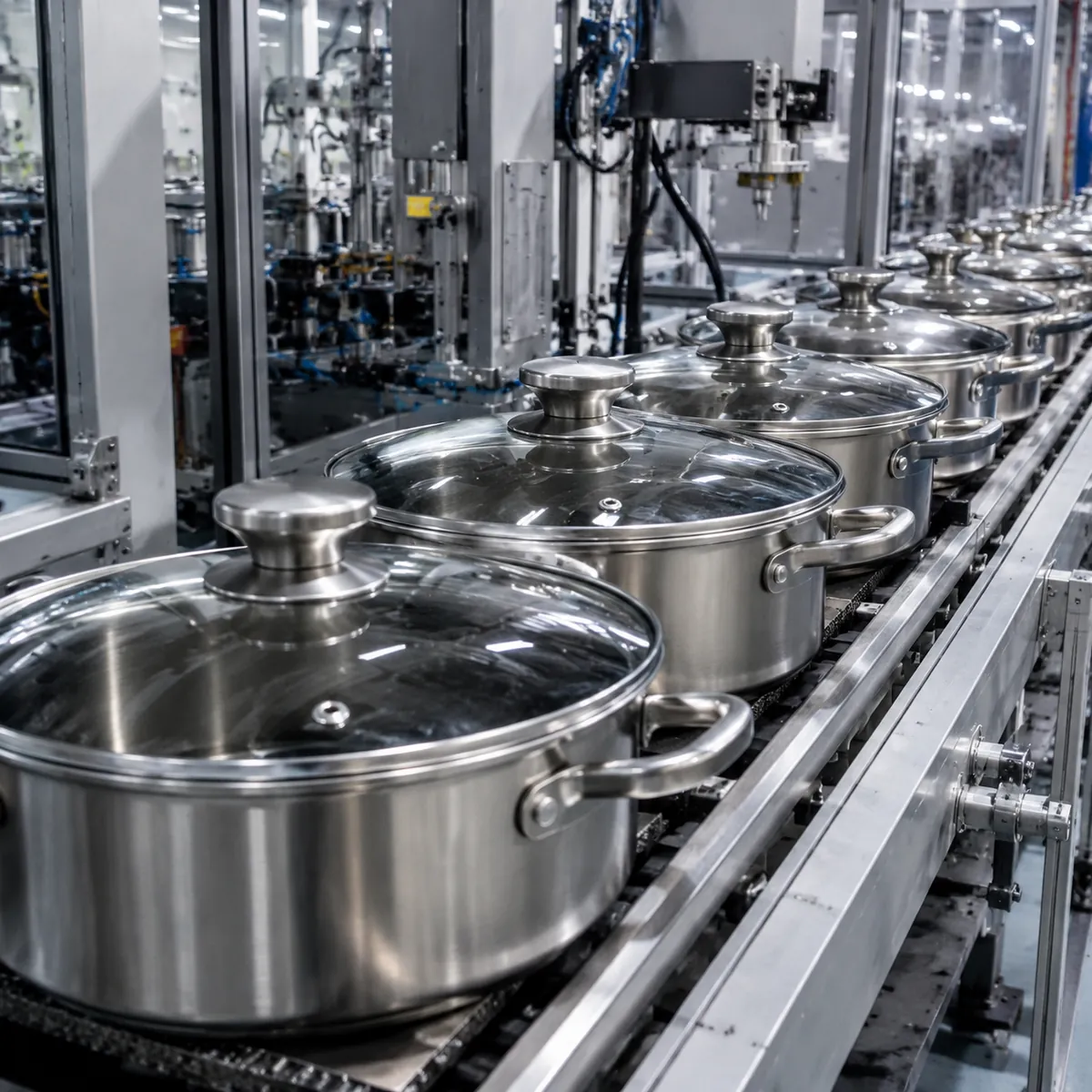
The materials and packaging are the verifiable product side, but the factory’s process matters too, and it is worth understanding even when it is harder to verify. Cookware production is energy-intensive: aluminium melting and forming, steel pressing, anodising, coating application, drying ovens and polishing all consume power. Factories that invest in efficient drying lines, waste-heat recovery, solar generation or cleaner coating application have a real story to tell, and they usually want to show it because it reduces their own costs. Ask about energy sources and efficiency measures, and if the factory offers a video tour or audit data, use it.
Water is the second process input. Anodising and coating lines use water for rinsing, and wastewater treatment is a genuine environmental issue in metal finishing. Ask how the factory treats process water and whether it recycles rinse water. Waste is the third: metal scrap from blanking and stamping should be recycled, coating waste should be handled according to local rules, and packaging waste should be sorted. A factory that can describe its waste streams is a factory that has thought about them; a factory that cannot usually has not.
The honest caveat: process claims need evidence, and the evidence is an audit report or a documented visit. For a first order, a video audit or a third-party audit covering environment and safety is a reasonable request. For repeat programs, an annual audit keeps the picture current. Process verification is the layer above the documents, and it is where the factory’s real sustainability maturity shows.
Frequently Asked Questions
What makes cookware sustainable?
Three verifiable factors: materials with recycled content and end-of-life recyclability, coating chemistry that is safe and tested, and packaging that is minimised, recyclable and correctly labelled. Process claims such as energy and water use matter but need audit evidence.
Is stainless steel cookware more sustainable than non-stick?
Stainless steel is more recyclable and avoids coating chemistry entirely, but it has a heavy embedded footprint from steelmaking. The honest comparison depends on recycled input, service life and how the product is used. Stainless is usually the easier sustainability story to document.
What documents should a cookware manufacturer provide for sustainability claims?
REACH compliance, food-contact test reports, material certificates, coating specifications and packaging material breakdowns. Process claims should be backed by audit reports. Check every document for product specificity.
How do I avoid greenwashing in cookware sourcing?
Ask for data, not adjectives. Request specific numbers for recycled content, named coating chemistry, and itemised packaging materials. Treat any claim without a supporting document as a claim, not a fact.
Does the EU require sustainability data from cookware importers?
Requirements are tightening, especially for packaging under the PPWR framework and for due diligence expectations from large retail customers. The practical move is to collect product-level data now, so you are ready when a customer or regulator asks.
Sustainability in cookware sourcing is a documentation exercise before it is a marketing exercise. Start with the materials, verify the coating chemistry, push the packaging toward recycled and recyclable components, and collect the documents that prove each claim. If you are reviewing cookware manufacturers for an EU programme and want a supplier who can produce product-level sustainability documentation, send your material and packaging requirements through our contact page and we will confirm what our current lines can document today. To see the breadth of a single supplier’s catalogue, browse our cookware product range and our stainless steel products.