If you buy baking trays wholesale, three specifications decide whether your line makes money or generates returns: gauge, flatness and warp resistance. Most catalogue pages list the size and the coating but skip the details that matter in a commercial kitchen or a retail bakery: how thick the metal is, how flat the sheet stays after a few hundred oven cycles, and whether the tray twists when it cools unevenly. This guide explains the three specs, how to check them before you commit, and the questions to put in your next inquiry to a baking tray supplier.
Why gauge is the first number to ask for
Gauge is the thickness of the metal. In baking trays it usually means the aluminium or steel sheet thickness measured in millimetres, and it is the single biggest driver of price and durability. A thin tray is cheaper to make, lighter to ship and faster to heat, but it dents easily, flexes under a loaded pan, and warps faster. A thick tray costs more, weighs more, and holds its shape through years of commercial use.
For aluminium baking sheets, common thicknesses run from about 0.5 mm for budget retail trays to 1.0 mm or more for heavy commercial sheets. For steel trays, the equivalent range is lower because steel is stiffer at the same thickness; tinned or coated steel trays often use thinner gauge than aluminium while still performing well. These are typical industry ranges, and the right choice depends on your channel, so always confirm the exact gauge with the supplier and write it into the specification, not just the price.
The buying mistake is assuming the gauge from the catalogue photo. Two trays that look identical in a listing can differ by 0.3 mm in thickness, which is a large difference in durability and in cost. Ask for the gauge in the specification, and if the supplier cannot state it, treat that as a warning sign.
| Application | Typical aluminium gauge | What it buys you |
|---|---|---|
| Budget retail cookie sheets | ~0.5-0.6 mm | Low price, light weight, short durability expectations |
| Mid-range retail and light commercial | ~0.7-0.8 mm | Balanced price and durability for home and small bakery use |
| Heavy commercial sheets | ~1.0 mm and up | Long service life, resists warping, handles heavy loads |
Flatness: the specification nobody quotes
Flatness is how close the tray surface is to a true plane. It matters because a tray that is not flat bakes unevenly: cookies spread more on the low side, cakes rise unevenly, and the tray rocks on the oven rack. In commercial bakeries, uneven baking is wasted product, and wasted product is margin you cannot recover.
Flatness is rarely stated as a number in baking tray catalogues, which is why it pays to ask. A reasonable expectation for a commercial aluminium sheet is that it sits flat on a level surface with no visible rocking and no gap under the centre. Some buyers test with a straightedge: place the tray on a flat table, press the corners, and check for movement. The straightedge test catches gross flatness problems in seconds, and it is exactly the kind of check a QC inspector should run before loading.
Flatness can also be affected by packaging and freight. Trays stacked without proper protection can arrive slightly bowed, and a bowed tray is hard to sell at full price. Ask the supplier how trays are stacked and protected in the carton, and inspect a sample carton before you commit to the packaging spec.
Warp resistance: what happens after the oven
Warp resistance is the tray’s ability to keep its shape through heating and cooling cycles. Warping happens when different parts of the metal expand and contract at different rates: a hot tray pulled from the oven and placed on a cold surface, or a thin tray heated unevenly, will distort. The distortion is usually permanent, and it compounds over time.
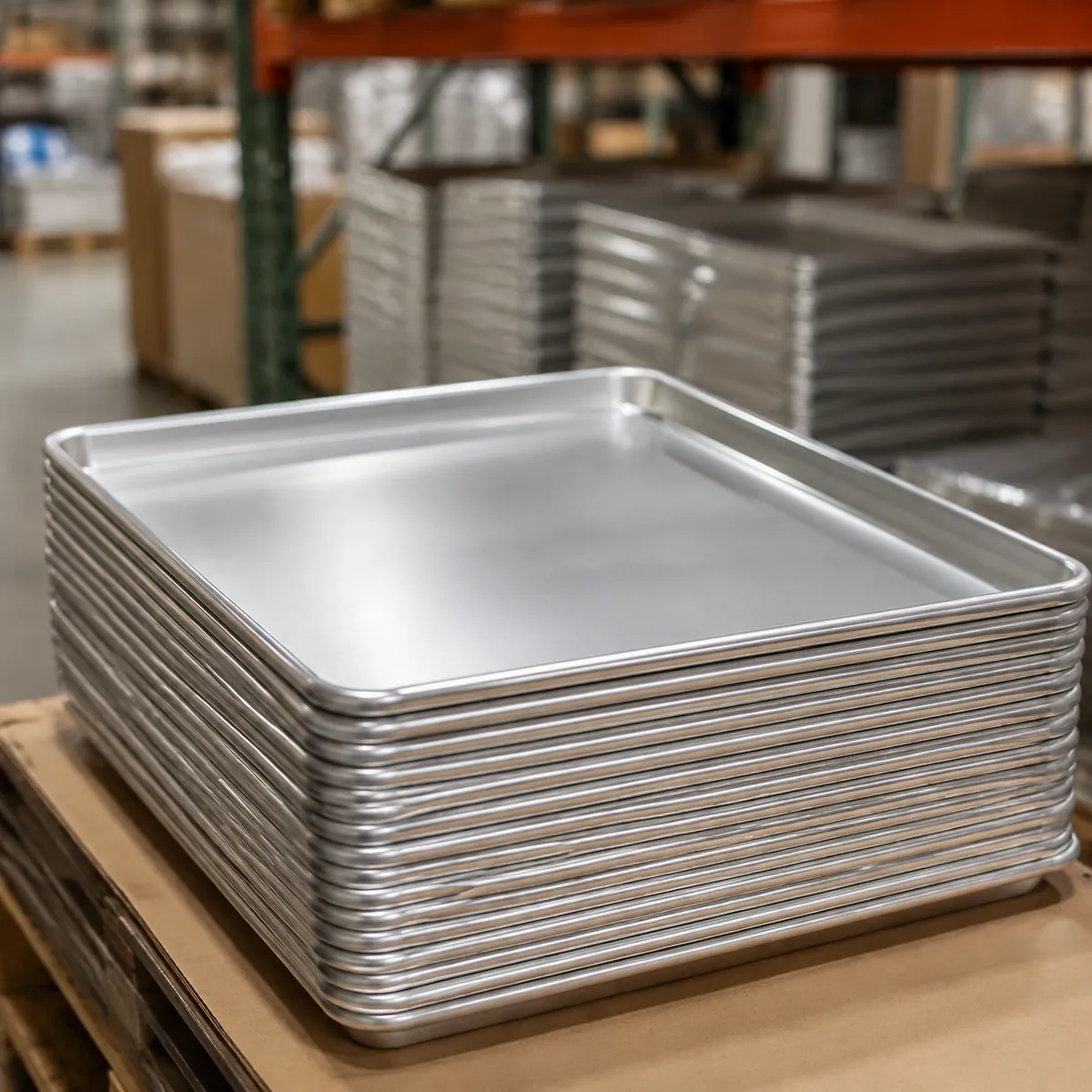
Three factors control warp resistance. Thickness is the first: thicker metal resists distortion better. Material is the second: aluminium conducts heat evenly but expands more than steel, while steel is stiffer and holds shape better at temperature. Construction is the third: a tray with a reinforced rim or a rolled edge resists warping much better than a flat blank, because the rim acts as a structural beam around the perimeter. When you compare trays, ask specifically whether the rim is rolled or reinforced, not just whether the tray “has a rim”.
Heat treatment during production also matters. Aluminium sheet can be supplied in different tempers, and the temper affects how the metal behaves under repeated heating. A supplier that understands temper selection is a supplier that understands warp resistance; a supplier that cannot discuss it is selling raw metal, not a baking product.
Coating: non-stick, silicone-coated or uncoated
Coating is the visible differentiator in baking tray wholesale, and it interacts with all three structural specs. An uncoated aluminium tray is cheap, conducts heat well and develops a natural patina; it needs greasing or parchment in use. A PTFE non-stick coated tray is easier to release food and easier to clean, but the coating adds cost and has a service life that depends on use and care. A silicone-coated tray is a middle option with good release and no PFAS chemistry, though its durability profile differs from PTFE.
The coating decision changes the QC checks. For non-stick trays, ask for the coating test report and the maximum service temperature, and confirm the coating is PFOA-free. For silicone coatings, confirm food-grade certification. In every case, write the coating spec into the order, because “non-stick” alone does not tell the factory which coating line to run.
Size standards: gastronorm and retail formats
Baking tray sizes follow two systems that rarely get explained clearly. The gastronorm (GN) system is the European standard for commercial kitchens: a GN 1/1 tray is 530 x 325 mm, and smaller sizes such as GN 1/2 and GN 1/3 divide that footprint in half and thirds. GN trays fit standard racks, trolleys and ovens, so they dominate foodservice and commercial bakery buying. Retail formats are different: half-sheet and full-sheet pans in the US market, and a range of sizes in the UK and Europe that follow oven cavities rather than rack standards.
Buyers should confirm which system the supplier’s trays follow, because a GN tray and a retail half-sheet are not interchangeable, and mixing them in one program creates confusion in warehousing and selling. If you sell to both foodservice and retail, plan two size families and make sure the catalogue and packaging keep them separate.
| Format | Typical dimensions | Market |
|---|---|---|
| GN 1/1 | 530 x 325 mm | Foodservice, commercial racks (Europe and export) |
| GN 1/2 | 265 x 325 mm | Foodservice, smaller ovens |
| Half sheet | 18 x 13 inches (about 457 x 330 mm) | US retail and foodservice |
| Full sheet | 26 x 18 inches (about 660 x 457 mm) | US foodservice |
QC checks to run before the container loads
A practical pre-shipment inspection for baking trays covers more than the three specs. Run these checks on a sample from the production batch: gauge measurement with a calliper at several points; the straightedge flatness test; a manual twist test that flexes the tray gently to feel for stiffness; rim and edge inspection for rolled or reinforced construction; coating adhesion and surface check for scratches or pinholes; dimension check against the agreed spec; and a packaging check that confirms stacking protection. Ask the supplier for photos or video of the inspection, or use a third-party inspector if the order size justifies it.
One caveat about the twist test: it is a comparative check, not a laboratory measurement. Use it to compare trays from different suppliers side by side, not to certify a tray. If flatness and warp resistance are critical to your customer, send samples to a laboratory that can measure them, or accept the supplier’s test method if it is documented.
Materials compared: aluminium, tinned steel, carbon steel and stainless
The gauge conversation only makes sense together with the material, because different metals behave differently at the same thickness. Aluminium is the default for baking sheets: it heats fast and evenly, is light to ship, and is inexpensive. Its weakness is softness: thin aluminium dents and warps, which is why gauge matters so much for aluminium trays. Tinned steel is stiffer than aluminium at the same gauge and holds its shape well, but the tin coating protects the steel and needs care; it is common in traditional baking and pastry work. Carbon steel is heavy, conducts well once seasoned, and is the choice for professional baking where mass and heat retention matter. Stainless steel resists corrosion and is easy to clean, but it conducts heat less evenly than aluminium, so it is less common for baking sheets and more common for commercial pans where durability beats conductivity.
| Material | Strength | Weakness | Typical use |
|---|---|---|---|
| Aluminium | Even heating, light, cheap | Soft, dents and warps if thin | Most retail and commercial baking sheets |
| Tinned steel | Stiff, holds shape | Coating needs care, scratches | Traditional baking, pastry trays |
| Carbon steel | Mass, heat retention, durable | Heavy, needs seasoning | Professional bakery pans |
| Stainless steel | Corrosion resistant, easy clean | Uneven heating, higher cost | Commercial pans, catering |
For most wholesale programs, aluminium is the right default and steel is the upgrade path, and the choice between them changes the gauge you should specify. Do not compare two trays on gauge alone without the material, because a 0.8 mm steel tray and a 0.8 mm aluminium tray are very different products.
To compare tray sizes and styles side by side, browse the bakeware product range and the wider full kitchenware range.
Worked example: comparing two tray quotes on total cost
Consider a wholesale buyer comparing two quotes for a commercial cookie sheet program. Quote A offers a 0.6 mm aluminium sheet at a low unit price. Quote B offers a 1.0 mm aluminium sheet with a rolled rim at a higher unit price. On the unit price alone, Quote A looks better. Add the durability difference: the thin tray warps after a few hundred oven cycles in a busy bakery, gets replaced more often, and generates customer complaints about uneven baking. The thick tray lasts years, keeps baking even, and survives the handling that commercial kitchens dish out.
Convert the durability difference into a cost per year: if the thin tray costs half as much but lasts a quarter as long, the thick tray is cheaper per year of service. That is the number a wholesale buyer should compare, not the invoice price. Add the complaint and return cost for the thin tray, and the comparison is not close. The lesson: for baking tray wholesale, price per year of service beats price per unit.
Common mistakes when buying baking trays wholesale
The mistakes are consistent across programs. Buying on size alone without specifying gauge or material is the first: the tray looks right and performs badly. Skipping the flatness check is the second: a slightly bowed tray bakes unevenly and comes back as a complaint. Ignoring rim construction is the third: a flat blank warps where a rolled rim would hold. Choosing coating without the use case is the fourth: a non-stick coating adds cost that a bakery may not need, while a retail line without coating disappoints home bakers. Forgetting the inspection is the fifth: the QC check happens after the container arrives instead of before it loads.
Each mistake maps to a spec line. Write the gauge, the material, the flatness expectation, the rim construction and the coating into the order specification, and add the pre-shipment inspection to the timeline. A baking tray is a simple product; the discipline is in the specification, not the engineering.
The pre-shipment inspection checklist
When the production batch is ready, run the inspection before the container loads. The checklist should cover: gauge measured with a calliper at several points on the tray, not just the edge; flatness on a level surface with the straightedge test; rim and edge construction checked for rolling or reinforcement; coating surface inspected for scratches, pinholes and adhesion; dimensions checked against the agreed spec, including corner radius if specified; stackability and packaging protection confirmed with a sample carton; and a manual stiffness test comparing the tray against the approved sample. Photograph each check and ask the supplier for the inspection record, or send a third-party inspector for larger orders.
FAQ: Do I need a third-party inspection for a baking tray order?
Answer: For a first order, yes if the volume justifies it; for repeat orders, a documented supplier inspection with photos may be enough. The inspection cost is small compared with the cost of a container of warped trays, and the inspection record becomes part of your own quality file.
Retail packaging and shelf presentation for baking trays
If the trays go to retail, the packaging is part of the product. A baking tray on a shelf needs to communicate size, material and care in seconds, because the customer cannot tell gauge by looking. The retail carton should state the material and thickness, the oven-safe temperature, the dishwasher-safety claim and the care instructions, and it should show the tray clearly enough for the customer to judge the product. Retail packaging also has to survive the journey: trays are heavy, flat and easy to bend in transit, so the carton needs internal protection or a stackable design that prevents flexing.
For e-commerce retail, the packaging question is different: the tray ships alone in a box, and the risk is bending and denting in the courier network. A tray in a thin carton with no internal support arrives warped and becomes a return. Design the e-commerce packaging with edge protection and a rigid structure, and test a sample through a real shipping route before committing to the design. The returns saved by better packaging often pay for the packaging upgrade.
Retail packaging also carries the compliance story: material claims, coating claims and care claims all have to match the product specification. A carton that says “dishwasher safe” on a coated tray that has not been tested for dishwasher cycles is a return and a complaint waiting to happen. Keep every label claim aligned with the test evidence, and confirm the claim wording with the supplier before printing.
Specifying trays for the order: a template
When you are ready to order, write the specification so the factory and the inspector are working from the same document. A practical template includes: material and grade; gauge in millimetres; size and corner radius; rim construction, stating rolled or reinforced; coating, stating none, PTFE non-stick, or silicone, with the coating temperature limit; flatness expectation, stating the straightedge test; dimensional tolerance; packaging specification, including the carton type and stacking protection; and the inspection criteria, including the sampling plan. Every line is confirmable at the factory, and every line appears on the QC checklist. A specification written this way prevents the two most common disputes in baking tray wholesale: what was approved, and what was delivered.
Ordering quantities and container planning
Baking trays are flat and stackable, which makes them excellent container fillers, but the order quantity should still be planned around the freight unit. A full container of trays is a large commitment, so many wholesale buyers share the container with other bakeware and kitchenware lines, or use a consolidated shipment through a forwarder. The tray dimensions drive the carton count per pallet, and the pallet count drives the container utilisation, so confirm the carton size and palletisation with the supplier before finalising the quantity. A tray line that loads well costs less per unit to ship; a line that wastes cube pays for it in freight. Include the palletisation plan in the order specification, and ask the supplier for the loading diagram before the container is booked.
One final habit for baking tray programs: keep a reference sample from the approved batch. The reference tray is the physical standard for the next order, the QC comparison and any dispute about what was approved. Store it flat, label it with the batch and spec, and pull it out when the next order is quoted. A reference sample costs nothing to keep and prevents the most expensive conversation in wholesale: arguing about what the factory agreed to deliver.
Frequently Asked Questions
What gauge baking tray should I stock for retail?
For general retail, 0.7-0.8 mm aluminium is a practical balance of price and durability. For foodservice or premium retail, prefer 1.0 mm or heavier, and confirm the exact gauge in the specification.
Why do baking trays warp and how can I avoid it?
Warping comes from uneven heating and cooling, made worse by thin metal and flat blanks. Choose thicker metal, rolled or reinforced rims, and avoid exposing hot trays to cold surfaces. Confirm the temper and rim construction with the supplier.
Are gastronorm trays better than retail half-sheets?
They serve different channels. GN trays fit commercial racks and ovens and are standard in foodservice; retail half-sheets match retail expectations. Choose based on your customer, and keep the two families separate in your program.
Is non-stick coating worth the extra cost on baking trays?
It depends on the use case. Non-stick reduces sticking and cleaning time, which matters in commercial kitchens, but the coating adds cost and has a service life. For budget retail lines, uncoated or silicone-coated trays often make more sense.
How do I verify flatness of a batch of baking trays?
Use a flat table and a straightedge: the tray should sit flat with no rocking and no visible gap under the centre. Check several samples from different cartons, and include the test in the pre-shipment inspection.
Gauge, flatness and warp resistance are the three numbers that define a baking tray’s real quality, and all three are checkable before you commit. Put them in your inquiry, confirm them in the specification, and run the inspection checks on the production batch. If you are building a baking tray wholesale program and need a supplier who will quote gauge, temper and rim construction as part of the specification, send your sizes and target volumes through our contact page and we will respond with a spec sheet you can compare.