Launching a knife brand online is a different game from selling through retail counters. The product still has to cut well, but the buying decision happens on a screen, the knife has to survive courier shipping in a protective box, and the packaging has to carry your brand without a salesperson to explain it. For an online brand, the kitchen knife OEM decisions that matter most are packaging, inserts and first-order planning — the parts of the program that determine whether customers receive a perfect product and reorder it. This guide covers what to brief, what to check and what to commit before your first container.
Why online brands fail at the packaging step
Retail brands can lean on shelf placement and in-store displays. Online brands cannot. When a customer opens a box from a courier, the unboxing is the whole brand experience, and the knife inside is either protected and impressive or damaged and disappointing. The most common OEM failure is treating the knife as a retail product and the packaging as an afterthought: a knife slides around in a generic box, the tip pokes through the carton, or the blade arrives scratched from rubbing against the box interior.
The second failure is ignoring the shipping environment. A knife box designed for a store shelf is not designed for a sorting machine, a van floor or a doorstep drop. Online packaging has to survive vibration, impact and compression, and the blade protection has to stay in place for the whole journey. That is a different engineering problem from retail packaging, and it changes the materials, the inserts and the box construction.
Packaging options for knife OEM programs
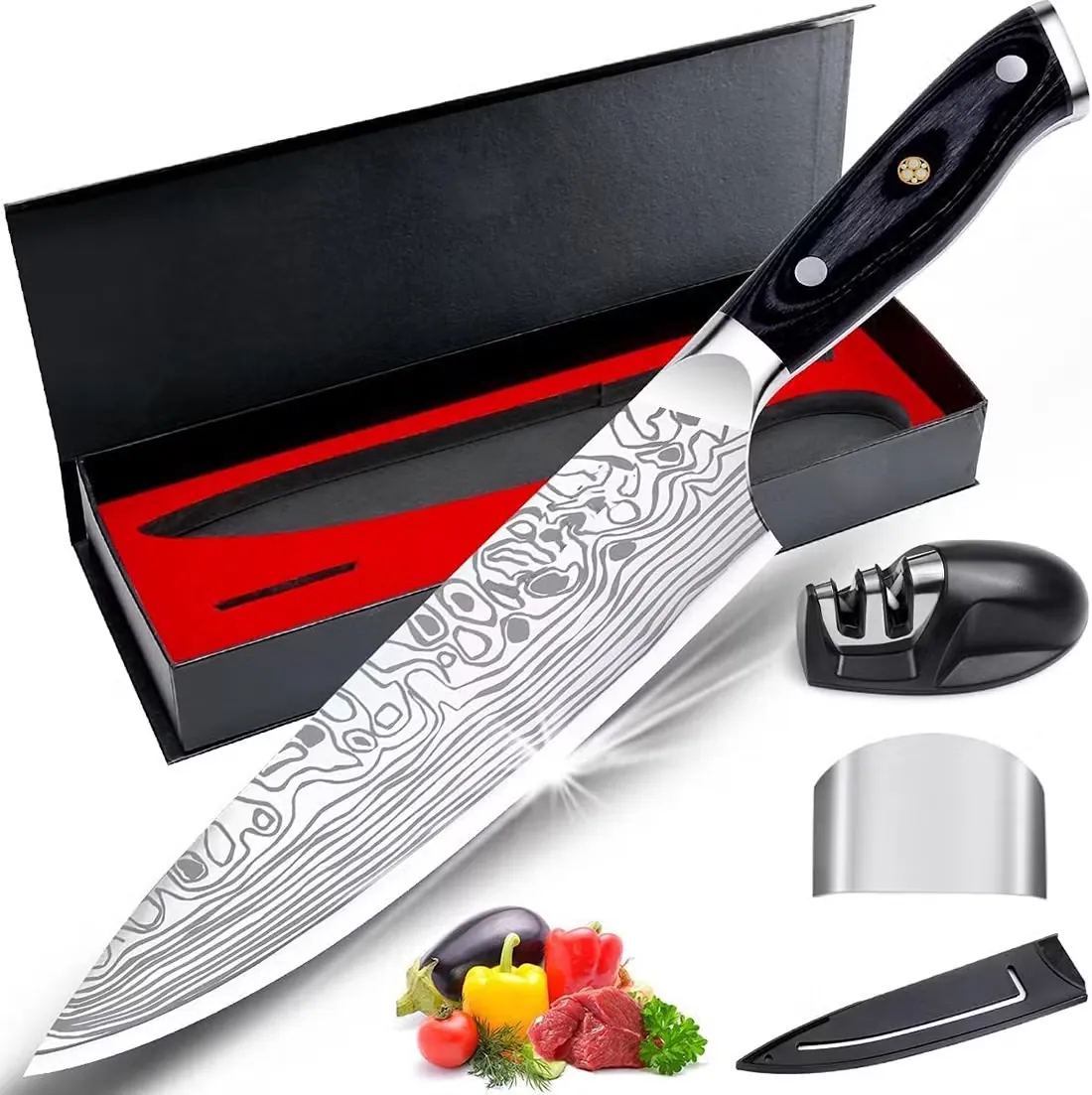
Knife packaging falls into a few standard families, and each fits a different price point and channel. The simplest is a polybag and edge guard: the blade gets a protective sleeve or tip guard, and the knife ships in a bag with a label. This is functional, cheap and common for entry-level lines, but it offers little brand story and weak protection for heavier shipping. The next step is a printed box with a fitted insert: the knife sits in a die-cut foam or pulp insert inside a printed carton. This is the workhorse of mid-range online knife brands, and it is where most of the packaging design effort should go. At the premium end, there are magnetic-lid boxes, wooden presentation cases and multi-knife block sets, which are really retail products that happen to ship well because of heavy inserts.
For online-first brands, the printed box with a fitted insert is usually the right starting point, because it balances cost, protection and brand presence. The two technical details that matter most are the insert design and the blade protection: the insert must hold the knife immobile in three dimensions, and the blade must have a sleeve, tip guard or protective coating that survives the journey. Ask the OEM supplier to show you the insert design before tooling, and test the actual shipping behaviour with a drop test sample.
| Packaging type | Best fit | Watch out for |
|---|---|---|
| Polybag + edge guard | Entry-level lines, inserts in multipacks | Weak brand story, limited shipping protection |
| Printed box + fitted insert | Mid-range online brands | Insert design must immobilise the knife; test drop behaviour |
| Magnetic or presentation box | Premium gift lines | Higher cost, heavier packaging, protection still needed |
| Knife block or roll set | Multi-piece sets | Weight and freight cost; knife retention in the block |
Blade protection that survives shipping
Blade protection is the part of the packaging where corners get cut. A blade sleeve made of soft plastic protects the edge in a store, but it can slide off in transit. A tip guard protects the point, which is the most fragile part of a knife and the most common damage point in shipping. For online programs, combine protections: a full-edge sleeve plus a tip guard, or a blade card that sandwiches the knife and locks into the insert. The test is simple: shake the packed box and check that nothing moves, then drop it from a reasonable height and check the knife again.
There is also a safety dimension. A knife arriving in damaged packaging with the blade exposed is a liability and a bad review. In the UK, knives are age-restricted products, and online sales carry specific expectations about delivery and age verification; the packaging should not make it easy for a knife to be removed and concealed during transit. These are regulatory considerations that belong in the packaging brief, not after the product ships.
Branding: etching, printing and the insert card
For an online brand, the brand mark appears in three places: the blade, the box and the insert card. On the blade, OEM suppliers offer laser engraving and etching, and the method affects both the look and the corrosion behaviour of the mark. Laser engraving is common and durable; etched logos are also standard. Ask the supplier to show samples of both on the exact steel grade you plan to use, because the contrast and durability vary between grades.
The box printing carries your name, the product name and the care instructions. The insert card carries the story: the steel grade, the edge angle, the care guide and your contact or social channels. Online customers read the card while the knife is still new, so it is the cheapest marketing asset in the box. Budget for it in the packaging cost, and ask the supplier to handle print and assembly so the card is in the box at the factory, not added later by your team.
FAQ: Should I put a logo on the blade or only on the box?
Answer: For online brands, do both, but treat them differently. The blade mark is the long-term brand signal that survives the packaging, while the box and card carry the selling story. Confirm the etching or engraving method with the supplier and check samples on your steel grade before committing.
Steel, handle and QC basics for the first order
Online buyers cannot touch the knife, so the specification has to be communicated through the listing and proven through consistency. The steel grade is the headline spec. Common OEM grades include 3Cr13 and 5Cr15MoV at the entry and mid levels, 8Cr13MoV for better edge retention, and higher-alloy grades such as VG-10 or German 1.4116 for premium lines. The grade name means little without the heat treatment behind it, so ask the supplier about the hardness target and the heat-treatment process, and request the hardness test results from the production batch.
The handle is the second spec that sells online. Material, shape, balance and the number of rivets all appear in product photos and reviews. Full-tang construction is a phrase customers recognise, and it is verifiable in the QC process: a full-tang knife has the steel running the full length of the handle, usually visible in the rivets and the handle profile. Ask the supplier to confirm tang construction in the specification, because it is a different assembly line from a partial-tang knife.
QC for the first order should cover edge sharpness, blade geometry, tip condition, rivet and handle finish, balance, and the packaging protection. Define the acceptance criteria in writing before production, and include a pre-shipment inspection. For a new program, sending one finished sample to a third-party inspection service is cheap insurance against a batch of inconsistent knives.
First-order planning: samples, MOQ and lead times
The first order for an online knife brand needs a longer runway than the product suggests. Plan for at least one sample round: a stock sample to check the base product, then a pre-production sample with your packaging and branding. Each round adds weeks. Typical OEM lead times run from 30 to 60 days for production after sample approval, plus sea freight of 30 to 45 days to Western markets, so a realistic first-order timeline from inquiry to warehouse is often three to four months. Confirm every date in writing, because knife production lines fill up ahead of peak seasons.
MOQs for knife OEM vary with the complexity of the product and packaging. Simple single knives with existing tooling carry lower minimums; sets, custom handles and custom packaging raise them. The first-order quantity should balance the MOQ against what you can actually sell in the first 90 days, because a warehouse full of unsold knives is a cash problem that no discount later fixes.
For the listing itself, plan the product photography with the sample in hand: lifestyle shots, a close-up of the blade mark, a shot of the packaging, and a video of the knife in use. Online customers buy from photos, and the sample is the moment to capture them properly, not a detail to handle after the container arrives.
Scaling after the first order
The second order is where the program economics improve. Tooling is paid, packaging is designed, QC criteria are set, and the supplier knows your expectations. Use the first-order data to set the reorder logic: sell-through rate, best-selling SKU, return reasons, and the packaging complaints that show up in reviews. A reorder should change only the quantity, not the specification, unless the data says otherwise.
It also helps to build a small review loop with the supplier after the first shipment: what arrived damaged, what customers complained about, and what the factory can adjust. Online brands that treat the first container as the end of the project miss the improvements that make the second and third containers profitable.
Steel grades compared for an online program
The steel grade is the first spec an online buyer reads, so the choice has to be defensible in the listing. Common OEM grades sit in a practical spectrum. 3Cr13 is an entry-level stainless: easy to manufacture, corrosion resistant, and adequate for budget lines, but with modest edge retention. 5Cr15MoV adds molybdenum and vanadium for better edge holding and is a common mid-range choice. 8Cr13MoV is a well-regarded mid-to-upper grade with strong edge retention and good toughness. At the premium end, VG-10 and German 1.4116 carry higher hardness and edge-holding expectations, with a higher price and more demanding sharpening requirements for the end user.
| Grade | Typical positioning | Edge retention | Cost level |
|---|---|---|---|
| 3Cr13 | Entry-level budget lines | Modest | Low |
| 5Cr15MoV | Mid-range everyday knives | Good | Medium |
| 8Cr13MoV | Mid-to-upper performance | Strong | Medium-high |
| VG-10 / 1.4116 | Premium chef lines | High | High |
Whatever the grade, the heat treatment decides the real performance: the same steel can produce a great blade or a mediocre one depending on hardening, tempering and edge geometry. Ask the supplier for the hardness range in Rockwell units and the heat-treatment process, and request hardness test results from the production batch. A supplier that cannot state a hardness target is selling steel by name, not knives by specification.
To shortlist factories by category, start with the kitchenware product range and the full product catalog.
Worked example: a first-order plan for an online knife brand
To see the decisions in sequence, take a new online brand planning its first knife line: three SKUs — a chef’s knife, a santoku and a paring knife — in 5Cr15MoV with laser-engraved branding, printed boxes with fitted inserts, and a care card. The plan starts with a stock sample round to check the base product, followed by a pre-production sample with the branding and packaging. The MOQ is confirmed for the set configuration and the packaging. The production order is placed with a 60-day lead time, and the container ships by sea, adding roughly 35-45 days. Total runway from first inquiry to warehouse is about four months.
While production runs, the brand captures the listing assets from the pre-production sample: lifestyle photos, a macro shot of the blade mark, packaging shots and a usage video. The QC criteria are agreed in writing before production: edge sharpness, tip condition, rivet finish, blade geometry and packaging protection. A pre-shipment inspection covers the batch. The launch is planned for a date that leaves buffer for customs and receiving. Every element of that plan is a decision the supplier should be involved in, and every date should be in writing.
Common mistakes in knife OEM first orders
The failures repeat across brands. Choosing steel on marketing rather than specification is the first: a premium-sounding grade with poor heat treatment performs worse than a mid-grade done well. Treating packaging as an afterthought is the second: the knife arrives damaged because the insert did not immobilise it. Skipping the pre-production sample is the third: the logo placement, the box size or the card printing is wrong, and the whole batch carries the error. Ordering the MOQ without sell-through planning is the fourth: the first container is bigger than the first 90 days of demand. Ignoring the shipping environment is the fifth: the box that works on a shelf fails in a courier van.
The fixes are all process fixes: specify the steel and heat treatment, test the packaging with a drop test, never skip the sample round, size the first order to the first season, and design the box for the journey. Online knife brands do not get a second chance at a first impression, so the first container has to be right.
Pricing, freight and the total first-order cost
The first-order cost is more than the factory price. Add the tooling if any, the packaging development and print, the samples, the inspection, the freight, the customs clearance and the warehouse receiving cost. Online knife brands frequently under-budget the non-product costs, then discover the landed cost is a third higher than the unit price suggested. Build the full landed-cost model before committing to the MOQ, and use it to set the retail price with a margin that survives the first season’s marketing spend.
FAQ: How do I set the retail price for a knife OEM line?
Answer: Work from the landed cost per unit, not the factory price: add freight, duties, inspection, packaging and warehousing, then set a retail price that covers marketing and returns while keeping a target margin. Confirm the landed-cost assumptions with your forwarder before you finalise the order volume.
The sample and approval workflow for knife programs
The sample workflow for a knife OEM program has more steps than buyers expect, and each step is a checkpoint. Start with the stock sample: the supplier’s standard knife in the shape you are considering, which lets you judge the base design, the steel behaviour and the finishing quality. Next is the customised sample: your steel grade choice, your handle material, your logo placement, made to your specification. This is where the branding decisions get locked, and it is the point to test the logo method on the actual steel. Then comes the packaging sample: the box, the insert, the card and the blade protection assembled as they will ship. Then the pre-production sample from the production line, with everything together.
Each step has its own sign-off. For the knife itself, check the blade geometry, edge sharpness, balance, handle finish, rivets, logo quality and the overall weight against the spec. For the packaging, check the insert fit, the blade protection, the print quality, the card text and the box durability with a drop test. Record each approval in writing with photos, because the production batch is judged against the approved samples, not against the original brief. A knife brand that treats the sample round as a formality is a brand that discovers its mistakes on a container of finished knives.
One practical detail: order two identical pre-production samples. Send one to your QC or third-party inspector for testing, and keep one as the reference sample for the production comparison. The reference sample is the physical standard the factory checks against, and it prevents arguments about what was approved.
Building the supplier relationship for the second order
The first order is a test of the supplier as much as the product. Keep the record of what went well and what did not: sample speed, communication quality, QC results, packaging condition on arrival, and how the factory handled the inevitable small problems. That record decides whether the second order goes to the same factory and whether the terms improve. Suppliers reward repeat buyers with better pricing, better slots and more flexibility, but only buyers who show up with organised specifications and honest feedback get the full benefit. Treat the post-shipment review as a formal step: a short list of what to keep, what to change and what to test next time. The second order should be boringly smooth, and that is the sign the program is working.
Frequently Asked Questions
What steel grades should an online knife brand start with?
Start with a proven mid-range grade such as 5Cr15MoV or 8Cr13MoV, which balances cost, edge retention and ease of sharpening, and upgrade to VG-10 or 1.4116 for premium lines. Confirm the heat treatment and hardness targets with the supplier.
How long does a kitchen knife OEM first order take?
Allow three to four months from inquiry to warehouse for a typical program: sample rounds, 30-60 days of production after approval, and 30-45 days of sea freight. Confirm dates in writing at each step.
What packaging do I need for selling knives online?
A printed box with a fitted insert plus blade edge protection and a tip guard. Test the packed box with a shake and drop test, and design the packaging for the courier journey, not just the shelf.
Is laser engraving or etching better for blade branding?
Both work; the better choice depends on your steel grade and design. Ask the supplier for samples of each on your exact grade, and check durability and contrast before choosing.
What QC checks matter most for a knife batch?
Edge sharpness, blade geometry, tip condition, rivet and handle finish, balance, and packaging protection. Define acceptance criteria in writing and run a pre-shipment inspection on the first order.
An online knife brand succeeds when the packaging, the blade mark and the first-order process are designed together. Brief the packaging as a shipping problem, confirm the steel and heat treatment with samples, and plan the timeline backwards from your launch date. If you are starting a kitchen knife OEM program and want a supplier who can handle the full packaging and QC scope in one place, send your product idea and target volumes through our contact page and we will walk you through the sample and tooling steps.