A US importer sourcing from a cookware manufacturer should verify three things before the first container: the non-stick coating is PFAS-free where the product claims it, the food-contact documentation matches what US enforcement actually checks, and the testing plan catches problems before the goods leave the factory. The US market is not a single rulebook — federal food-contact rules, state-level chemical restrictions and retailer requirements all apply at once — and the buyers who treat compliance as a paperwork checkbox are the ones who end up paying for a product recall or a rejected shipment. This guide walks through what to confirm with a cookware manufacturer, what tests to run, and how to plan the first container so compliance is built in rather than bolted on.
The compliance map for cookware in the US
US cookware compliance works on three layers, and each layer has a different owner. The federal layer is the FDA’s food-contact rules: materials that touch food must be suitable for their intended use, and manufacturers are expected to maintain documentation supporting the safety of the materials. The state layer is where the recent action has been: several states have enacted restrictions on PFAS in cookware, with disclosure requirements and, in some cases, bans on intentionally added PFAS in non-stick coatings. The retail layer is the practical one — major retailers and marketplace platforms often require suppliers to submit test reports, certificates and declarations before a product can be listed or sold.
The practical consequence for an importer is that “FDA compliant” alone is not enough. The buyer needs to know which state rules apply to the states where the product will be sold, what the retailer requires, and whether the manufacturer’s coating supplier can document the absence of intentionally added PFAS. This is not an argument to avoid non-stick cookware — PFAS-free ceramic and PFAS-free PTFE alternatives are available — but it is an argument to ask the coating question directly and to hold the answer in writing.
| Compliance layer | What it covers | Who asks for it |
|---|---|---|
| FDA food-contact | Material suitability for food contact | Federal enforcement, customs, due diligence |
| State chemical rules | PFAS restrictions and disclosure in cookware | State regulators, retailer compliance teams |
| Retailer requirements | Test reports, declarations, product liability evidence | Marketplaces, chains, buying groups |
Because the rules change and the details matter, the safe habit is to confirm the exact current requirements for your product and destination with the importer of record and the retailer before placing the order — this article describes the structure of the compliance picture, not a legal opinion for a specific shipment.
Quick FAQ: Is PFAS-free cookware required in the US?
Not nationwide yet, but several US states have enacted PFAS restrictions or disclosure rules for cookware, and major retailers are adding PFAS-free requirements to their supplier standards. The requirement that applies to your product depends on the states where it is sold and the retailer’s policy. Confirm the current rules for your channels with the importer of record before you commit.
What to ask a cookware manufacturer about coatings
The coating conversation with a manufacturer should be specific, not general. Asking “is this non-stick?” is useless; asking “which coating system is on this pan, who supplies the coating, and can you document that no PFAS was intentionally added?” produces a useful answer. The common coating families in the market are PTFE-based non-stick, ceramic (sol-gel) non-stick, and uncoated finishes such as stainless steel, cast iron and carbon steel. Within PTFE-based coatings there are formulations that claim PFAS-free performance, and within ceramic there are differences in durability and in how the coating is applied.
Three follow-up questions matter for a US program. First, ask for the coating supplier’s name and the coating’s product specification — this lets you verify claims against the coating manufacturer’s own documentation. Second, ask whether the finished pan can be tested for intentionally added PFAS and what the test method would be; a manufacturer who can run or commission a test has a different answer from one who only repeats a sales claim. Third, ask how the coating is applied (roller, spray, or pre-coated sheet) and what the warranty and failure mode are, because application quality drives the durability that US consumers actually experience.
Food-contact documentation: what to collect before production
US food-contact compliance for cookware rests on documentation, and the documentation has to come from the right place. The useful documents are: the material declarations for each food-contact component (the metal body, the coating, any gasket or handle part that touches food), the coating supplier’s compliance statement or test report, and, where relevant, migration or extractable test results for the finished product. For stainless steel, the mill certificate or material certificate for the steel grade is the starting point; for coatings, the coating manufacturer’s documentation is usually the strongest evidence because the coating chemistry is their expertise.
Collect these documents at the sample stage, not at the shipping stage. If a document is missing, you need time to ask for it, find a substitute or change the material — and you do not have that time when the container is at the dock. One practical approach is a document checklist attached to the purchase order, with each document named and a deadline for delivery. The checklist should also name the destination-state rules the buyer is tracking, so the manufacturer and the coating supplier can confirm against the actual requirement rather than against a generic “FDA approved” phrase.
Testing: what actually protects a US program
Testing is where the budget should go, because a test report is the evidence that survives an audit. The useful tests for a cookware program, in order of priority, are: material verification (stainless grade by a reliable method, coating identity), migration or extractable testing for the food-contact materials where the destination requires it, mechanical and performance tests (coating adhesion, abrasion resistance, thermal shock, handle stability, base flatness), and, where the product claims it, verification that no PFAS was intentionally added. Not every shipment needs every test; the priority is set by the destination rules and the retailer’s requirements.
Two practical notes. First, tests are only as good as the laboratory and the sample: use an accredited laboratory, and test a production sample, not a hand-made prototype. Second, a test report is a snapshot, not a guarantee — the manufacturer should be required to confirm that production materials match the tested materials, and a change in the coating supplier or the steel source should trigger a re-test. Put that commitment in writing in the supply agreement.
| Test type | What it verifies | When it matters most |
|---|---|---|
| Material verification | Steel grade, coating identity match the spec | First order, material change, every audit |
| Migration / extractables | Substances released into food under use | Destination rules and retailer requirements |
| PFAS verification | No intentionally added PFAS where claimed | States and retailers with PFAS rules |
| Performance tests | Adhesion, abrasion, thermal shock, handle | Product claims, warranty, return reduction |
| Base flatness and geometry | Induction compatibility, even cooking | Induction claims, quality complaints |
Material strategy: aluminium, stainless steel or cast iron for the US market
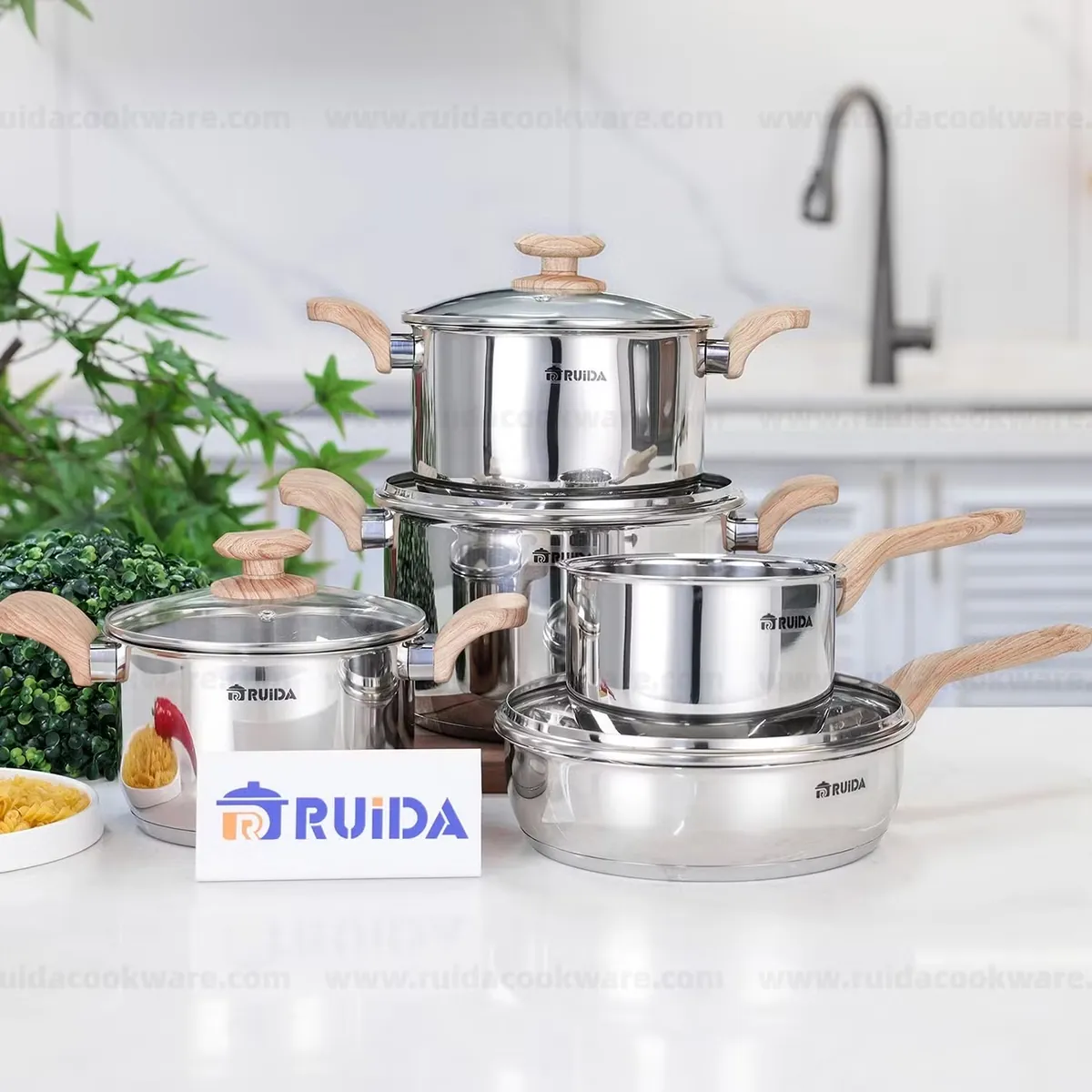
The material decision shapes the compliance work, the price point and the freight cost, so it belongs early in the sourcing conversation. Aluminium non-stick is the volume category: it is light, affordable and easy to coat, and the compliance focus is the coating system and the aluminium’s food-contact suitability. Stainless steel is the compliance-simplest category: an uncoated 304 or 18/10 surface has no coating question at all, the material documentation is straightforward, and the price point supports a premium position. Cast iron and carbon steel are the durability niche: heavy, uncoated or seasoned, with strong US demand for heirloom-style cookware and no PFAS concern in the uncoated version.
| Material | Typical US position | Compliance focus | Freight profile |
|---|---|---|---|
| Aluminium non-stick | Volume, accessible price | Coating system, PFAS position, food contact | Light, low cost |
| Stainless steel | Premium, induction-ready | Steel grade documentation | Moderate weight |
| Cast iron / carbon steel | Durability, heirloom niche | Minimal; seasoning and finish claims | Heavy, higher freight |
Many US importers run two material lines deliberately: a stainless line for the compliance-simple, premium story and an aluminium non-stick line for volume. If the non-stick line is where the margin is, the coating documentation deserves the most attention; if stainless is the priority, the steel grade and the construction (tri-ply vs disc-bottom) become the specification focus. Decide the mix before you send the RFQ so the manufacturer quotes against a clear material plan. And write the material decision into the spec even when you have no preference, because “material as per supplier” is an invitation for the factory to choose the cheapest option: name the base material, the grade where it matters, and the construction, and confirm the material on the production sample.
Working with a cookware manufacturer: RFQ essentials and the supply agreement
The RFQ to a cookware manufacturer should read like a specification, not a shopping list. The essential fields are: the material and grade per piece, the construction (tri-ply, disc-bottom, or single-layer), the coating system and the PFAS position, the dimensions and capacity per piece, the handle type and material, the compatibility claims (induction, oven-safe), the packaging format, the destination market and required documents, the quantity per SKU, and the QC standard including tests and inspection. A manufacturer who answers all the fields in writing is a different supplier from one who answers with “yes, we can do that”.
The supply agreement adds the terms that protect the program after the RFQ: the approved sample as the reference standard, the change-notification clause (any material, coating or supplier change requires notice and re-approval), the test and inspection schedule, the warranty and defect procedure, and the documentation delivery deadlines. These clauses are cheap to agree and expensive to miss. A US importer who has the approved sample, the change-notification clause and the document deadlines in writing has a defensible position when something goes wrong; without them, the conversation is he-said-she-said with a factory on the other side of the world.
First-container planning with the manufacturer
The first container is the proof run, and its plan has to be written so that a problem is cheap to fix. The low-risk structure is: a pre-production sample with the exact production materials and coating, an approved sample held as the reference, a pilot run with inspection at the factory, the full production run with in-line QC, and a pre-shipment inspection with the agreed sampling plan before loading. Each stage has a sign-off, and the sign-off belongs to a named person on each side, not to a WhatsApp chat.
Timing deserves a buffer on a first order. Production for a standard cookware container typically runs three to five weeks, but the first order usually needs extra weeks for the coating confirmation, the test reports and the sample rounds. Plan for the first order to take two to three months from order placement to the port, and do not promise your retail customer an in-store date that assumes everything goes perfectly. Once the first order clears, the second order can run on a tighter schedule because the materials, the tests and the supplier’s documentation are already proven.
The Incoterms and freight decision also belongs in the first-container plan. The common choices are FOB (the supplier delivers to the named port, and the buyer controls the freight from there), EXW (the buyer collects from the factory), and CIF or DDP arrangements where the supplier handles more of the chain. For a first order, FOB with a freight forwarder the buyer controls is the common middle ground: it gives the buyer control of the shipping decision and the customs documentation while keeping the supplier’s responsibility clear. Agree the Incoterm, the port pair and the party responsible for each document before production, because a dispute about who owns the freight risk is the last thing a first order needs.
Quick FAQ: How long does a first cookware order from China take?
Plan for two to three months from order placement to the US port for a first order, including sampling, test reports, production and sea transit. The second order can run faster once the materials, tests and documents are proven. Confirm the production slot in writing with the manufacturer.
QC checks before the container loads
The pre-shipment inspection for a US cookware program should cover the standard kitchenware checks plus the compliance-relevant ones. The standard checks are material grade, coating quality and thickness where measurable, dimensions and weight, handle stability, base flatness, packaging and labelling. The compliance-relevant checks are: the finished goods match the approved sample, the carton and label markings match the US requirements (country of origin, material composition, care instructions), the batch documentation matches the shipment (material certificates, test reports, coating declarations), and the packing list matches the commercial invoice.
Use a written inspection checklist with clear pass/fail rules, agree the sampling level in the contract, and keep the evidence — photos, measurements, the inspection report — for every batch. If the inspection finds a defect, the contract should say what happens next: rework, replacement or refusal, and who pays for the re-inspection. A US importer who treats the inspection as a formality is buying the manufacturer’s quality system blind. The inspection is also the buyer’s first chance to see whether the batch matches the approved sample, the documents match the shipment, and the packaging matches the retail plan — three matches that the first container will otherwise reveal the hard way.
Market timing and seasonal planning for US retail
US cookware demand follows a predictable calendar, and the sourcing plan should be built around it. The biggest peaks are the fourth-quarter holiday season, the January “new year, new kitchen” wave and the spring bridal season, with a steady base through the rest of the year. For a first program, the practical approach is to target one peak first: place the order so production, sea transit, customs and warehousing all clear before the peak, and use the first season to learn the timing rather than to maximise volume.
Seasonal planning also changes the packaging and the SKU mix. Holiday programs favour gift-ready sets and seasonal packaging; the January wave favours value sets and organisation products; the bridal season favours premium stainless and complete set configurations. A manufacturer who can produce the same base cookware with different packaging for different peaks is more valuable than one who only runs one format. Confirm the production slots for your peaks early — the fourth quarter is when every cookware factory in China runs at capacity, and the buyer who booked in June gets the line time that the October caller cannot have.
Common mistakes US importers make with a first cookware order
Most first-order problems in US cookware programs follow a short list of repeatable mistakes, and naming them makes them avoidable. The first is ordering on a sales sheet instead of a specification: the buyer picks a catalogue item, the factory ships something close, and the difference shows up in the first customer review. The second is skipping the pre-production sample with production materials — a prototype with a different coating or a different steel grade tells you nothing about the production run. The third is treating the test report as a one-time document: materials change, suppliers change, and the report goes stale. The fourth is under-specifying packaging for the US retail channel, where the carton has to survive a warehouse, a truck and a shelf, not a hand-carry. The fifth is promising a retail date before the first container clears, which turns a normal sourcing delay into a customer-relationship problem.
Each mistake has the same cure: write the spec, hold the sample, keep the documents current, pack for the channel, and buffer the calendar. None of these are expensive. They are just the difference between a buyer who owns the process and a buyer who rents it.
Frequently Asked Questions
Do I need PFAS-free cookware to sell in the US? Not nationwide, but several states restrict or require disclosure of PFAS in cookware, and major retailers are adding PFAS-free requirements. Check the rules for the states where you sell and the retailer’s supplier standards, and confirm the current requirements with the importer of record.
What food-contact documents should I ask the cookware manufacturer for? Material declarations for every food-contact component, the coating supplier’s compliance statement or test report, and, where relevant, migration or extractable test results for the finished product. Collect them at the sample stage, with a deadline per document.
Is a test report enough to prove a cookware coating is PFAS-free? A test report is strong evidence, but it is a snapshot. Confirm the test was done by an accredited laboratory on a production sample, and require the manufacturer to notify you of any change in coating supplier or chemistry that would require a re-test.
What is the difference between ceramic and PTFE non-stick for US buyers? Ceramic (sol-gel) coatings are marketed as PFAS-free and metal-free, while PTFE-based coatings have a longer track record of release performance. Durability and application quality vary within both families, so specify the coating system and the test evidence rather than relying on the category name.
Should I inspect the first container before shipment? Yes. A pre-shipment inspection with an agreed sampling plan catches defects while they are cheap to fix and gives you the evidence base for the batch. It is the cheapest insurance on the first order.
Building the first US program
A US cookware program works when compliance is treated as a product spec: name the coating system and the PFAS position, collect the food-contact documents at the sample stage, run the tests that the destination actually requires, and put the inspection checks in the contract. Our cookware products range covers aluminium non-stick and stainless steel lines, and the stainless steel range gives US importers the uncoated options that sidestep the coating question entirely. If you are planning a US first container and want to review the coating spec, document list and test plan before you commit, send your requirements through our contact page and we will confirm what we can support.