Comparing frying pan manufacturers comes down to three specifications: the coating system, the base gauge and the test evidence, and a buyer who can read those three numbers can separate a real production line from a catalogue reseller in one conversation. The frying pan is the highest-volume cookware item in most markets, which means it is also the most price-competitive, and the manufacturer who wins your order by cutting the spec will cost you returns, warranty claims and shelf complaints later. This guide explains what to specify, what test reports to ask for, and how to run a fair comparison between manufacturers before you commit.
Why the frying pan deserves its own sourcing discipline
A frying pan is the cookware item consumers use most, abuse most and complain about most. It is exposed to high heat, metal utensils, dishwashers and impatient home cooks, and its failure modes — coating wear, warping, handle loosening, base deformation — are visible within months, not years. That makes the frying pan the highest-return-risk item in a cookware range, and it makes the manufacturing spec the real contract between buyer and factory.
The three specifications that matter most are the coating system (what is on the cooking surface and who supplies it), the base gauge (how thick the metal is, especially at the bottom), and the construction of the pan body (single-layer, disc-bottom or tri-ply). Around those three, the handle type, the rim design and the packaging decide the retail experience. A buyer who can name these specifications gets useful quotes; a buyer who only says “non-stick frying pan” gets whatever the factory wants to ship.
Coating systems: the surface is the product
The coating is the first spec to pin down, because it drives both the selling story and the compliance work. The main families are PTFE-based non-stick, ceramic (sol-gel) non-stick, and uncoated finishes like stainless steel and carbon steel. Within PTFE-based coatings, formulations differ in thickness, layers and durability, and the market has moved toward PFAS-free claims in several regions. Within ceramic coatings, the differences are in the sol-gel chemistry, the number of layers and the curing process. The category name tells you almost nothing; the coating supplier’s specification and the test evidence tell you almost everything.
When you brief a frying pan manufacturer, ask for the coating by supplier and product name, the number of layers and the total coating thickness where the supplier specifies it, the maximum recommended temperature, and the evidence that the coating meets the food-contact and chemical requirements of your destination market. Ask whether the coating is applied in the factory or on pre-coated sheet, because the application process affects consistency. And ask the manufacturer to confirm in writing that production coatings match the approved sample — coating changes are the quietest way to cheapen a frying pan.
| Coating family | Typical positioning | Key question to ask |
|---|---|---|
| PTFE-based non-stick | Volume, best release | PFAS position, layers, max temperature |
| Ceramic (sol-gel) non-stick | PFAS-free story | Layer count, durability test evidence |
| Stainless steel uncoated | Premium, compliance-simple | Steel grade, construction |
| Carbon steel uncoated | Professional, durability | Gauge, seasoning behaviour |
Quick FAQ: Which frying pan coating lasts longest?
Durability depends more on the coating system’s quality and application than on the category name. A well-applied PTFE-based coating and a well-applied ceramic coating both last with proper care; a cheap version of either fails quickly. Ask for abrasion and adhesion test evidence from the coating supplier and judge on that, not on the label.
Base gauge and construction: the hidden cost driver
Base gauge is the specification where frying pan quotes hide their differences. A common aluminium frying pan base is around 2.3 to 3.0 millimetres in the bottom for a disc-bottom construction, while the wall may be thinner; a cheap pan can drop the base below 2 millimetres, and the difference shows up as warping and hot spots. In a single-layer aluminium pan, the gauge is the pan wall and the base together, and it must be thick enough to hold heat without flexing. In a stainless disc-bottom pan, the disc is a sandwich of aluminium between stainless layers, and the disc thickness and its coverage matter for induction performance and even heating.
When you compare quotes, ask for the base gauge in millimetres and the construction type for every piece in the range, and treat a quote that refuses to state the gauge as a red flag. The gauge also drives weight, which drives freight cost and the “premium feel” at retail — a pan that feels flimsy in the hand gets returned even when it cooks fine. Confirm the gauge on the production sample, not just on the quote, because the gauge is one of the easiest specs to quietly change.
Handles, rims and the details that drive returns
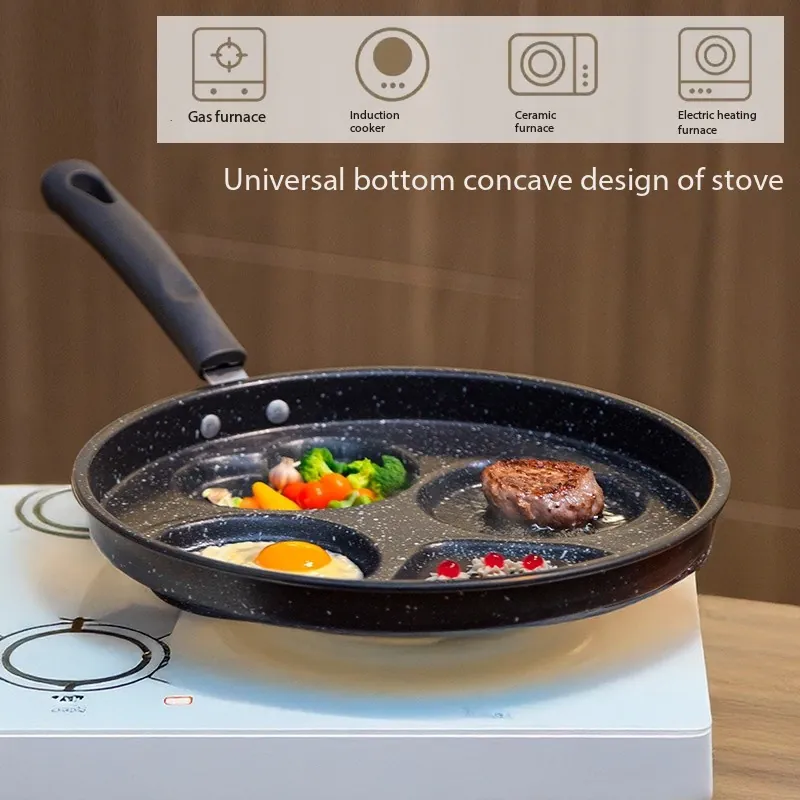
The handle is the second-most-common failure point after the coating, and it deserves a spec of its own. The main options are bakelite or phenolic handles (the classic stovetop handle, heat-resistant but not oven-safe), silicone-coated metal handles (better grip, oven-safe to the silicone’s rating), stainless steel handles with or without a silicone sleeve (premium, oven-safe, but they conduct heat), and wooden handles (mostly on carbon steel pans). For each handle, confirm the attachment method — riveted, screwed or welded — because a loose handle is a safety complaint and a return. The rivet or screw type and the torque standard matter more than the handle style.
The rim also matters. A rolled or encapsulated rim protects the exposed aluminium edge and reduces the chance of chips and corrosion; a raw cut rim is cheaper and more prone to complaints. The pouring rim, the helper handle on larger sizes and the lid fit are the retail details that differentiate a considered product from a commodity. Write these into the spec sheet with the coating and the gauge so the manufacturer quotes one product, not their cheapest version of it.
Sizes, capacities and SKU planning
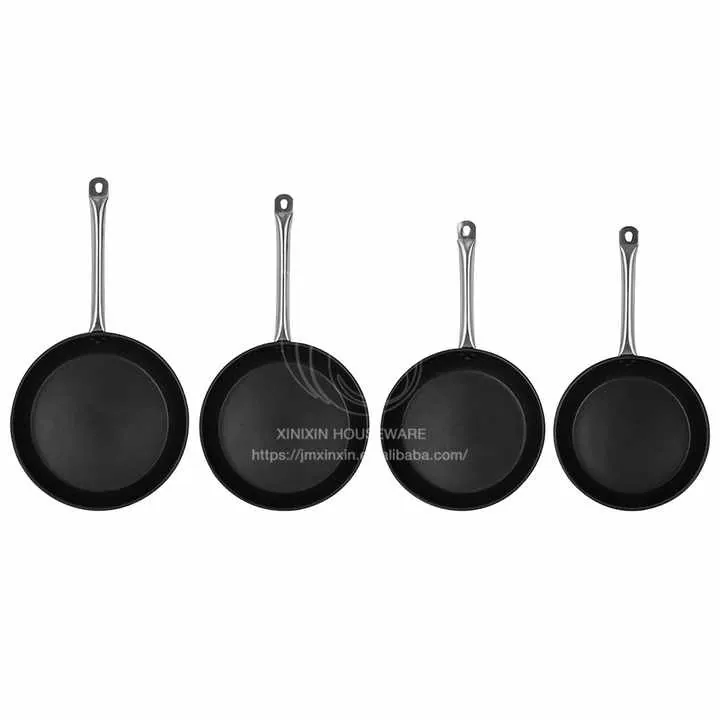
The frying pan range is usually planned around three sizes: a small pan around 20 centimetres for eggs and single portions, a medium pan around 24 to 26 centimetres for everyday cooking, and a large pan around 28 to 30 centimetres for family meals. Some ranges add an extra-large pan or a wok-style frying pan at the top. The sizes you choose shape the manufacturing conversation because each size may need its own tooling, coating setup and carton, and the per-size MOQ is often the real constraint in a range.
For a wholesale program, keep the first range small and the depth per size realistic: three sizes with one coating option each is easier to manage than five sizes with two coating options each. Confirm the packed carton dimensions and weight per size at quotation stage, because the carton footprint drives the pallet plan and the freight cost, and a set of three nested pans packs very differently from three individual boxes. If the retail story is a set, plan the set carton early; if the story is individual pans, plan the display carton.
Packaging and the retail story
Frying pan packaging has to do two jobs: protect the coating in transit and sell the pan at retail. The coating is the fragile part — a pan that slides against another pan in a carton will arrive scratched — so the between-pan protection is a packaging spec, not an option. For individual pans, a foam or EPE sleeve over the cooking surface plus a stable carton is the standard; for sets, a die-cut insert that holds each pan in place is the reliable approach. Specify the protection in the purchase order and check it at inspection.
The retail story lives on the carton and the label: the pan size, the coating type and the claims (PFAS-free where applicable, dishwasher-safe where tested, induction-compatible where true), the care instructions, and the brand and barcode. Keep the claims to what the test evidence supports, because a retail claim that fails in use is a return and a review. Ask the manufacturer for a printed packaging sample at approval time so you see the colours and the label position before production, not after.
Test reports: the evidence a serious buyer requests
The test evidence separates a frying pan manufacturer who understands the market from one who sells sheet metal with a coating. The useful tests, in order of priority, are: coating adhesion and abrasion resistance (the coating’s ability to stay on the pan), thermal shock resistance (the pan’s ability to survive temperature swings without warping or coating failure), base flatness at cooking temperature (the cause of hot spots and induction noise), handle stability under load, and food-contact migration or extractable testing where the destination requires it. If the product claims PFAS-free, the manufacturer should be able to point to the coating supplier’s documentation or a test result.
Ask for the test method and the laboratory for each report, and test a production sample rather than relying on a brochure. A manufacturer who cannot produce any test evidence is either new to export or hoping you will not ask; both are reasons to slow down. You do not need every test on every order — set the required list against your destination market and your retailer’s requirements, and put the list in the supply agreement so it is binding.
| Test | What it catches | Typical evidence |
|---|---|---|
| Coating adhesion / abrasion | Coating wear, flaking | Cross-hatch, abrasion cycles |
| Thermal shock | Warping, coating failure | Temperature cycle test report |
| Base flatness | Hot spots, induction noise | Flatness measurement at temp |
| Handle stability | Loose handles, safety | Torque / load test report |
| Food-contact | Migration, compliance | Migration / extractables report |
Running a fair manufacturer comparison
The fair way to compare frying pan manufacturers is to send the same specification sheet to three suppliers and compare three answers: the price, the spec confirmation and the questions they ask. A supplier who confirms the coating by name, the gauge in millimetres and the test list is quoting your spec; a supplier who quotes “non-stick frying pan, good quality” is quoting their margin. The questions they ask back are also informative: a manufacturer who asks about your retail price band, your market’s compliance rules and your packaging requirements is thinking about the product you will sell, not just the pan you ordered.
Price comparison should be done on a landed-cost basis, not on the FOB price alone. Add freight, duty and the inspection cost to each quote, and weight the difference against the test evidence. The cheapest quote with no test evidence is usually the most expensive pan you will ever buy — it just bills you later, in returns and warranty claims.
Quick FAQ: How do I compare quotes from different frying pan manufacturers?
Send the same specification sheet to all of them, with the coating system, base gauge, handle type, construction and test list named. Compare the landed cost per unit and judge the price against the spec confirmation and the test evidence, not against the quote alone.
Sample approval and the first production order
The sample is the contract. Approve a pre-production sample made with the production materials — the same coating, the same gauge, the same handle — and hold it as the reference for every later check. Test the sample the way your customers will use the pan: heat it, cook with oil, check the handle torque, measure the base for flatness after heating, and run it through a dishwasher cycle if your market expects dishwasher safety. A sample that only sits on a desk tells you nothing.
For the first production order, keep the SKU count small and the quantity per SKU realistic, add a pre-production inspection and a pre-shipment inspection to the schedule, and confirm the production slot in writing. The first order is the proof run for the whole relationship: materials, coating, QC, packaging and documentation. If it is clean, the second order can scale; if it is not, the problems are cheap to fix while they are still in the factory.
Evaluating the factory: production line, QC and export experience
The specification conversation is only half the evaluation; the factory’s line and process decide whether the spec is actually achievable. When you evaluate a frying pan manufacturer, look for evidence of four things: an in-house coating line or a stable relationship with a coating supplier (coating is the highest-risk process and the one most often outsourced or substituted), a QC process with written standards and a sampling plan (ask who checks the coating thickness, the gauge and the handle torque, and how often), a production sample protocol (the factory should be willing to make a pre-production sample with production materials, not just send a catalogue sample), and export experience with your market (ask which countries they export to and what compliance documents they routinely provide).
If you cannot visit the factory, a third-party audit or a video walkthrough of the line is a reasonable substitute for the first order, and a pre-shipment inspection is non-negotiable. Ask for the factory’s export records or at least a list of destination countries, and check whether the documents they name match what your market actually requires. A factory that says “we export everywhere” without naming markets is telling you they have not thought about compliance; a factory that names three markets and their document requirements is telling you they have done this before.
Landed cost and freight planning for the pan range
Frying pans are volumetric cargo: a carton of pans takes up space out of proportion to its weight, and the freight cost per unit can decide the viability of a low-priced SKU. When you plan the range, ask the manufacturer for the packed carton dimensions and weight per size, and calculate the freight per unit for the actual container type you will use. A 28-centimetre pan in a large carton can cost meaningfully more to ship than a 20-centimetre pan, and the retail price has to absorb the difference. Nesting pans for shipping — stacking them with protection between — changes the carton size dramatically, and the set format is often the freight-efficient choice for a multi-size range.
The freight plan also sets the reorder rhythm. A full container at the right price per unit is the most efficient way to buy, but it forces the buyer to hold more stock; a less-than-container load (LCL) costs more per unit but lets the buyer reorder faster and test more SKUs. Many frying pan programs start LCL, prove the winners, then move to full-container for the top SKUs. Work the landed cost per unit for both options before choosing, and keep the freight plan in the same spreadsheet as the factory price so the retail margin is honest.
Specialty pans and the line extension
Beyond the classic frying pan, most programs add specialty pans that share the same coating and handle systems and extend the line without multiplying the supplier base. The common extensions are the wok-style frying pan (deep, sloping sides, popular in Asian and stir-fry markets), the crepe pan (low sides, flat cooking surface), the grill pan (ridged cooking surface, marketed for grilling indoors), and the paella pan or sauteuse (a shallow pan with two handles, bridging the frying pan and the sauté pan). Each specialty pan has its own specification point: the wok needs a stable flat base for induction, the crepe pan needs a very flat surface, the grill pan’s ridges make the coating application harder, and the two-handle sauteuse changes the handle spec entirely.
For a first program, the specialty pans are the second order, not the first. Prove the core frying pan range — coating, gauge, handles, packaging, freight — and then extend the line with the specialty items that share the proven spec. The specialty pan also works as the retail differentiator: a plain frying pan range competes on price, while a range with a wok and a grill pan competes on completeness, which is a better margin position. The same logic applies to sets: a three-piece set of 20, 24 and 28 centimetre pans with a shared coating story sells on value, and the set carton’s freight efficiency often makes it the best-margin SKU in the range.
Frequently Asked Questions
What base gauge should I specify for a frying pan? It depends on the construction and the price position. A common aluminium disc-bottom base is around 2.3 to 3.0 millimetres, with thinner walls; a cheap pan can drop below 2 millimetres. Specify the gauge in millimetres in the RFQ and confirm it on the production sample.
Which frying pan coating lasts longest? Durability follows the coating system’s quality and application, not the category name. Ask for adhesion and abrasion test evidence and judge on that. Care instructions also matter: pans that are heated empty or washed in a dishwasher wear faster.
What test reports should I ask a frying pan manufacturer for? Coating adhesion and abrasion, thermal shock, base flatness, handle stability and, where the destination requires it, food-contact migration or extractable testing. Ask for the test method and laboratory, and test a production sample.
Is a disc-bottom frying pan better than a single-layer pan? For induction compatibility and even heating, a disc-bottom or tri-ply construction is generally better because the aluminium core spreads heat. Single-layer aluminium pans are lighter and cheaper but more prone to hot spots and warping at thin gauges.
How many samples should I request before a frying pan order? Start with one sample per SKU from each shortlisted manufacturer, evaluate them in your own test protocol, then ask the winner for a pre-production sample made with production materials before the full run.
Choosing the manufacturer and building the line
The frying pan line is won at the specification stage: name the coating, the gauge and the construction, collect the test evidence, compare landed costs, approve a production sample and hold it as the reference. Our cookware products range covers aluminium non-stick and stainless steel frying pans, and the wider kitchenware products range includes the supporting SKUs for a full pan program. If you want to review a frying pan specification sheet or a test list before sending it to manufacturers, send your requirements through our contact page and we will confirm what we can support.