Wooden chopping board OEM orders fail on three specifications more than any other: moisture content, glue type and finish, and a buyer who can specify those three numbers will get boards that last, while a buyer who only sends a photo gets boards that crack, warp or stain in the first months. Wood is a living material, and the difference between a board that survives export transit and retail life and one that does not is decided in the factory before the board is ever used. This guide covers what to specify, what to test and how to run a wooden chopping board OEM program without learning the hard lessons on a customer’s counter.
Why wood is a different sourcing problem from metal or silicone
Metal and silicone products are consistent from batch to batch because the material is engineered; wood is natural, and every board carries the history of its tree. The sourcing consequences are practical. Wood absorbs moisture, which changes dimensions and can warp or crack. Wood has grain direction, which affects how a board survives cutting stress. Wood finishes wear with use and food acids, and the finish has to be food-safe. And wood is a biological material, which means the supplier’s drying and storage process matters as much as the cutting and sanding process.
The buyer’s job is to turn those material realities into specifications. A wooden board OEM brief that covers moisture content, wood species, glue type, finish, dimensions and QC will produce predictable boards; a brief that only covers dimensions and logo position will produce whatever the factory had on hand. The three specifications that protect the product life are moisture content, glue type and finish, and each one deserves its own conversation.
Moisture content: the number that decides cracking and warping
Moisture content is the percentage of water in the wood, and it is the single most important spec for export boards. Wood that is too wet when it is packed will continue to dry after it leaves the factory, and the drying shrinks the board — which is exactly when cracks appear at the ends and warping sets in. The target moisture content for kitchen boards in most temperate markets is in the range of 8 to 12 percent, and the supplier should be able to state the value and measure it with a moisture meter on the production line. The destination climate matters: a board at 10 percent moisture in the factory will behave differently in a dry retail warehouse in winter than in a humid coastal market.
Ask the manufacturer three questions: what moisture content do they dry to, how do they measure it, and what is the storage condition between drying and packing. A factory with a kiln and a moisture-measurement step is different from a factory that air-dries and hopes. The moisture spec belongs in the purchase order, and a spot moisture check belongs in the pre-shipment inspection — a moisture meter is cheap and the reading tells you whether the board was packed in the right condition.
| Spec point | What to specify | Why it matters |
|---|---|---|
| Moisture content | 8-12% target, measured on the line | Prevents cracking, warping and dimension change after packing |
| Wood species | Named species, not “hardwood” | Species decides hardness, grain, price and knife behaviour |
| Glue type | Food-safe, water-resistant adhesive | Prevents delamination and glue-line failure in use |
| Finish | Food-safe oil, wax or none | Protects the surface and matches the market’s food-safety expectations |
| Dimensions and tolerances | Exact size, thickness tolerance | Retail packaging and display need consistent dimensions |
Wood species: what “hardwood” actually means
“Hardwood” is a sales word, not a specification. The species commonly used for chopping boards include bamboo (technically a grass, but sold as wood), acacia, rubberwood, beech, walnut, maple, oak and teak, and each behaves differently. Bamboo is hard, renewable and affordable, but it is abrasive on knives and can be prone to splitting at the finger joints if the glue line is weak. Acacia is dense and water-resistant, popular at a mid price. Rubberwood is light-coloured, affordable and widely used for boards and kitchen items, but it is softer and marks more easily. Walnut and maple are the premium species, harder and with a better retail story, at a higher price. Teak has natural oils that resist moisture, which makes it popular for outdoor and commercial use.
The species choice drives three numbers the buyer should know: the Janka hardness (roughly, how resistant the wood is to denting), the price per board, and the knife-friendliness (harder woods hold up longer but dull knives faster). There is no perfect species; there is a species that matches the retail price point and the promised performance. Name the species in the RFQ, and ask the supplier to confirm the species on the production sample — species substitution is one of the easiest ways to cheapen a board order, and it is invisible to most buyers at the sample stage.
Quick FAQ: Which wood is best for a chopping board OEM order?
There is no single best; it depends on the price point and the promise. Bamboo and rubberwood suit value positions, acacia is a strong mid-price option, and walnut and maple carry premium retail stories. Name the species in the RFQ and confirm it on the production sample, because species substitution is common and hard to spot.
Glue type: the hidden line that holds the board together
Most wooden boards above a certain width are made from glued strips or finger-jointed pieces, and the glue line is where boards fail when the glue is wrong. The spec is simple: the adhesive must be food-safe and water-resistant, and the supplier should be able to name the adhesive and its compliance documentation. Ordinary PVA wood glue is water-sensitive; a water-resistant or waterproof food-safe adhesive is the safer choice for kitchen boards that will be washed and left wet.
Ask the supplier three questions: what adhesive do they use, is it rated food-safe for the destination market, and how do they test the glue line. A simple delamination test — soak a sample board and check the joints — belongs in your own evaluation too. The glue line also shows in the finished board as the joint pattern, and the buyer should agree the acceptable joint appearance with the supplier, because some joint patterns are a design feature and some are a quality complaint waiting to happen.
Finish options: oil, wax or bare wood
The finish is the board’s first line of defence and the part of the product the customer sees. The common options are food-safe mineral oil, a food-safe oil-wax blend, a pre-sealed finish from the factory, or bare unfinished wood. Mineral oil and oil-wax blends are the standard for kitchen boards: they penetrate the wood, protect it from moisture and are safe for food contact, and the customer is expected to re-oil the board periodically. A pre-sealed or varnished finish is easier for the customer (no maintenance) but the coating can chip or wear, and some markets expect bare wood they can season themselves. Confirm which finish is used and how it is applied, because a “food-safe oil” can mean anything from a hand-wiped mineral oil to a machine-applied blend.
The finish decision also affects the retail story and the care instructions printed on the packaging. If the board is oiled, the instructions should say how to care for it; if it is bare, the instructions should say to oil it before first use. A customer who receives a board with no care instructions and no finish information is a customer who will complain about the board cracking after a month of washing — which is really a complaint about the missing instructions. Put the finish and the care text in the packaging spec.
Dimensions, tolerances and the retail pack
Chopping board dimensions follow the retail use: a small board around 25 by 20 centimetres for prep, a medium board around 35 by 25 centimetres for everyday chopping, and a large board around 40 by 30 centimetres or bigger for meat and heavy work. Thickness is typically 1.5 to 2.5 centimetres for end-grain-style boards and 1 to 2 centimetres for edge-grain boards. Specify the nominal dimensions AND the tolerance, because a board that is 3 millimetres oversize will not fit its retail carton, and a board that is 3 millimetres undersize looks cheap on the shelf.
The retail pack adds the packaging spec: the carton size and material, the inner protection (a board that slides in a loose carton will scratch or chip), the label with the species, size, care instructions and origin, and the barcode. For OEM programs, the logo placement — laser-engraved, printed or burned — needs its own spec with the position, size and colour, and the logo quality should be checked on the production sample. A laser-engraved logo on a light wood shows differently from the same logo on a dark wood, and the buyer should see the actual result before production.
Edge grain vs end grain: construction matters
Beyond the species, the construction of the board decides its behaviour under the knife. The two main constructions are edge grain and end grain. In an edge-grain board, the wood strips run along the length of the board and the cutting surface shows the long grain; this is the common, affordable construction and it holds up well for everyday chopping. In an end-grain board, the board is made of blocks with the end grain facing up, which is the classic butcher-block construction; the end grain absorbs knife impacts differently and is gentler on knife edges, which is why end-grain boards are the professional preference. End-grain boards are more expensive because they use more wood and more glue area, and they need a stronger glue spec because there are many more joints.
For an OEM program, the construction choice is a price and performance trade: edge grain for value and everyday retail, end grain for the premium chef-story. The construction also changes the weight, the packaging and the care instructions — an end-grain board is heavier and needs different handling in transit. Specify the construction in the RFQ, not just the species, and confirm the joint quality on the sample: a poorly glued end-grain board will open at the joints within months.
Export transit and storage considerations
Wooden boards travel well if the moisture and packaging are right, and badly if they are not. The two risks in transit are moisture change and physical damage. If the board is packed at the correct moisture content but then sits in a humid container or a damp warehouse, it will absorb moisture and may warp or grow mould; if it is packed too wet, it will dry and crack. The container’s ventilation and the packaging’s breathability matter: a fully sealed plastic wrap can trap moisture, while a paper-wrapped or ventilated pack allows the board to breathe and stabilise. Confirm the packaging with the supplier and test a transit sample through your own shipping simulation before committing to the full order.
Storage at your end matters equally. Store the boards in a dry, ventilated area, off the floor and away from direct sunlight, and rotate the stock so nothing sits in the warehouse for months. If the boards are oiled, the oil can bleed into the packaging in warm storage, so confirm the finish’s behaviour at your storage temperatures. These are small logistics details, but they are the difference between boards that arrive perfect and boards that arrive with a mould complaint the supplier says was “your warehouse’s fault”.
Labelling and compliance for wooden boards
Wooden boards face a compliance question that metal and silicone products do not: the finished product is a natural material that has been cut, glued and finished, and the destination market wants to know what is in it and on it. The core documents are the finish’s food-safety statement (mineral oil, wax or finish with food-contact suitability), the glue’s food-safety documentation where the destination requires it, and the origin declaration for customs. Some markets also have wood-packing or phytosanitary considerations for the shipping material, so confirm with the forwarder whether the packaging (pallets, crates, cartons) needs any treatment documentation for your route.
The retail label matters just as much: the species name, the size, the care instructions (oil before first use, hand wash, dry upright), the origin and the barcode. Care instructions are not decoration for wooden products — they are the difference between a board that lasts and a board that comes back with a cracking complaint. Keep the claims on the label to what the product actually is: “food-safe finish” is supportable, while “never needs oiling” is a promise the product will break. Confirm the label content with the supplier at the sample stage, because a printed label error costs a full print run.
The product line around the chopping board
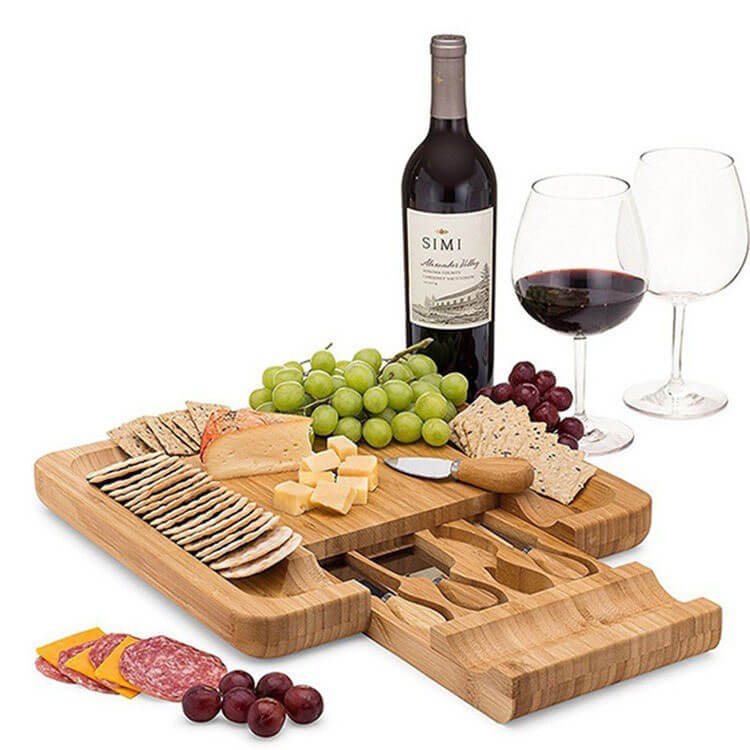
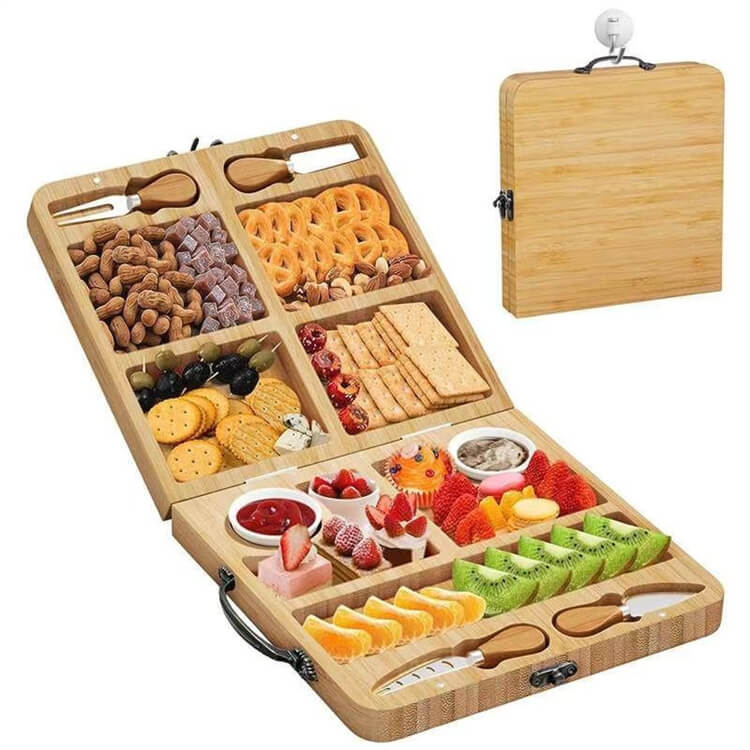
A wooden board OEM program rarely stops at one board; the line around it — serving boards, cheese boards, board sets and the wooden kitchen tools that match — is where the margin and the retail story grow. Serving boards (larger, thinner, made for presenting food) share the moisture, glue and finish specs with chopping boards, but add a surface-quality standard because they are seen at the table, not just used in the kitchen. Cheese boards add the serving tools (cheese knives, spreaders) and the gift-set packaging that makes them a seasonal product. Board sets (a chopping board plus a serving board, or a set of different sizes) add the set carton with a die-cut insert and the value-story pricing.
For the OEM program, the line extension is efficient because it uses the same supplier, the same wood species and the same finish, and the packaging and freight can be consolidated. Plan the line with the supplier at the RFQ stage: ask which items can share the material batch and the finish line, and build the first order around the shared-spec items so the MOQ per item stays manageable. The chopping board is the entry product that proves the quality; the serving board and the set are the products that carry the margin.
QC checks for a wooden board order
The pre-shipment inspection for wooden boards should check, in order: moisture content (spot-check with a moisture meter against the spec), dimensions and thickness against the tolerance, surface quality (sanding, scratches, tool marks), glue lines and joint quality (visible gaps, open joints), finish application (even coverage, no residue), logo quality and position, packaging integrity, and the packing list. Wood-specific defects to look for are end-checking (cracks at the board ends), wane (missing bark edge), knots that weaken the board, and discolouration between boards in the same batch.
Because wood is natural, the inspection standard should allow for normal variation — the goal is not identical boards but boards within the agreed tolerance. Agree the acceptable limits in the contract, keep a sample of the acceptable range as the reference, and make the inspection evidence part of the batch record. A buyer who rejects every board that differs slightly from the sample will burn the relationship; a buyer who accepts every board will get the factory’s lowest quality. The tolerance conversation is the professional middle ground.
Quick FAQ: How do I check moisture content on a wooden board?
A handheld moisture meter with the right calibration for the wood species gives a spot reading. Check several boards across the batch, not just the top of the carton, and compare against the 8-12 percent target you specified. The reading at the factory is the useful one; by the time the board reaches your warehouse, the story has already been written.
Frequently Asked Questions
What moisture content should a wooden chopping board be? Around 8 to 12 percent for most temperate markets. The board should be dried to that range, measured on the production line, and stored in stable conditions between drying and packing. Specify the range and spot-check it at inspection.
Which wood is best for a chopping board OEM order? It depends on the price point and the retail promise. Bamboo and rubberwood suit value positions, acacia is a strong mid-price option, and walnut and maple carry premium stories. Name the species in the RFQ and confirm it on the production sample.
Is bamboo a good chopping board material for export? Bamboo is hard, renewable and affordable, which makes it a popular export choice, but it is abrasive on knives and depends on good glue lines in the finger joints. Specify the glue type and the joint quality, and test a sample before committing.
What finish should I specify for a wooden chopping board? Food-safe mineral oil or an oil-wax blend is the standard for kitchen boards; a pre-sealed finish is easier for the customer but can wear. Specify the finish and print the care instructions, because a board without care guidance generates avoidable complaints.
How should I inspect a wooden board order before shipment? Check moisture content with a meter, dimensions and thickness against the tolerance, surface and joint quality, finish application, logo quality and packaging. Allow for natural variation within the agreed tolerance, and keep the reference sample.
Running the OEM program
A wooden chopping board OEM program works when the buyer speaks the factory’s language: moisture content, species, glue, finish, tolerance. Specify the three numbers that protect the product life, name the species, confirm the glue and finish on a production sample, and put the moisture spot-check in the inspection. Our kitchenware products range includes the cutting and serving boards that sit alongside a full kitchen program, and the tableware range covers the serving and presentation side of the same retail shelf. If you want to review a wooden board specification sheet or a QC checklist before sending it to a factory, send your requirements through our contact page and we will confirm what we can support. For restaurant buyers who are outfitting a kitchen at the same time, the restaurant furniture buying guide from FurnitureOrigin covers the tables and chairs side of the same procurement cycle.