An OEM kitchenware MOQ is not a magic number the supplier invented to block small buyers; it is the quantity at which the factory stops losing money on your order, and once you understand how it is calculated you can negotiate it, structure your order around it, or decide it is simply the wrong supplier. The MOQ breaks down into three cost blocks — setup, line capacity and materials — plus packaging minimums, and each block behaves differently in negotiation. This guide explains how suppliers calculate MOQ for kitchenware, what drives the number up and down, and where a buyer actually has room to move.
What an MOQ actually pays for
Think of an MOQ as the factory’s break-even quantity for a specific order. Every order has fixed costs that do not change with quantity: the production setup (changing the line, installing the coating or the tooling), the sample and approval work, the QC setup, the packaging plates or tooling, and the export documentation. Spread those fixed costs over more pieces and the per-piece cost drops; below a certain quantity, the per-piece cost is so high that the factory would rather run the line for another buyer. The MOQ is the line between “this order is worth setting up” and “this order costs me money”.
For a kitchenware buyer, the practical implication is that the MOQ is not a wall; it is a price structure. A supplier can almost always run below the stated MOQ if the buyer accepts a higher per-piece price that covers the setup. The useful question is not “can you lower the MOQ?” but “what does a smaller order cost per piece, and where does the price curve flatten?” A supplier who answers that question with numbers is negotiating; a supplier who answers with “our minimum is 3,000” and nothing else is quoting policy, not economics.
The three cost blocks behind a kitchenware MOQ
The first block is setup cost. For a coated pan, the coating line has to be changed over and cleaned; for a printed box, the printing plates have to be mounted; for a molded product, the mold or die has to be set. Setup is a fixed cost per order, and it is usually the reason a very small first order is expensive per piece. The second block is line capacity: the factory has a production rate per day, and an order has to fill enough line time to be worth the changeover. The third block is material minimums: aluminium sheet, stainless steel coil, silicone and packaging materials are bought in supplier minimums, and the factory cannot buy less than its own material MOQ without paying a premium.
Each block has a different negotiation lever. Setup cost can be reduced by combining items that use the same setup (same coating, same line, same packaging print) into one run. Line capacity can be flexed by running a small order in a quiet season or as a fill-in between larger orders. Material minimums can be absorbed if the factory already stocks the material for its own catalogue production — which is exactly why a catalogue item almost always has a lower MOQ than a fully custom product.
| Cost block | What it covers | Negotiation lever |
|---|---|---|
| Setup | Line changeover, coating setup, printing plates, tooling setup | Combine same-setup items into one run |
| Line capacity | Production time worth the changeover | Small order as fill-in in a quiet season |
| Material minimums | Sheet, coil, silicone, packaging minimums | Choose catalogue-stocked materials |
| Packaging | Printed box or label minimums | Standard packaging, sleeve-only changes |
Why catalogue items have lower MOQs than custom items
The fastest way to reduce an MOQ is to buy closer to the factory’s catalogue. A catalogue item is already set up: the tooling exists, the coating is already on the line, the material is already stocked, and the packaging may already be standard. The factory’s only remaining fixed cost is the changeover and the export documentation, so the MOQ can be small — sometimes a few hundred pieces. A fully custom product starts from zero: new tooling, new coating setup, new packaging print, new QC plan — and the fixed costs are much higher, which pushes the MOQ up to the thousands.
This is the practical lever most buyers miss: the first order does not have to be fully custom. Many OEM programs start with a catalogue item in a custom colour or with a custom logo, which carries a near-catalogue MOQ, and move to fully custom tooling once the volume justifies it. The buyer gets the brand story (custom colour and logo) at a fraction of the custom-tooling MOQ, and the supplier gets a low-risk first order. The trade-off is design freedom, which is exactly the trade the buyer should be making in year one.
Quick FAQ: Why is the MOQ for custom kitchenware so much higher than catalogue items?
Custom items start from zero: new tooling, new coating or material setup, new packaging print and a new QC plan, all of which are fixed costs spread over the order. Catalogue items are already set up and stocked, so the only fixed cost is the changeover. Start with catalogue items in custom colours or logos to keep the first MOQ low.
Where the MOQ can actually move: the negotiation map
Negotiation works differently on each block, and the professional approach is to know which lever applies. The MOQ can move down when: the order is a fill-in in a quiet season (the factory’s line would otherwise be idle); the buyer combines several SKUs that share the same setup (one run, one changeover); the packaging is kept standard or sleeve-only (no new plates); the buyer commits to a repeat order (the factory can spread the setup across two orders); or the buyer accepts a higher per-piece price for a small first run (the setup is recovered in the price). The MOQ usually does not move when: the constraint is the material minimum (the factory genuinely cannot buy less), the constraint is a regulatory or coating minimum, or the factory’s policy is to protect line efficiency for its bigger buyers.
Ask the supplier which block is binding on your item. A straight answer — “the MOQ is driven by the printing plates, not the production” — tells you exactly where to negotiate. A vague answer — “that’s our minimum” — usually means the factory has not done the calculation and is quoting policy. In that case, ask for the price at several quantities and watch where the curve flattens; the flattening point is the real MOQ. Keep the negotiation on the cost blocks rather than on a discount: asking “can you do 500 instead of 1,000?” invites a policy answer, while asking “what does 500 cost per piece if we keep the packaging standard?” invites a calculation.
Packaging: the hidden MOQ driver
Packaging minimums are the most underrated MOQ driver in kitchenware. A printed retail box has printing plates and a print run minimum; a printed sleeve has a smaller plate cost but still a run minimum; a plain carton with a printed label has the lowest minimum of all. The packaging decision can move the effective MOQ more than the production decision. A buyer who insists on a fully printed retail box at the start may face a packaging MOQ of several thousand, while the same product in a plain carton with a printed label can ship at a much smaller quantity.
The staging trick used by many importers is to start with the simpler packaging and upgrade later. Year one: plain carton plus a printed label and a barcode. Year two: a printed sleeve over the plain carton. Year three: a fully printed box. The product is the same; the packaging matures with the volume. This also reduces the risk of holding printed packaging stock that goes stale when the design changes.
MOQ for different kitchenware categories: what to expect
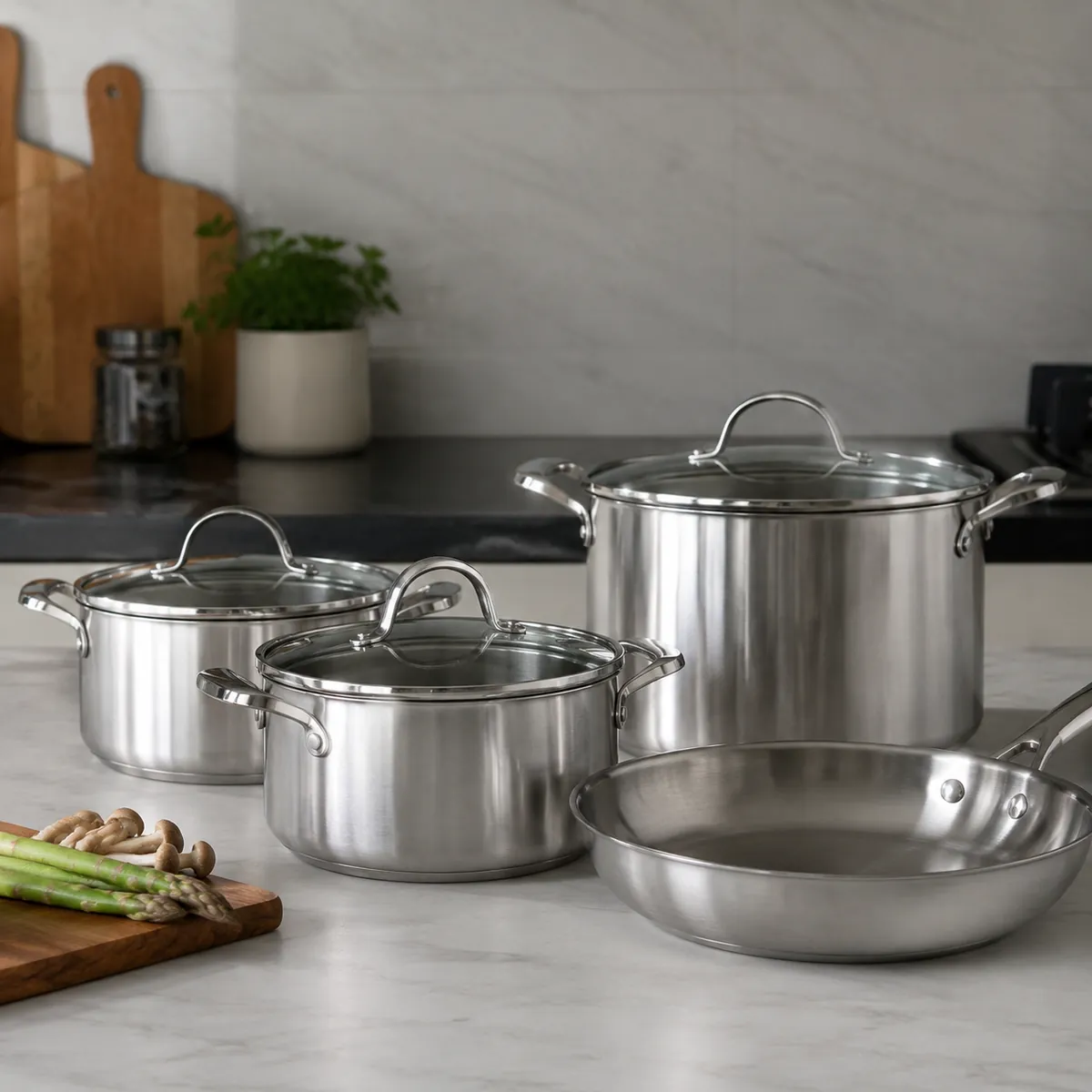
Typical MOQ ranges vary by category because the manufacturing economics differ. Stamped and coated aluminium cookware usually carries a mid-range MOQ driven by the coating line and the packaging; stainless steel cookware often has a higher MOQ because the deep-drawing and polishing setup is heavier; silicone products can have surprisingly low MOQs because the mold is the main fixed cost and the material is cheap; wooden products are set by the material batch and the finish line; and glass or ceramic products are driven by the firing batch, which can be large. These are general patterns, not fixed numbers — the actual MOQ for a specific item depends on the factory’s line and the item’s position in its catalogue. There is also a seasonal dimension: in the fourth quarter, when every cookware line in China runs at capacity for the holiday shipments, MOQs tend to be firm because the factory can fill the line with bigger buyers; in the quiet season, the same factory is more willing to run a small order as fill-in work. A buyer who can time the first order to the quiet season — and is honest about the schedule — often gets the most flexible MOQ of the year.
| Category | Typical MOQ driver | Buyer’s first question |
|---|---|---|
| Aluminium non-stick cookware | Coating line, packaging print | Is the coating already on the line? |
| Stainless steel cookware | Deep-drawing and polishing setup | What is the smallest diameter range? |
| Silicone products | Mold cost, low material cost | Can you share the mold ownership terms? |
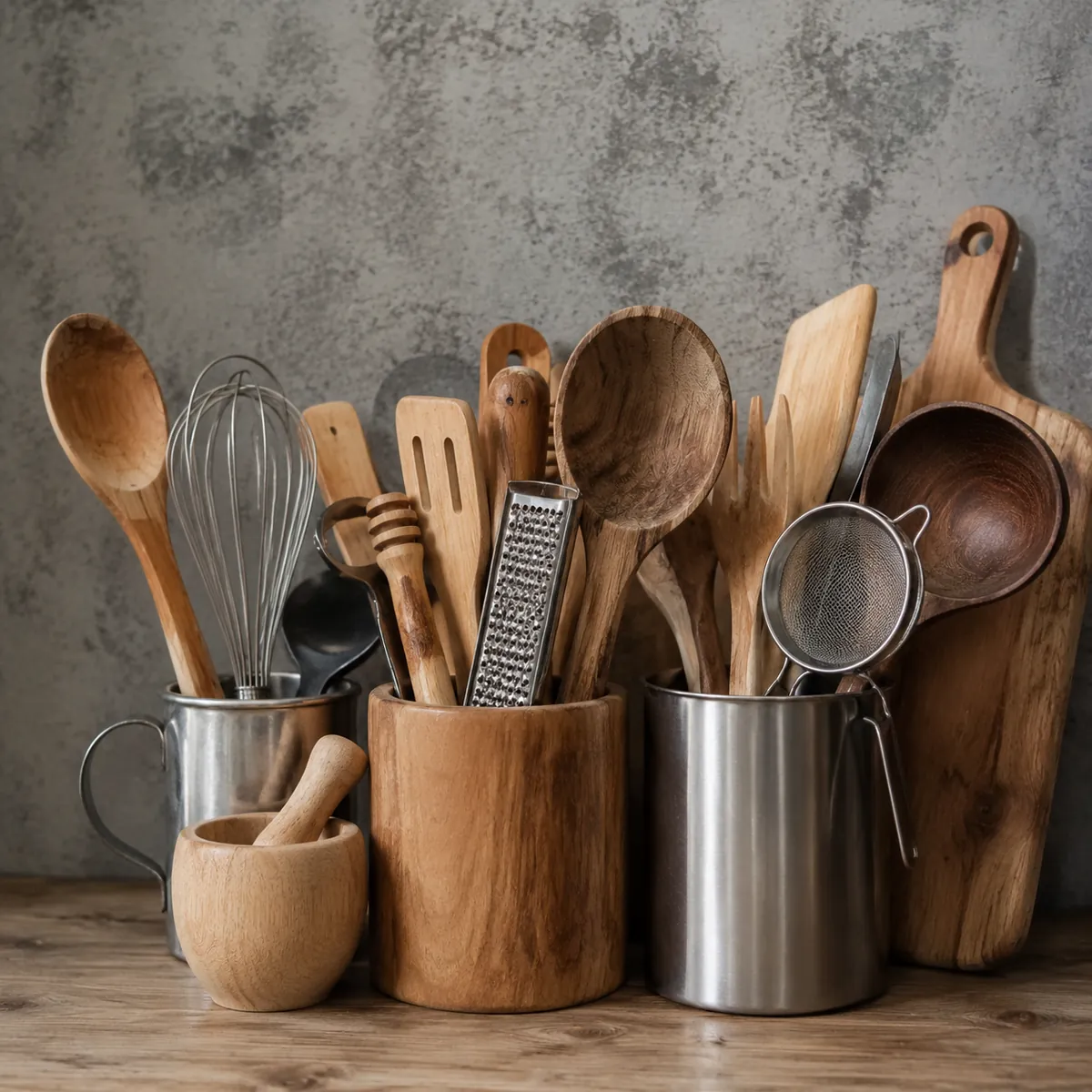
| Wooden products | Material batch, finish line | What moisture and finish specs apply? |
| Glass / ceramic | Firing batch size | What is the minimum firing quantity? |
Structuring the order to fit the MOQ
Once the MOQ is understood, the buyer’s job is to structure the order so it fits the economics instead of fighting them. The practical structures are: combine SKUs that share a setup into one run; split the first order into a small paid-sample stage and a production stage; use catalogue items with custom branding for year one; commit to a repeat quantity in exchange for a lower first MOQ; and consolidate seasonal needs so the factory runs one batch instead of three. Each structure trades a little flexibility for a better number, and the buyer who offers the factory a predictable production plan gets better terms than the buyer who asks for favours.
The written side matters too: the MOQ, the price at the agreed quantity, the setup or tooling costs, and the packaging minimums all belong in the purchase order. A supplier who verbally agrees to 500 pieces but ships the policy minimum of 3,000 has created a dispute; the purchase order with the MOQ and the price per quantity is the record that prevents it.
Quick FAQ: Can I get a lower MOQ if I pay more per piece?
Usually yes. The MOQ exists to cover fixed setup costs, and a higher per-piece price can recover the setup on a smaller order. Ask the supplier for the price at several quantities and find the point where the curve flattens. Never assume the stated MOQ is immovable — it is a price structure, not a wall.
MOQ and the first-order strategy for new importers
For an importer placing a first OEM order, the MOQ conversation is really a risk conversation: how much stock can you afford to be wrong about? The professional first-order strategy is to size the order so that a slow-selling product is a lesson, not a disaster. That usually means a small first order at a higher per-piece price, a focused SKU list (fewer SKUs, enough quantity per SKU to test the market), and a clear decision date — “if this sells by this date, we reorder at the better price”. The MOQ is part of that sizing: the buyer should know the minimum workable order, the price at that order, and the price at the next quantity level up, and then choose the smallest order that still tests the product fairly.
New importers also underestimate the value of the sample stage as an MOQ negotiation tool. A paid sample order — a few pieces per SKU at a fair sample price — tells the supplier you are serious and gives you the product evidence before you commit. Suppliers are far more willing to discuss a small first production order for a buyer who paid for samples than for a buyer who demands free samples and then asks for favours. The sample stage also produces the spec confirmation, the packaging test and the QC reference that make the production order run smoothly.
Common MOQ mistakes buyers make
The first common mistake is treating the stated MOQ as a fixed number and walking away from a good supplier over it. The MOQ is usually negotiable around the cost blocks, and a buyer who never asks for the price at several quantities never learns where the real number is. The second mistake is fighting the MOQ down on the wrong item: for a fully custom product with new tooling, the MOQ is genuinely high, and the better move is to change the item (catalogue base, custom finish) rather than to grind the price. The third mistake is ignoring the packaging MOQ, which is often the binding constraint and the easiest to reduce by staging the packaging. The fourth is ordering below the MOQ without agreeing the setup cost — the supplier will recover the setup somewhere, and the buyer who does not know where is paying for it invisibly. The fifth is committing to a repeat order the buyer cannot honour: the lower MOQ bought with a promised repeat quantity disappears when the repeat never comes, and the relationship is damaged for the next negotiation.
Each mistake is avoidable with the same habit: ask for the numbers, understand which cost block is binding, and put the agreed structure in writing. The MOQ is not a test of the buyer’s toughness; it is a number the buyer should understand well enough to negotiate on the right variable. When in doubt, ask the supplier to walk you through the calculation: most factories will happily explain the setup and material constraints, and the explanation is usually the roadmap to a better number.
What to put in the purchase order
The MOQ discussion only becomes real when it is written into the purchase order, and the PO is the document that protects both sides when the order runs into trouble. The PO should name, per SKU: the item description and the reference to the approved sample, the quantity and the agreed MOQ, the unit price at that quantity and the prices at the next quantity levels, the tooling or setup costs if any, the packaging spec (carton size, inner protection, label, pack quantity), the delivery terms (Incoterm, port, expected dates), and the payment terms. Add the QC plan by reference: the inspection standard, the sampling level and the party who conducts the inspection. And add the document list — the commercial invoice, packing list, material certificates, test reports and origin documents — so the buyer knows exactly what the supplier must deliver with the shipment.
A PO that covers these points does not guarantee a perfect order, but it removes the ambiguity that causes most disputes. The supplier knows what is being bought, the buyer knows what is being paid for, and when something changes — a quantity, a price, a date — the change is agreed in writing before it happens. The MOQ that was negotiated over email becomes the MOQ that is enforced in the PO, and that is the only version that counts.
Frequently Asked Questions
How is a kitchenware MOQ calculated? It is the quantity at which the fixed costs — setup, line capacity, material minimums and packaging — are spread acceptably over the order. The exact number depends on the factory’s line, the item’s position in its catalogue and the packaging. Ask for the price at several quantities to find the real MOQ.
Can I get a lower MOQ if I pay more per piece? Usually yes, because the MOQ exists to cover fixed setup costs. Ask the supplier for the price at several quantities and negotiate where the curve flattens. A small first order at a higher price is a normal way to prove a product.
Why is the MOQ for custom kitchenware so much higher than catalogue items? Custom items start from zero: new tooling, new setup, new packaging print and a new QC plan. Catalogue items are already set up and stocked. Start with catalogue items in custom colours or logos to keep the first MOQ low.
Does packaging affect the MOQ? Yes, often more than production. Printed boxes carry plate and run minimums; printed sleeves are cheaper; plain cartons with printed labels have the lowest minimums. Stage the packaging: label first, sleeve later, full print once the volume supports it.
What is the best way to negotiate a kitchenware MOQ? Ask which cost block is binding (setup, line capacity, materials or packaging), combine same-setup SKUs, offer a fill-in slot in a quiet season, keep the packaging standard, and commit to a repeat order. Put the agreed MOQ and prices in the purchase order.
Building the order around the economics
The OEM kitchenware MOQ stops being a barrier the moment you understand it as a price structure. Find which cost block is binding, use the catalogue-to-custom staging path, negotiate on the block that can move, and put the agreed numbers in writing. Every supplier’s MOQ is a snapshot of their line and their order book at a moment in time, so the number is worth revisiting as your volumes grow and your order structure improves. Our full product range shows the catalogue items that carry the lowest entry MOQs, and the kitchenware products range covers the everyday lines that suit first OEM programs. If you want help structuring a first order around the MOQ — which items to combine, which packaging stage to choose, what to ask the supplier — send your requirements through our contact page and we will confirm what we can support.