Kitchen storage sells because most kitchens run out of space before they run out of money, and the products that fix that problem — containers, canisters, racks, caddies and drawer organisers — are exactly the kind of shelf-ready line that retail buyers can build a year-round program on without heavy tooling investment. A shelf-ready kitchen storage product is one that arrives in a carton, moves to the shelf or hook with minimal handling, and carries its own retail story on the pack: the material is visible, the sizes are obvious, and the barcode works. This guide covers what wholesale buyers should check when building a kitchen storage line, from material selection and pack counts to shelf-ready packaging and the QC checks that keep a storage program profitable.
Why kitchen storage behaves differently from other kitchenware lines
Cookware and bakeware orders are about one hero product with a spec sheet. Kitchen storage is a range problem: a retailer rarely buys one SKU, they buy a family of sizes, materials and colours that have to work together on the shelf. That changes the sourcing conversation. A storage program needs a consistent design language across dozens of SKUs, a pack-count strategy that matches retail display units, and packaging that survives a warehouse without the lids popping off. Suppliers who are strong at single-product manufacturing are not automatically strong at range consistency, so the first question is not “what can you make” but “how do you keep 30 SKUs looking like one family”.
The second difference is seasonality with a twist. Kitchen storage has no holiday spike like cookware gift sets, but it has steady year-round demand with two predictable waves: spring cleaning and the back-to-school kitchen reset. That flat demand profile is an advantage for first-time importers because it leaves room for a small test order and a reorder cycle, without the freight-race pressure of a seasonal deadline.
| Program feature | Cookware line | Kitchen storage line |
|---|---|---|
| SKU count | 10–30 pieces | 30–80 SKUs typical |
| Hero product | One hero pan or set | Range consistency across sizes |
| Seasonality | Holiday spikes | Year-round with mild waves |
| Packaging role | Protection + gift story | Shelf-ready display + lid protection |
| Main damage risk | Scratched coating | Cracked lids, crushed cartons, missing parts |
Accept that kitchen storage is a range business and the rest of the decisions — materials, pack counts, packaging, QC — line up behind that one fact.
Material options: what each storage material is actually good at
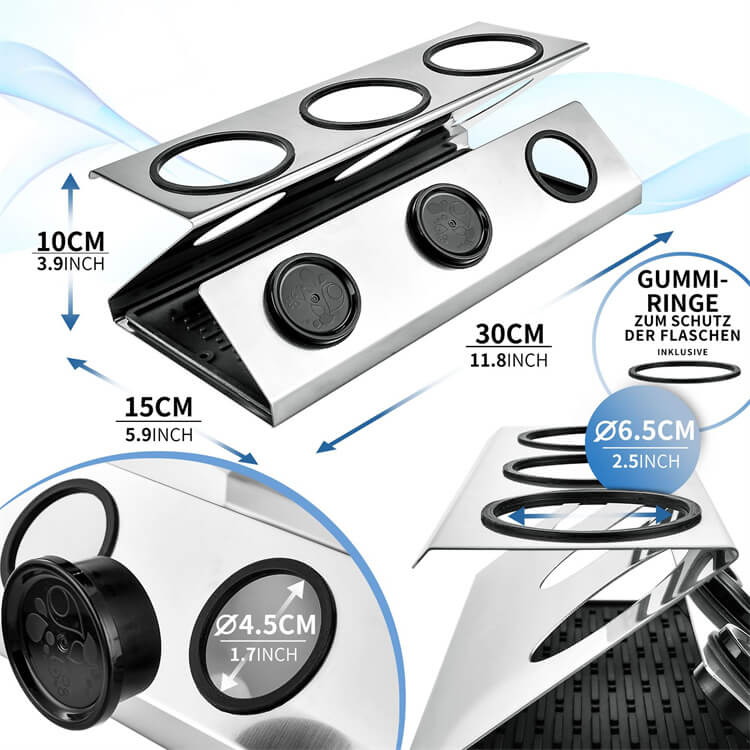
Storage buyers pick materials by retail position, not by preference. The main options are plastic (PP and PET), glass, bamboo and wood, stainless steel, and silicone. Each one carries a different cost, a different breakage risk in transit, and a different shelf message.
Plastic (PP / PET)
PP containers dominate the mid and entry price bands. They are light, cheap, stackable and the easiest material to keep consistent across a range. The buyer-side checks are the food-grade claim (PP for food contact is standard, but the certificate should name the material and the destination market), the lid seal, and the clarity or colour consistency between batches. PET is common for clear jars and dispensers; it is stronger than PP optically but more brittle in cold transit, so confirm the carton protection for PET lines.
Glass
Glass canisters and jars carry the premium shelf message. The two decisions that matter are the glass type (soda-lime for standard jars, borosilicate for oven and thermal-shock resistance) and the lid system (bamboo lid, PP lid with silicone gasket, or metal clip). Breakage in transit is the main cost risk, so the inner packaging spec — dividers, foam end-caps, flute strength — deserves the same detail as the product spec. Retailers in Europe and North America routinely ask for the same food-contact documentation for glass lids and gaskets as for the containers themselves.
Bamboo and wood
Bamboo and wood storage (lids, caddies, cutlery trays) is the natural-material story that sells well in the same aisle as bamboo utensils. The checks are moisture content for the wood, glue type for laminated parts, and the finish (food-safe oil or lacquer). Bamboo is the more predictable choice for export because it grows fast and the moisture behaviour is consistent; solid hardwood looks premium but moves more with humidity and needs a more careful spec. Always confirm the finish is food-contact safe for the destination market.
Stainless steel
Stainless steel storage pieces — canisters, racks, caddies — are the commercial-grade story for hotel and restaurant buyers and for the premium retail shelf. The material grade (usually 304, sometimes 201 for cost-down lines), the surface finish (brushed or mirror), and the rim treatment (rolled edge for safety) are the specs to write into the RFQ. Steel storage is heavier, which raises freight, but it also carries the highest retail price point per piece.
Silicone
Silicone appears in storage as collapsible containers, lids, and seal components. The food-grade question is the same as for bakeware: confirm the silicone certification and the temperature range in writing, and remember that pure silicone is expensive — a low price usually means a silicone blend or a filler, which changes the food-contact story.
| Material | Best retail position | Main spec to confirm | Main transit risk |
|---|---|---|---|
| PP plastic | Entry / mid price | Food-grade certificate, lid seal | Deformed lids in stacked cartons |
| PET clear | Mid price clear jars | Clarity, cold-temperature brittleness | Cracked jars in cold transit |
| Glass | Premium | Glass type, lid gasket spec | Breakage without inner protection |
| Bamboo / wood | Natural / eco story | Moisture content, glue, finish | Warping and cracking in humid containers |
| Stainless steel | Premium / commercial | Grade, finish, rolled edges | Scratches and dents, higher freight |
| Silicone | Collapsible / space-saving | Food-grade cert, filler content | Heat damage in container stacking |
Pack counts and range planning for shelf-ready kitchen storage
Shelf-ready does not mean “loose product on a peg”. It means the pack is designed for the retail operation: the unit that goes on the shelf is the unit the store can handle without re-packing. For kitchen storage, the pack-count decision is usually about three numbers: the pieces per retail pack, the packs per master carton, and the carton weight. A canister set of three is a stronger shelf story than three single canisters, but the set pack raises the carton weight and the display footprint. A caddy or a rack is usually sold single with a hang tag or a window box; containers are sold in sets of 3, 5 or 7 for the retail shelf.
The range plan should be built backwards from the display: how many hooks or shelf positions does the retailer allocate, and what pack counts fit those positions. A common mistake is importing a beautiful 40-SKU range and discovering that the retailer only wants 12 SKUs in two materials. Start with a tight range — one material, three to five sizes, one pack style — prove it, then expand. Suppliers price range expansion much more favourably once the first program is running, because the packing lines and the packaging blanks already exist.
Also plan the reorder logic before the first order. Storage lines have slow movers and fast movers within the same range, and the fast movers are rarely the ones you predict. A practical approach is to keep the slow-moving sizes in the range but order them in smaller multiples, and to negotiate a mixed-SKU container from the start — many storage suppliers will consolidate several SKUs in one container if the pack counts are standardised.
Quick FAQ: What pack counts work best for kitchen storage retail?
Sets of 3, 5 or 7 for containers, single units with hang tags for racks and caddies. Match the pack to the display position and keep the master carton weight under the retailer’s handling limit — usually around 15–20 kg for manual handling in most markets.
Shelf-ready packaging: the details that decide store acceptance
For kitchen storage, the packaging has two jobs: protect the product in transit and let the store put it on the shelf without extra labour. The packaging decisions, in order of importance, are the lid protection, the display unit, the label and barcode, and the carton strength.
Lid protection. Lids are the weakest part of a storage product. A PP container with a lid that pops off in the carton produces a shelf full of lidless containers and a stream of store complaints. Specify the lid fix in the pack — a tape tab, a shrink band or an inner tray that holds the lid in place — and check it at QC by opening random cartons after a drop test, not just at the packing station.
Display unit. Some storage products are designed to hang: caddies, rack components and tool organisers work on peg hooks, so the hang tag or the euro-slot needs to be in the retail spec. Others sit on the shelf, so the window box or the printed sleeve has to show the product clearly without opening. Ask the retailer for their display requirements (peg spacing, shelf depth, max carton size) before finalising the pack, because a product designed for a shelf cannot be switched to a peg without a packaging change.
Label and barcode. The EAN/UPC barcode position and size, the country-of-origin label and the care instructions must match the destination market. For kitchen storage, the care label matters more than it looks: “not dishwasher safe” on the wrong pack creates returns and store-level rejections. Send the retailer’s label requirements with the artwork and check a printed sample at approval.
Carton strength. Storage cartons carry a mix of weights, and a carton full of steel racks is much heavier than a carton of PP containers. Confirm the carton’s edge-crush specification against the actual packed weight, and run a stacked-container test for the warehouse leg — the bottom cartons in a high stack take the real abuse.
Building a shelf story around dish racks and drying mats
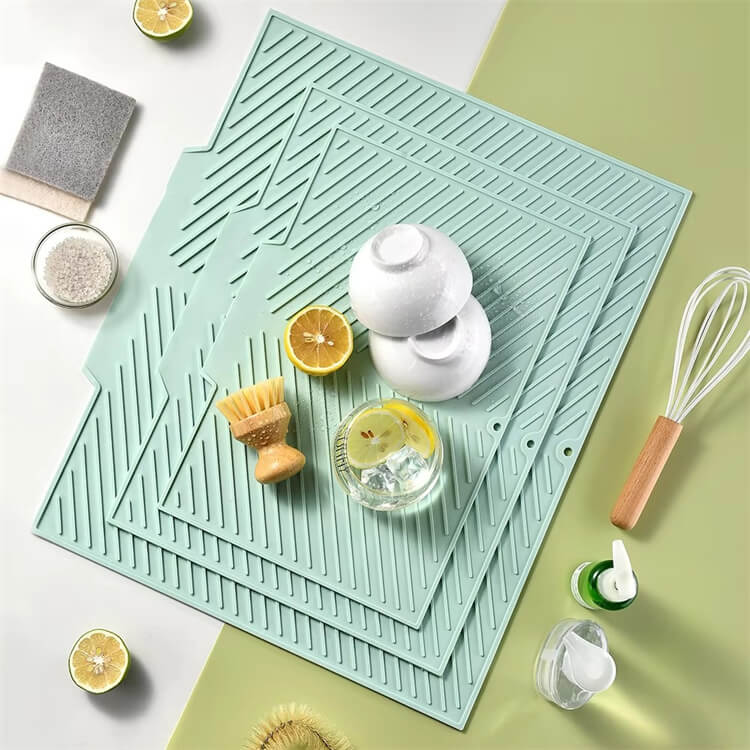
Within the kitchen storage category, the dish rack and drying mat family deserves its own plan because it behaves differently from containers. Dish racks are the visible storage product — stainless steel racks with drain trays, foldable racks, and the matching heat-resistant drying mats that sit under them. The retail story is about the sink area: the rack drains the dishes, the mat protects the counter, and the pair reads as one organised system. For wholesale buyers, that pairing is the opportunity: a rack and a mat sold together lift the average order value and give the supplier a range to quote instead of a single item.
The material decision for dish racks is usually stainless steel or coated steel, with the finish and the drain design as the differentiators. A triple-hole or bubble-water drain design (the holes that let water run off the rack surface) is a spec detail that changes the drying behaviour and the retail story, and the wire spacing has to fit the plates and glasses the buyer’s market actually uses. The checks are the same as for any steel product: the grade, the surface finish, the welded joints and the rust performance in a wet environment. A dish rack that rusts at the welds is a returned product and a dead retail SKU.
Drying mats are the lower-priced companion: heat-resistant silicone or rubber mats with a drain pattern, sold under the rack or as a standalone counter protector. The checks are the material’s heat resistance (a mat that melts under a hot pot is a safety complaint), the food-contact story if the mat touches food preparation surfaces, and the drain pattern’s effectiveness. The mat is also the easiest product in the storage range to private-label, because the surface print carries the brand without tooling cost.
For the range plan, the dish rack and mat family should be planned as one display block: two or three rack sizes, one or two mat sizes, one material story (stainless), and a set option for the sink-organised customer. The display story — “the organised sink” — is stronger than the individual product stories, and it gives the retailer a reason to give the block more shelf space.
MOQ, pricing and the first kitchen storage order
The MOQ for kitchen storage is usually driven by the packaging and the moulding run rather than by the product itself. A PP container has a mould cost that the supplier amortises over the first run; a printed sleeve or a window box has a plate cost; and the master carton has a minimum order from the carton factory. For a first order, the low-risk structure is a small test range in one material with standard packaging, a higher per-piece price, and a written commitment on the reorder quantity. Suppliers accept this pattern because storage is a repeat business — the range that works gets reordered every quarter.
Ask for the quote in three lines: product cost, packaging cost and tooling amortisation. If the supplier cannot separate them, the tooling is probably hidden in the piece price, which makes the first order look cheaper and every reorder more expensive than it should be. A clean three-line quote is also the basis for the landed-cost calculation, because the packaging weight and the tooling cost behave differently in the freight and the margin.
Two pricing traps hit storage buyers specifically. The first is the per-piece price on the hero size: suppliers know the most popular size drives the range, and they will quote it aggressively while padding the slow sizes. Check the whole range price, not just the hero. The second is the “free sample” that costs more than a paid one: a free sample with no carton, no label and no barcode tells you nothing about the shelf-ready pack you will actually receive. Order a production-style sample with the full retail pack and test it through your own handling.
QC checks for a kitchen storage program
Storage QC is mostly packaging QC, because the product failure modes are visible early if you look for them. The pre-shipment inspection should cover the material check (grade, colour consistency across the batch), the lid seal and fix (open random packed units), the dimensions (capacity markings and stack fit), the surface finish (no scratches, no rough edges on steel or glass), and the packaging checks: drop test on a fully packed master carton, barcode scan, label language and position, and the contents count against the packing list.
One storage-specific check deserves its own line: the stack test. Containers are displayed stacked, and a range that does not stack evenly looks broken on the shelf. Stack a full display unit at the factory and check the alignment, the lid fit and the stability. Also check the storage temperature claim if the range includes silicone or PET — a “freezer safe” claim needs the test report behind it, not just a sticker.
Quick FAQ: What are the most common kitchen storage QC failures?
Popped lids from missing lid fix, cracked PET jars in cold containers, warped bamboo lids from high moisture, scratched steel surfaces from poor inner packing, and barcode or label errors that get the whole batch rejected at the store. All of them are preventable with a drop test, a stack test and a label check at pre-shipment inspection.
Regional notes: how storage programs differ by market
The same storage range sells differently in different markets, and the differences are practical, not cultural. European buyers tend to lead with the food-contact documentation and the pack sustainability story — a storage line with a clear material story (bamboo, glass, recyclable PP) and the certificates to back it moves through retail buyers faster. US buyers tend to lead with the range breadth, the shelf-ready display and the retailer’s supplier documentation, and they expect the barcode and label work done before the artwork is sent. Central Asian importers tend to lead with the price and the container economics — a mixed-SKU storage container with a wide range and a good landed cost is the winning story there, and the packaging language and label requirements (Russian or the local language on the retail pack) need to be confirmed early.
None of this changes the product spec; it changes the pack, the document set and the conversation order. A supplier who has shipped storage to the destination market before usually knows the local requirements, so the shipping history is worth asking about in the first RFQ round.
Frequently Asked Questions
What is the difference between shelf-ready and standard kitchen storage packaging? Shelf-ready packaging is designed for the retail operation: the unit can be moved from carton to shelf or peg without re-packing, the label and barcode are retail-ready, and the carton strength matches the actual packed weight. Standard packaging protects the product but does not carry the retail story or the handling convenience.
Which kitchen storage materials are safest for a first import program? PP plastic is the lowest-risk starting material because it is light, cheap, easy to keep consistent across a range, and the food-contact documentation is straightforward. Add bamboo or glass in a second phase once the range logic and the QC routine are proven.
How many SKUs should a first kitchen storage range have? Twelve to twenty SKUs in one material is a practical first range. That is enough to fill a display and test the market, small enough to control the QC, and large enough to make the container economics work. Expand after the first reorder.
Do kitchen storage products need food-contact certificates? Yes, for anything that touches food — containers, canisters, jars, lids and gaskets. The standard depends on the destination market (FDA for the US, EU food-contact rules and LFGB documentation for European markets). Ask for the certificate before production and confirm it names the exact material and product.
What pack counts work best for kitchen storage? Sets of 3, 5 or 7 for containers, single units with hang tags for racks and caddies. Match the pack to the retailer’s display position and keep the master carton within the handling limit of the destination market.
Building the kitchen storage program with your supplier
A kitchen storage wholesale program works when the buyer treats the range, the pack and the QC as one system instead of three separate decisions. Choose one material and a tight range for the first order, spec the lid protection and the display unit in the pack, ask for a three-line quote that separates product, packaging and tooling, and put the drop test, the stack test and the label check into the inspection contract. The products themselves are simple; the range discipline is what separates a storage program that turns from one that collects dust. Our kitchenware products range includes the storage, organisation and kitchen-tool lines that fit a retail program, and the full product range covers cookware, bakeware and tableware for the rest of the kitchen aisle. If you want to review a storage range plan, pack counts and shelf-ready packaging specs before you commit, send the plan through our contact page and we will work through what can be supported. For retailers who want to pair kitchen storage with a drinkware line, the Frozl range covers insulated tumblers and bottles that fit the same shelf-ready display logic.