Stainless steel cookware is the line where buyers discover that the finish, the lid and the packing are as important as the steel grade. A stainless pot with the right grade and the wrong surface finish scratches in the first week; a pan with a beautiful body and a lid that does not seat properly steams instead of simmering; and a container of polished stainless that arrives scratched is a container of damage claims. This guide covers the finish grades, lid fit and export packing decisions that wholesale buyers should put into a stainless steel cookware program.
Steel grade: the baseline that everyone checks
The steel grade is the first spec, and it is the one buyers usually know. The common grades in stainless cookware are 304 (18/8 or 18/10 depending on the nickel content, the standard for food-contact quality), 316 (with molybdenum for extra corrosion resistance, common in marine and some premium lines), and 201 (a lower-nickel grade used for cost-down lines, with weaker corrosion performance). For cookware that will see acidic food and dishwasher cycles, 304 is the practical standard; 201 belongs in entry lines where the price point decides and the corrosion story is acceptable.
The grade matters less than the construction for cooking performance. A stainless pot is a sandwich: the stainless layers provide the surface and the corrosion resistance, and the aluminium or copper core provides the heat distribution. The construction options are the full cladded build (aluminium or copper core running up the side walls — tri-ply and five-ply constructions), the disc bottom (an aluminium disc bonded to the base only), and the bonded-bottom designs with different core thicknesses. The cladded build costs more and heats evenly up the walls; the disc bottom costs less and heats only from the base. For a wholesale program, the construction choice is a price-band decision, and the spec should name the construction and the core thickness in the RFQ.
| Construction | Heat behaviour | Cost position | Typical program |
|---|---|---|---|
| Disc bottom, thin core (2–2.5 mm) | Base-only heating, hot spots on large pans | Entry / mid | Value sets, promotional lines |
| Disc bottom, thick core (2.5–4 mm) | Better base response, less warping | Mid | Mid-price sets and singles |
| Full cladded tri-ply | Even heat up the walls, fast response | Premium | Premium sets, brand programs |
| Five-ply / copper core | Premium heat control | High premium | Chef lines, gift programs |
Write the construction, the core material and the core thickness into the spec. A “stainless steel pot” quote without those details is not comparable to another quote that names them.
Surface finish grades: brushed, mirror and the scratch story
The surface finish is the visible quality of a stainless pot, and it is a real cost and QC line. The main finishes are the brushed or satin finish (a fine directional texture from abrasive belts), the mirror or high-polish finish (a bright reflective surface from progressive polishing), and the combination finishes used on sets (brushed body with a mirror band or mirror interior).
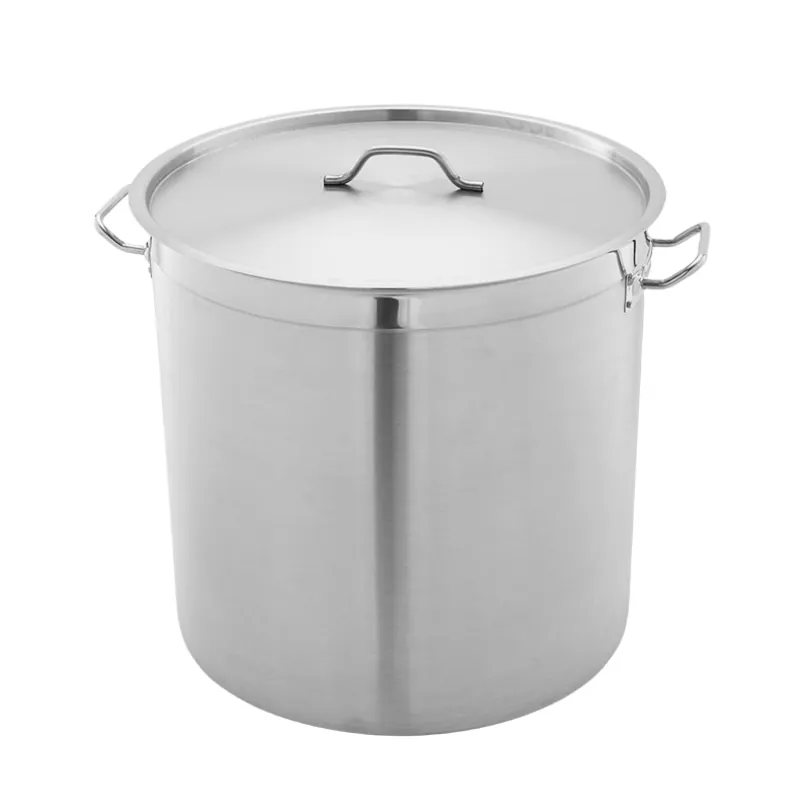
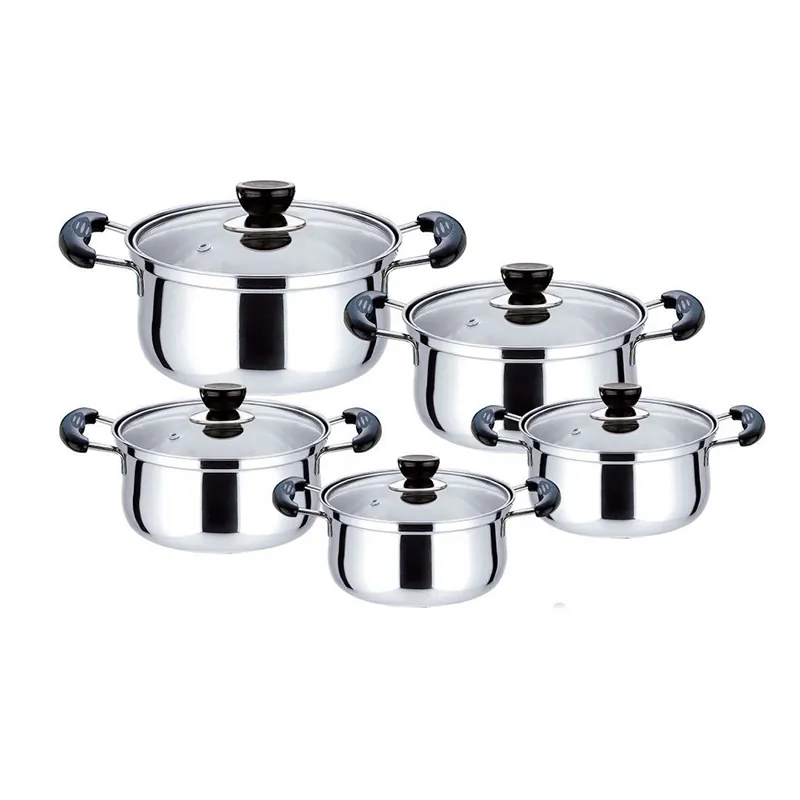
Brushed is the workhorse for retail stainless cookware: it hides fingerprints and small scratches, it is cheaper to produce, and it reads as practical quality. Mirror is the premium story: it photographs beautifully and carries the luxury message, but it shows every fingerprint and every scratch, which makes it a display finish more than a daily-use finish. The combination approach — brushed exterior, mirror interior — is common on mid and premium sets because the interior polish is part of the cooking story (easy cleaning, no food sticking to rough spots) while the exterior stays practical.
The finish check belongs in the QC list: a scratch that is invisible on brushed is a reject on mirror, and the packing environment has to match the finish claim. If the price point does not justify the extra polishing and packing care, specify brushed and say so in the retail story — a good brushed finish is honest quality, while a cheap mirror finish is a complaint waiting to happen.
Quick FAQ: Which surface finish should a stainless cookware set use?
Brushed for daily-use retail sets: it hides scratches, costs less and reads as practical quality. Mirror for premium display lines that justify the polishing time and the stricter QC. Combination finishes (brushed body, mirror interior) are common on mid and premium sets.
Lid fit: the spec that decides the cooking story
The lid is where stainless cookware programs quietly fail. A lid that does not seat properly lets steam escape, changes the cooking behaviour and produces the “this pot does not simmer” complaints that no marketing can fix. The lid spec has four parts: the material (glass lid with a stainless rim, or full stainless), the rim seal (a rolled stainless edge or a silicone gasket for a tighter seal), the fit tolerance (the gap between lid and pot rim), and the handle and vent design.
Glass lids are the retail standard because they show the cooking and they photograph well, but the rim and the gasket are the quality points: a glass lid with a thin stainless rim and no gasket rattles and steams; a lid with a proper rolled rim and a silicone gasket seats quietly and seals. Full stainless lids are the commercial choice — they survive abuse and high heat, but they hide the cooking and add weight.
The fit check is simple and should be in the QC list: place the lid on the pot, check the gap is even around the rim, check the lid does not rock, and check the handle alignment. Also check the lid knob heat performance — a metal knob on a glass lid gets hot, and the knob spec has to match the retail story and the safety expectations.
Export packing decisions for stainless cookware
Stainless cookware is heavy and scratch-sensitive, and the export packing has to solve both problems. The packing decisions, in order of importance, are the surface protection, the inner box, the master carton and the label.
Surface protection. The polished and brushed surfaces need a separating layer between stacked pieces — a paper liner, a PE foam sheet or a protective film for mirror finishes. Scratched interiors from pans rubbing in the carton are the most common damage claim on stainless sets, and every claim is a packaging failure, not a steel failure. Specify the separating material by name in the purchase order and check it at QC by opening random cartons.
Inner box. A stainless set usually ships in an inner box with fitted trays or foam end-caps that hold each piece in place. The inner box design should be approved on a production-style sample, because a set that shifts inside the box scratches itself in transit.
Master carton. The carton strength has to match the packed weight — a carton of stainless pots is much heavier than a carton of aluminium non-stick pans. Confirm the edge-crush spec against the actual weight and run a stacked-container test. The bottom cartons in a warehouse stack take the real abuse.
Label and retail story. The label carries the material grade, the care instructions and the barcode, and it has to match the destination market. “Dishwasher safe” on the label needs the test behind it, and the care instructions for stainless (no metal scourers on brushed surfaces, proper drying to avoid water spots) should be printed where the customer will read them.
Induction compatibility and the base spec
Stainless cookware is induction-ready by construction when the base has a magnetic stainless layer, which is why the induction claim is usually automatic for stainless — but the performance still depends on the base thickness and the core distribution. The same induction checklist applies as for any cookware: confirm the base construction and thickness, check the recommended burner size against the pan diameter, and test the heat response on the production sample. A stainless pot with a thin disc base will heat unevenly on induction even though it is technically “compatible”.
QC checklist for a stainless cookware order
The pre-shipment inspection for stainless cookware should cover the grade verification (material certificate against the product), the construction check (core thickness on a cut or by the manufacturer’s process record), the finish check (brushed direction consistency, mirror clarity, no scratches), the lid fit check (seating, gap, handle alignment), the induction test if claimed, the handle and rivet check, and the packing checks (surface protection present, inner box fit, carton strength, label and barcode correct).
| QC check | Method | Pass criterion |
|---|---|---|
| Steel grade | Material certificate vs product | 304 / 316 / 201 as specified |
| Core thickness | Process record or cut sample | Matches the RFQ construction |
| Surface finish | Visual under standard light | No scratches, consistent brushed direction |
| Lid fit | Placement and gap check | Even gap, no rock, aligned handle |
| Induction response | Heat test on induction plate | Even heat within the test protocol |
| Handles / rivets | Visual + torque check | Secure, no wobble, correct spec |
| Packing | Open random cartons | Surface protection present, box fit, label correct |
Add a water-spot and staining check on the brushed surfaces: a poor passivation or a wrong finish can produce water spots that look like damage to the end customer.
Quick FAQ: What are the most common stainless cookware QC failures?
Scratched surfaces from missing separating layers, lid fit problems that produce the “does not simmer” complaints, downgraded core thickness on large pots, and water-spot staining on brushed finishes. All four are preventable with the checklist above.
Set composition and range planning
Stainless cookware sells as sets more than as singles, and the set composition is a pricing decision like any cookware set: the classic structures are 3-piece, 5-piece, 7-piece and 10-piece sets, with the piece count matched to the price band and the display. For wholesale programs, the set composition should also consider the lid count (a pot without a lid in a set is a specification decision, not an accident), the induction story across the set, and the stackability of the pieces for display and transit.
Range planning for stainless follows the same logic as any cookware line: one construction and one finish family per range, a tight SKU count for the first order, and the reorder logic built before the first container. The stainless range that works is the one where the buyer can predict the fast movers and keep the slow movers in smaller multiples.
Compliance notes for stainless cookware
Stainless cookware carries the standard food-contact documentation for the destination market — FDA-related considerations for the US, EU food-contact rules and LFGB documentation for European markets, and local requirements elsewhere. The material certificate is the core document, and the coating or surface treatment documentation matters if the product has a release treatment. Confirm the document set with the retailer and the importer of record before production, and keep the claims conservative: a “dishwasher safe” claim needs the test, and a “no PFAS” claim needs the coating documentation behind it.
Care instructions and the retail story for stainless cookware
Stainless cookware has a higher misuse rate than most kitchenware because the care requirements are counterintuitive: the same surface that looks indestructible needs careful cleaning to keep its looks. The care story belongs in the retail pack and in the product design. The instructions that matter are the cleaning rule (no metal scourers on brushed surfaces), the drying rule (wipe dry to avoid water spots), the heat rule (preheat with oil or food in the pan to avoid sticking), and the dishwasher rule, which depends on the finish and the handle spec.
The retail story should use the care rules as features, not warnings. “Easy to clean, wipes dry without water spots” is a feature sentence that carries the brushing and drying instructions; “dishwasher safe” is a claim that needs the test behind it. The pack should also carry the material story — the grade, the construction and the induction claim — because stainless cookware is bought on specification confidence as much as on looks. A buyer who understands what they are buying is a buyer who does not return it.
For the range design, the care story should match the finish choice. A brushed finish with a simple care message fits the everyday retail position; a mirror finish with a “hand wash recommended” message fits the premium position, and the pack should say so before the customer discovers it the hard way.
Common stainless cookware wholesale mistakes
The mistakes that cost wholesale buyers on stainless cookware are consistent. The first is comparing quotes on the grade alone and ignoring the construction: two “304” pots with different core thicknesses are different products with different prices. The second is choosing the finish for the photograph instead of the use case, then paying for the mirror-polish QC and the returns. The third is skipping the lid fit check, which produces the simmering complaints that no marketing fixes. The fourth is under-specifying the packing, which produces scratched surfaces and damage claims that the factory blames on transit. The fifth is printing care and dishwasher claims without the tests behind them, which turns a small omission into a liability. Every one of these mistakes has a cheap fix in the RFQ and the QC checklist.
Mix-and-match set programs and open stock
Stainless cookware can be sold as fixed sets, as open stock, or as a mix-and-match program where the customer builds a set from individual pieces. The fixed set is the simplest to source and pack, but it carries the dead-SKU risk: the pieces that do not sell in the set sell nowhere. Open stock spreads the risk but changes the packaging story — every piece needs its own retail pack and its own barcode, which raises the packaging cost. The mix-and-match program combines both: the retail display shows the individual pieces with their prices, and the set pricing rewards the customer for buying several pieces together. It is the strongest retail story for stainless because the customer sees the value of the set and the flexibility of the pieces, but it is the hardest to source because every piece must work as both a single SKU and a set component.
For wholesale buyers, the mix-and-match decision is really a packaging decision. The individual retail packs have to carry the barcodes, the care story and the induction claim, and the set bundle has to work with the same packs — which usually means an outer sleeve or a bundle label instead of a dedicated set box. Confirm the display requirement with the retailer before committing to the format, because a mix-and-match program designed without the display is just a pile of loose pieces with set pricing.
Regional notes for stainless cookware buyers
Stainless cookware buyers in different markets weight the same specs differently. European buyers tend to lead with the food-contact documentation, the material certificate and the construction story, because the retailer requirements are strict and the claims are checked. US buyers tend to lead with the induction story, the PFAS question on any coated line and the retailer’s supplier documentation, and they expect the material and care claims to be documented before they are printed. Central Asian importers tend to lead with the price and the container economics, and they buy the set program more than the single SKU — the mixed set container is the common order shape there, with the label language and the care instructions confirmed for the local market.
The market also changes the pack. European retail expects the care and material story in the local language on the pack; US retail expects the barcode and the retailer’s label format; Central Asian importers need the label language and the packaging size to fit the local shelf and the customs documentation. Confirm the market requirements in the first RFQ round, because the pack is part of the product, and a stainless pot with the wrong label language is not sellable no matter how good the steel is.
Frequently Asked Questions
What is the best steel grade for stainless cookware? 304 is the practical standard for food-contact quality and corrosion resistance. 316 adds molybdenum for extra corrosion resistance in premium lines, and 201 is the cost-down option for entry lines where the corrosion story is acceptable.
What is the difference between cladded and disc-bottom stainless cookware? Cladded construction has an aluminium or copper core running up the side walls for even heat, while disc-bottom construction has a bonded base disc only. Cladded costs more and heats evenly; disc-bottom costs less and heats from the base.
Which surface finish should I choose for stainless cookware? Brushed for daily-use retail sets, mirror for premium display lines, and combination finishes (brushed body, mirror interior) for mid and premium sets. The finish is a cost line and a QC line, not just a look.
Why does lid fit matter in stainless cookware? A lid that does not seat properly lets steam escape and changes the cooking behaviour, producing the “does not simmer” complaints. Check the seating, the gap and the handle alignment at QC.
What packing protects stainless cookware in export? A separating layer between stacked pieces, a fitted inner box with trays or foam end-caps, a carton with edge-crush strength matched to the packed weight, and a label with the care instructions and barcode for the destination market.
Building the stainless cookware program with your supplier
A stainless steel cookware wholesale program works when the buyer specs the invisible parts: the construction and core thickness, the finish grade, the lid fit tolerance, and the packing that keeps polished steel polished. Confirm the grade and construction in the RFQ, choose the finish by price point, put the lid fit and the surface-protection checks into the inspection contract, and approve the production-style packed sample before the first run. Our stainless steel products range covers cookware, mixing bowls and kitchen tools, and the cookware products range shows the broader set program. If you are planning a stainless line and want to review construction, finish and packing specs before you commit, send your product list through our contact page and we will work through what can be supported.