A wooden chopping board OEM program for foodservice starts with the same three questions every commercial kitchen buyer asks: what sizes and thicknesses, what finish survives repeated sanitation, and what documentation proves the board is food-safe. Wooden boards are a legitimate choice in professional kitchens, but they follow different rules than retail boards — thicker blanks, more demanding finish systems, and care instructions that become part of the specification. This guide covers the OEM decisions for foodservice buyers, from wood selection and dimensions to finish, sanitation, and the documentation your buyer will request.
Why Foodservice Wooden Boards Are a Different Product
A retail cutting board needs to look good on a shelf and survive home use. A foodservice board needs to survive eight hours of prep, repeated washing, knife wear, and the occasional sanitation cycle — and it needs to do that without warping, cracking, or harboring bacteria. The engineering is different: thicker blanks, edge-grain or end-grain construction instead of thin flat-grain, and finish systems designed for commercial cleaning.
For an OEM buyer, this changes the spec sheet. You are not choosing a board; you are choosing a construction method, a wood moisture story, and a finish that matches the buyer’s sanitation routine. If you cannot explain those three, the commercial buyer will move to a supplier who can.
Foodservice is also a documentation-heavy market. Institutional buyers, catering groups, and restaurant chains often require food-contact material declarations, finish safety data, and sometimes test reports. The OEM program should treat the documentation as part of the product, not as an add-on.
Wood Selection for Commercial Use
The woods most common in foodservice boards are hard maple, beech, walnut, and bamboo (though bamboo is technically a grass, it is used in the same category). Hard maple is the classic professional choice: dense, light-colored, low-porosity, and gentle on knife edges. Beech is common in European production and slightly more affordable. Walnut is chosen for dark color and aesthetics, especially in front-of-house or display cutting.
What matters more than the species is the grade and the drying story. Boards made from properly kiln-dried wood with a controlled moisture content — usually in the 6 to 10 percent range for interior products — are far less likely to warp or crack in a commercial kitchen. Confirm the moisture content range with the factory and ask how they control it through the production process.
| Wood | Typical use | Notes for foodservice |
|---|---|---|
| Hard maple | Professional prep boards | Dense, knife-friendly, classic choice |
| Beech | European production boards | Slightly lower cost, good durability |
| Walnut | Display and service boards | Dark color, premium presentation |
| Bamboo | Value and eco lines | Hard, but may dull knives faster; confirm construction |
Construction: Edge-Grain vs End-Grain
Commercial boards come in three constructions: flat-grain (single piece or glued strips), edge-grain (strips glued on edge), and end-grain (blocks glued with the end surface up). End-grain is the professional favorite because it is self-healing — knife cuts close back up — and it is the most durable, but it is also the most expensive and the heaviest. Edge-grain is a strong middle option: durable, more affordable than end-grain, and easier to keep flat.
For an OEM program, the construction decision drives the price and the care story. If your buyer’s kitchen does heavy chopping, end-grain justifies a higher price point. If the use is prep and service rather than heavy butchery, edge-grain gives most of the durability at a better cost. Flat-grain boards are usually a retail product and a poor fit for foodservice.
Dimensions, Thickness and Edge Profiles
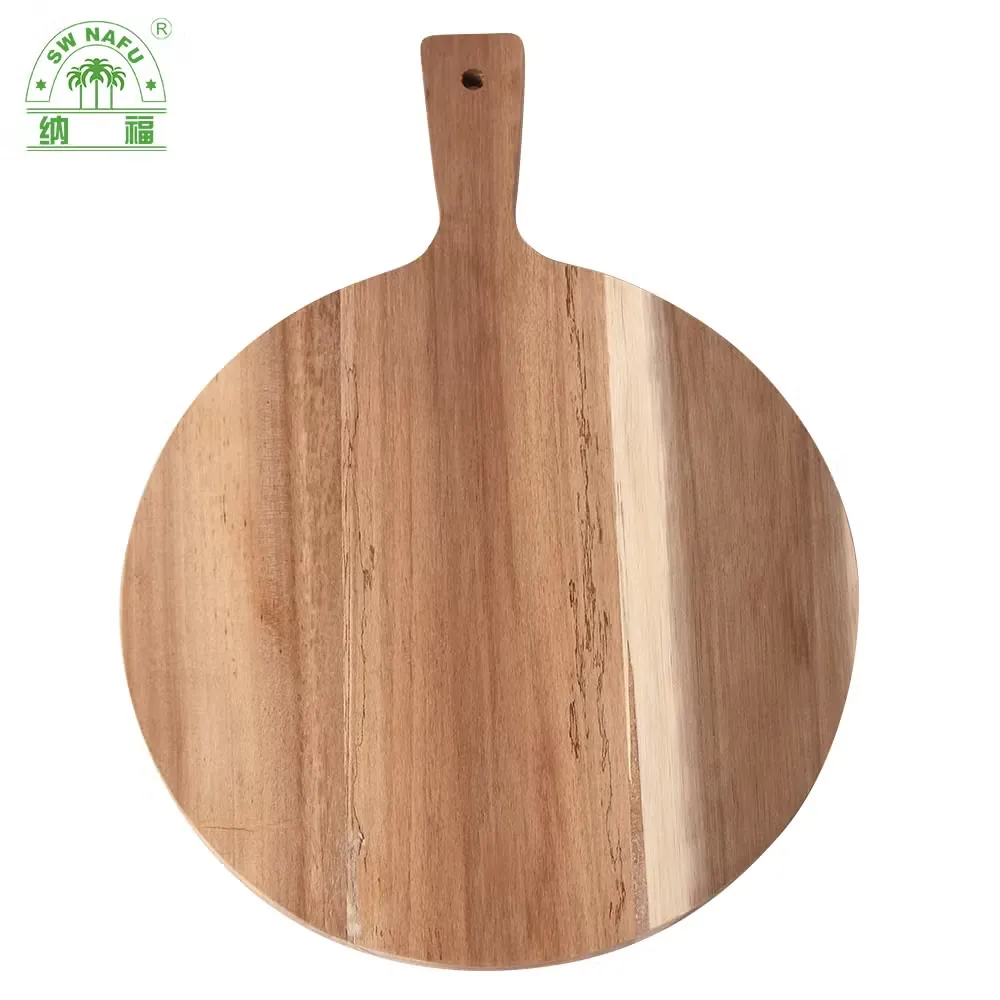
Foodservice boards are ordered in commercial sizes: typically 40–60 cm length, 25–40 cm width, and 2.5–4 cm thickness for prep boards, with larger sizes for butcher blocks. The thickness is the durability story — a 4 cm end-grain board will outlast a 2.5 cm board by a wide margin under commercial use.
Edge profiles matter for handling: beveled or routed handles (finger grips) make heavy boards easy to lift, while juice grooves are more of a retail feature unless the board is used for carving or service. Confirm the handle and edge design with the buyer; a board without handles is a liability in a busy kitchen.
For OEM, the dimensions and edge profile should be written into the spec with tolerances — for example, length ±5 mm, thickness ±1 mm — so the batch matches the approved sample. Commercial buyers notice dimensional drift because boards must fit their workstations and dish racks.
Finish Systems and Sanitation
The finish is where foodservice wood boards succeed or fail. Options range from food-safe mineral oil, oil-and-wax blends, and food-safe lacquers. Each has a sanitation story: oiled boards need periodic re-oiling and are the traditional professional choice; lacquered boards resist moisture better but can chip and need different care. Confirm the finish system’s food-contact compliance and its expected maintenance cycle with the supplier.
Sanitation in a commercial kitchen usually means washing with hot water and detergent, and some operations use dilute bleach or commercial sanitizers. The finish documentation should state what the board tolerates. This is also where the care sheet becomes part of the OEM deliverable: the buyer needs written care instructions for the staff, and the care sheet protects you from claims caused by misuse.
Our guide on wooden chopping board OEM finishes goes deeper into moisture content, glue types, and finish choices that affect food safety.
Food-Safety Documentation for Foodservice Buyers
Commercial buyers will ask for documents before they commit: a food-contact material declaration for the wood and finish, possibly a test report depending on the market, and details on the glue used in glued boards (the glue must be food-safe and moisture-resistant). Prepare these at the sample stage, not after the order.
For the finish, ask the supplier for the product name and its food-contact status. For the glue, confirm it is food-safe and rated for the temperature and moisture conditions of a commercial kitchen. For the wood itself, the key document is the moisture content record and, where relevant, the origin/species declaration.
Documentation expectations vary by market and buyer type. A restaurant chain may accept a declaration; an institutional or government buyer may require test reports. Confirm the requirement with your buyer and ask the factory whether the matching documents are available for your target market.
Do foodservice buyers prefer oiled or lacquered boards?
Preferences vary, but traditional professional practice favors oiled (mineral oil or oil-and-wax) boards because they are easy to maintain and re-apply, and because the wood surface remains natural. Lacquered boards appeal to buyers who want lower maintenance, but the buyer should understand the care difference before choosing.
How often does a commercial board need re-oiling?
Under daily professional use, an oiled board typically needs re-oiling every few weeks, depending on washing frequency and detergent strength. The care sheet should give a realistic schedule, because the finish warranty story depends on maintenance.
The Ordering Process for a Foodservice Board Program
A foodservice board OEM program follows a defined order pipeline, and each stage has its own documentation. The pipeline starts with the specification sheet: product type, dimensions, thickness, wood species, construction, edge profile, finish, branding (if any), and the quantity per size. The factory confirms feasibility and lead time against the spec, then produces samples — usually one sample per size or finish option — for your approval.
The sample approval stage is where the foodservice program is won or lost. Check the sample against the written spec: measure the dimensions, feel the edge profile, confirm the finish is even, and verify the weight. Ask the factory for the moisture content record of the sample batch, because moisture control is the difference between boards that stay flat and boards that warp in a commercial kitchen. Approve the sample in writing, with photos and measurements attached, so the production batch has an unambiguous reference.
After approval, production runs, and the pre-shipment inspection should verify the batch against the approved sample: dimensions within tolerance, finish consistency, no cracks or glue-line failures, and packaging that protects the boards in transit. For a foodservice buyer, the packaging is also part of the spec — boards should arrive clean and ready for the kitchen, not covered in sawdust or damaged by rough handling.
MOQ, Lead Times and Pricing for Wooden Boards
Wooden board MOQs vary with the construction and the customization. Standard flat or edge-grain boards can often be ordered in smaller quantities, while end-grain boards and custom shapes require higher minimums because of the cutting and glueing setup. Custom branding — laser engraving or hot-stamping a logo — adds a setup step and usually a modest MOQ increase. Confirm the numbers for your exact configuration, because the range across products is wide.
Lead times for wooden boards typically run 45 to 75 days for standard items, with custom shapes and finishes adding time for tooling or finishing development. The drying stage is the wildcard: wood must reach the target moisture content before cutting and glueing, and rushing that stage produces boards that fail in the field. A supplier that quotes a suspiciously fast lead time for wooden boards may be skipping the moisture control that matters.
Pricing is driven by wood grade, construction, thickness, finish, and quantity. End-grain costs more than edge-grain, thicker costs more than thinner, and a premium finish costs more than a basic oil coat. For foodservice programs, the price conversation should include the documentation package — if your buyer requires test reports, that cost belongs in the quote, not in a surprise later.
Care Sheets and Warranty Terms
The care sheet is a deliverable in a foodservice program, not a marketing extra. It should state, in plain language: how to wash the board (hot water and detergent, no prolonged soaking), how to sanitize if required by the operation, when to re-oil and with what product, how to store the board (upright or flat, dry location), and the signs of wear that mean replacement. The care sheet protects the board’s lifespan and protects you from claims caused by misuse.
Warranty terms for wooden boards are usually limited, because wood is a natural material and its lifespan depends on care. The honest warranty conversation covers: what is covered (manufacturing defects such as cracks, glue-line failures, and finish defects), what is not covered (damage from misuse, dishwasher exposure if the board is not dishwasher-safe, or normal wear), and the claim window. Commercial buyers appreciate a clear warranty because it makes their purchasing decision easier.
Some foodservice programs also include a replacement part strategy: the buyer keeps a small spare stock of the most-used sizes, so a damaged board does not stop a prep station. If your program can supply a fast reorder lane for core sizes, that is a selling point that the paperwork alone cannot match.
How long does a wooden chopping board last in foodservice use?
With proper care, a well-made commercial board lasts for years; heavy-use kitchens may replace boards every 12 to 24 months depending on the operation and the care routine. The maintenance schedule in the care sheet has a direct effect on lifespan, which is why the care documentation is part of the product.
Sustainability and Sourcing Certifications for Wooden Boards
Foodservice buyers increasingly ask about the sustainability story behind wooden boards: where the wood comes from, whether the source is certified, and what the factory does with offcuts. The sourcing conversation should cover the species’ availability, the certification options (such as FSC-type chain-of-custody where applicable), and the factory’s waste handling. You do not need every certification for every order, but you should know what is available because buyers will ask.
Wood is a natural material, and its documentation differs from metal or plastic products. The key documents are the species and origin declaration, the moisture content record, and the finish’s food-contact status. If a buyer requires a formal certification, ask the factory early whether the documentation can be produced for your product — some certifications apply to the raw material, and the chain-of-custody paperwork takes time to assemble.
The sustainability angle also influences product design: boards made from efficient cutting patterns, with offcuts turned into smaller boards or serving boards, carry a better story and often a better cost. A factory that can explain its yield and waste approach is usually a factory that runs its wood program professionally.
Working With a Foodservice Distributor
Many foodservice board programs flow through distributors rather than directly to end kitchens, and the OEM relationship changes accordingly. The distributor buys on behalf of multiple operators, so the program needs a defined range, stable lead times, and a reorder rhythm the distributor can rely on. The specification work — sizes, thicknesses, finish, documentation — is done once, then the distributor reorders against a standing program.
For the OEM buyer working with a distributor, the key deliverables are the product spec sheet, the care sheet, the documentation package, and a reliable reorder lane. Distributors also expect consistent quality across batches, because their customers reorder the same SKU repeatedly. The QC plan for the program should include batch-to-batch consistency checks: color matching on finish, dimension tolerances, and packaging that stays identical across runs.
Pricing for distributor programs is usually structured with volume tiers and a reorder schedule. Confirm the tier pricing and the reorder MOQ in writing, because the distributor’s margin model depends on predictable costs. A program that locks the spec, the documentation, and the pricing is easier for a distributor to sell than a series of one-off quotes.
Should foodservice boards be branded or unbranded?
It depends on the channel. Unbranded boards are common for distributor programs and generic foodservice supply, while branded boards suit operations that want their own identity or retail-adjacent channels. Branding — laser engraving or stamping — adds a setup cost and usually a small MOQ increase, so confirm the trade-off before committing.
Storage and Handling in the Supply Chain
Wooden boards need care between the factory and the kitchen, and the supply chain handling is part of the OEM spec. The risks in transit are moisture (boards stored in damp containers or warehouses absorb water and warp), impact (heavy boards dropped or stacked badly crack and dent), and temperature swings that stress the wood and finish. The packaging spec should protect against all three: moisture-barrier wrapping or well-sealed cartons, edge protection for the board corners, and stacking guidance that keeps heavy boards on the bottom.
Storage instructions belong in the delivery documentation. Boards should be stored in a dry, ventilated area, off the floor, and not under heavy loads. The care sheet can include the storage rules as well as the kitchen care rules, because the damage that appears in the first weeks of use is often storage damage from the journey, not a manufacturing defect.
For large programs, consider the warehouse receiving routine in the spec: check the boards on arrival for warping or damage before the batch is accepted, and photograph any issues immediately. The same discipline that protects your claim position on cookware applies to wooden boards — the evidence is the photos, the packing records, and the moisture documentation.
Frequently Asked Questions
What is the best wood for foodservice chopping boards?
Hard maple is the traditional professional choice for its density and knife-friendliness. Beech is a common European alternative, walnut suits display and service, and bamboo works for value lines. Match the wood to the buyer’s use and budget.
What thickness should a commercial cutting board be?
Prep boards are commonly 2.5 to 4 cm thick, with heavier butcher-block boards going thicker. Thicker boards last longer under commercial use and justify a higher price, especially in end-grain construction.
Are wooden boards safe for commercial kitchens?
Yes, when properly made, finished, and maintained. The safety story is construction, moisture control, food-safe finish, and documented care instructions — which is why the documentation matters as much as the board itself.
What documentation do I need for a wooden board OEM foodservice order?
Expect to provide a food-contact material declaration for wood, glue, and finish, moisture content records, and, depending on the buyer and market, test reports. Collect these at the sample stage.
Final Recommendation
Specify a wooden chopping board for foodservice like an engineer, not a merchant: choose the construction for the use, write the dimensions and tolerances, select a finish that matches the buyer’s sanitation routine, and assemble the documentation before the order. The commercial buyer is buying durability and compliance, and the OEM program that delivers both wins the contract.
If you are sourcing wooden boards for restaurants, catering, or institutional kitchens, we can build the program around your sizes, finish, and documentation needs. For the full service-and-prep picture, commercial buyers also plan the furniture side of their operation — a restaurant furniture buying guide from FurnitureOrigin covers tables and seating for the same projects. Start your board order through our contact page or review the kitchenware product range.