Selling kitchenware to supermarket chains is a different business from selling to online stores or independent shops, and the difference starts before the first quote. Supermarket buyers think in planograms, shelf-ready packaging, and replenishment cycles, not in individual products. If you are approaching kitchenware wholesale for supermarket chains, your assortment has to be organized as a program: a defined set of SKUs, retail-ready packaging, agreed compliance documents, and a reorder rhythm that the store’s category manager can understand and defend to their own buyers.
What a Supermarket Kitchenware Program Looks Like
A supermarket kitchenware program is usually organized by category: cookware, bakeware, food storage, kitchen tools, and tableware. Each category gets a planogram position, a set of SKUs that fit the shelf, and a reorder trigger. The buyer is not buying one pan; they are buying a pan set, a fry pan line, a bakeware assortment, or a kitchen tools reset. Your job as a wholesaler is to make that decision easy by presenting the category as a finished plan rather than a list of products.
The size of the program varies. A regional chain might test with 20 to 40 SKUs; a national chain often plans 100 or more per category, rolled out by region. The initial order for a tested SKU may be a few hundred units, but the reorder volume is where the program becomes attractive, because supermarket channels reorder on a predictable schedule, usually every 4 to 12 weeks depending on the category and the chain.
That predictability is the core value of supermarket business: you trade the high margins of one-off sales for a reorder rhythm you can plan production around. For a factory or a wholesaler, a committed supermarket program is worth more than a stack of one-time orders, because it fills production slots in the off-season.

Assortment Planning for Supermarket Buyers
Supermarket assortment is driven by the shelf, not by your catalog. Before you propose SKUs, find out the chain’s planogram structure: how many facings the kitchenware category gets, what price points the chain targets, and which competitors already occupy the shelf. Your assortment should fill gaps, not duplicate what is already there.
Practical assortment rules for supermarkets:
- Lead with proven movers. Stainless steel bowls, frying pans, baking trays, measuring cups, and food storage containers are the categories that turn fastest in supermarkets. Build the program around them, then add differentiation items.
- Limit SKU depth per category. A supermarket buyer prefers 3 to 5 well-chosen SKUs per category position to 20 marginal ones, because shelf space is fixed and slow movers get delisted.
- Match the chain’s price architecture. Every chain has a good-better-best logic; know which price point your program serves before you quote.
- Plan for display packaging. Blister packs, boxed sets, and hanging hooks perform differently on the shelf, and the chain’s planogram determines which format works.
When you present the assortment, show the buyer the shelf logic: which SKU is the traffic builder, which is the margin item, and which one differentiates you from the current supplier. Category managers respond to assortment stories, not to product lists.
Retail-Ready Packaging Is Not Optional
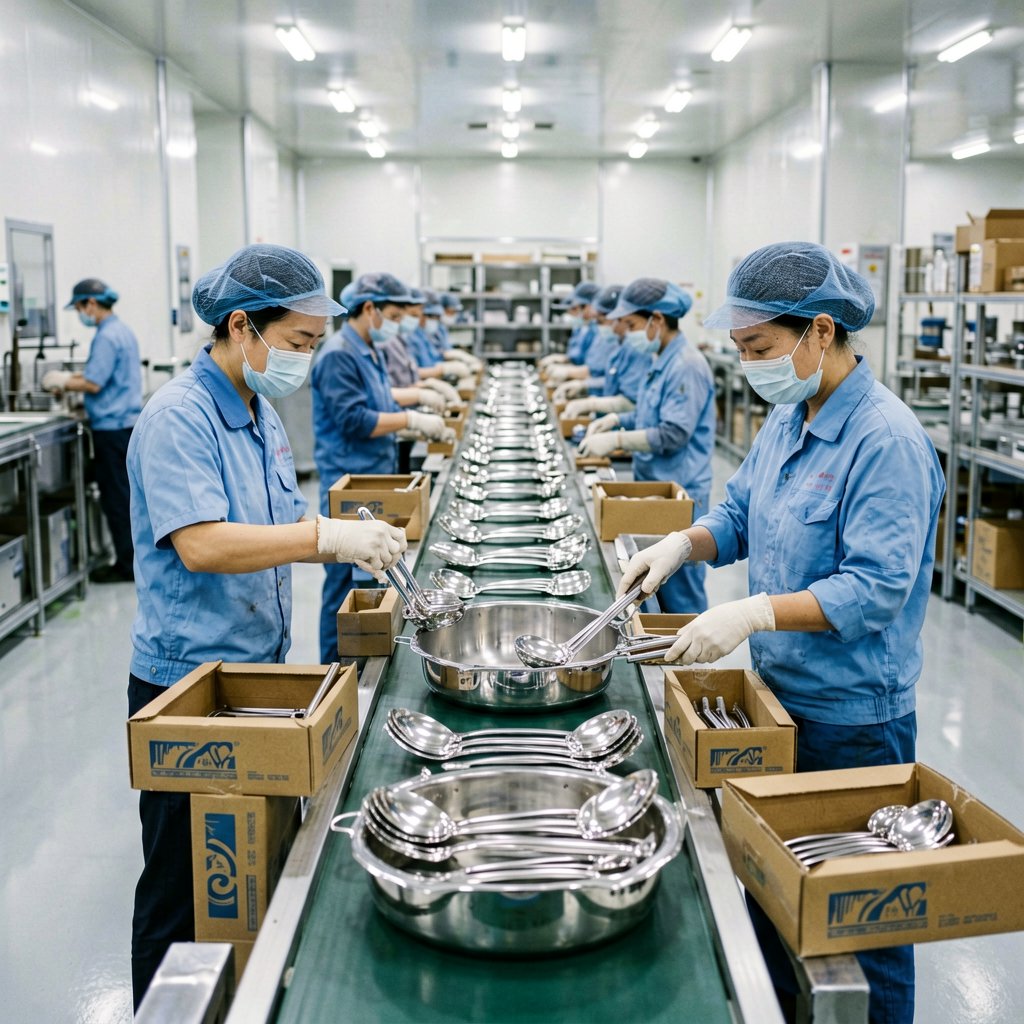
Supermarket logistics penalizes packaging that does not work in the store. Retail-ready packaging (RRP) means the case can be opened in the back room and placed on the shelf without removing each unit by hand: the carton tears open cleanly, the product is already in its retail pack, and the barcode is scannable on the outer case. Chains increasingly require this because labor in stores is expensive and shelf-stocking speed matters.
The packaging decisions that affect your wholesale program:
- Retail pack format: boxed, blister, hanging hook, or loose with an EAS tag. Confirm the format with the chain before tooling any custom packaging.
- Barcode and labeling: each retail unit needs its own scannable barcode, and the outer case needs the chain’s case label. Barcode verification is a separate step; do not assume the factory’s barcode is correct for your market.
- Unit count per case: supermarkets want case counts that match their replenishment math. A case of 6, 12, or 24 is easier to plan around than an odd count.
- Food-contact and material labeling: cookware and bakeware packaging in most markets must state material, care instructions, and any relevant compliance marks. Confirm what the destination market requires.
Ask the buyer or the chain’s vendor manual for the packaging specification before you produce, not after. A packaging correction after production is expensive, and it is one of the most common reasons a first supermarket order slips its launch date.
Compliance Documents Supermarket Buyers Expect
Supermarket chains have stricter compliance requirements than most other channels because they carry liability for the products they sell. Expect the buyer to request: material certificates for stainless steel or aluminum, food-contact test reports for products that touch food, coating test reports for non-stick cookware, and market-specific declarations where they apply. The exact list varies by chain and by country; a chain in the European Union will ask for different documentation than a chain in the United States.
The documents matter at two points: during supplier approval and at every shipment. Many chains require updated test reports per batch or per season, and they may refuse a shipment whose documentation has expired. Build the document schedule into your sourcing plan: confirm which reports are needed, how often they must be renewed, and which laboratory the chain accepts. The factory can usually provide or arrange these, but the cost and lead time for testing belong in your quote, not in a surprise later.
What food-contact documents do supermarket suppliers usually need?
It depends on the market, but the common set includes material certificates, migration or food-contact test reports for the products that touch food, and coating or surface test reports where coatings are used. Some chains also ask for batch-level traceability records. Ask the buyer for their vendor requirement list in writing; guessing is how importers end up with a container that cannot be cleared into the store.
Pricing and Margin Structure for Supermarket Programs
Supermarket pricing is transparent and unforgiving. The buyer knows the shelf price, the competitor’s price, and the category margin, and they will compare your landed cost against alternatives line by line. Your quote must be built on total landed cost: ex-works price, inland freight, ocean freight, duties, clearance, and the cost of the compliance documents. If your margin math stops at the factory price, the program will quietly lose money.
Be realistic about the price conversation. Supermarkets negotiate hard on high-volume staples, but they accept reasonable margins on differentiated items. The profitable way to serve supermarkets is a mix: staples that meet the chain’s price point, and differentiated products with features the chain cannot source elsewhere. Do not try to win the entire program on price; win the staples on efficiency and the differentiators on design.
Quote with price validity periods. Steel and aluminum prices move, and supermarkets plan 6 to 12 months ahead. A 60 to 90 day price validity gives the buyer a planning window without forcing you to eat raw material increases for a year. Confirm the validity period in the quote and revisit it when material costs shift.
MOQ and First Order Strategy for Supermarkets
Supermarket first orders are often smaller than buyers expect, because the chain wants to test the product and the supplier before committing shelf space. A typical test program might be 300 to 600 units per SKU, depending on the chain and the category. The MOQ conversation should focus on what the chain commits to, not on the first shipment: a commitment to reorder at a defined rate is worth more than a large one-off order, and it is the basis for a factory to reserve capacity.
When you negotiate MOQ with the factory for a supermarket program, present the full picture: the test order, the planned reorder rate, and the seasonality. Factories respond to committed volume. If the test quantity is below the factory’s standard minimum, ask what raises the minimum (custom packaging, custom color, custom tooling) and which of those you can defer. Keeping the first order to standard items with standard packaging is the fastest way to a low test MOQ.
Replenishment Programs and Order Rhythm
The reorder rhythm is what makes supermarket business predictable. After the test period, most chains reorder on a fixed schedule: staple kitchenware every 4 to 8 weeks, seasonal items in defined windows, and promotional items ad hoc. Your job is to build a replenishment program the chain can rely on: agreed lead times, agreed service levels, and a standing arrangement for the top movers.
For the supplier side, replenishment planning means holding capacity for reorders. If your factory only schedules production when a purchase order arrives, the reorder lead time will be too long for supermarket expectations. Agree with the factory on a reserved production slot for your program, or keep a safety stock of the top 5 to 10 SKUs. The cost of holding stock is real, but it is usually lower than losing the program to a supplier who can deliver in half the lead time.
Track sell-through data if the chain shares it. Replenishment decisions based on actual movement beat decisions based on forecast, and a supplier who adjusts reorder quantities to sell-through becomes valuable to the category manager.
Service levels matter as much as price in the replenishment phase. A chain that orders 500 units and receives them in two weeks is happier than a chain that saves a small percentage and waits eight. Define the service level in the program agreement: the order confirmation time, the lead time, the fill rate on reorders, and the response time for quality issues. When the program is running, measure your performance against those numbers monthly, because a category manager who sees reliable numbers will defend the program in their own reviews.
Working With the Category Manager: The Buyer Conversation
The person who decides whether your kitchenware program gets in is the category manager, and their decision is not only about your products. They are managing a category P&L, a supplier roster, and a set of internal targets, and your pitch has to help them hit those targets. That changes how you prepare for the conversation.
Before the meeting, find out three things: who the current kitchenware supplier is, what the chain’s kitchenware price architecture looks like, and which category the chain is trying to grow. If the chain is pushing a premium kitchenware line, a commodity bowl program will not excite the buyer; if the chain competes on price, a premium design story will not either. Match the pitch to the strategy.
In the conversation, present the program in the buyer’s language: sell-through rates, margin per facing, replenishment reliability, and store labor saved by retail-ready packaging. A category manager defending your program to their own buying committee needs numbers they can repeat, so give them the shelf logic, the case count, and the compliance summary in one page. The supplier who makes the buyer look good internally is the supplier who wins the program.
Also be clear about what you need from the chain. Supermarket programs work when both sides commit: the chain commits to shelf space and a reorder rhythm, and you commit to lead times, compliance documents, and service levels. A buyer who wants everything and commits nothing is a warning sign; a buyer who shares the planogram and the vendor manual is a buyer worth building a program with.
Seasonal Kitchenware in Supermarkets
Supermarket kitchenware has a seasonal shape that affects your sourcing plan. The big windows are the holiday season, when cookware sets, bakeware, and gift items sell; the spring/summer outdoor season, when grill tools and storage move; and the back-to-school window, when lunch kits and small tools sell. Each window has its own order timing, and the chain plans these months ahead.
For the holiday window, orders are typically placed 6 to 9 months before the season, because factories fill up and freight gets tight. A holiday bakeware program that needs to land in September must be confirmed with the supplier by early spring, with packaging and compliance locked before production. For the outdoor season, the timing is similar but the products are different: grill pans, barbecue tools, and food storage that moves in warm weather.
Seasonal programs have one extra planning rule: they do not reorder. When the window closes, leftover seasonal inventory becomes a liability, so the order quantity has to be right the first time. Use sell-through data from the previous season where you have it, plan a conservative first seasonal order, and reserve a small reorder lane for fast movers within the window. A supplier who can produce a quick seasonal top-up is worth more than a supplier who can only run large batches.
A Worked Example: Building a 30-SKU Test Program
To make the program logic concrete, walk through a typical test: a regional supermarket chain with 40 stores wants to test kitchenware. The category manager shares the planogram, which has space for 30 SKUs across cookware, bakeware, food storage, kitchen tools, and tableware.
The wholesaler proposes 30 SKUs built on proven movers: four stainless steel bowls, three frying pans, three bakeware items, four food storage containers, five kitchen tools, three knife items, and eight tableware pieces. Each SKU gets a price tier: the bowls and storage containers sit at the chain’s opening price point, the pans and bakeware at the mid tier, and a small branded set at the top tier. The packaging is retail-ready for all 30 SKUs, with case counts that match the chain’s replenishment math.
The chain approves a test order of 300 to 500 units per SKU, about 10,000 units in total, split across two suppliers to reduce risk. The wholesaler quotes on landed cost, confirms the compliance documents for each category, and locks production slots with the factories. Four months later the program lands, the chain runs it for one quarter, and the sell-through data decides which 15 to 20 SKUs move to the permanent program and which are delisted.
Notice what made this work: the assortment was built on the planogram, the price architecture matched the chain, the packaging was decided before production, and the compliance documents were ready at approval. None of that is glamorous, but it is exactly what supermarket buyers look for.
Program Development Timeline
Supermarket programs move on a slower clock than online retail, and the timeline below is a realistic guide; confirm each step with the chain and the factory because timing varies.
| Stage | Typical timing | Key decisions |
|---|---|---|
| Category research and planogram review | 2–4 weeks | Price architecture, competitor position, display format |
| Assortment proposal and buyer approval | 2–6 weeks | SKU list, case counts, packaging format |
| Compliance and vendor approval | 2–8 weeks | Material certificates, test reports, vendor manual items |
| Sampling and factory confirmation | 3–6 weeks | Sample approval, MOQ, lead time, price validity |
| Production and QC | 6–14 weeks | Batch inspections, packaging checks, labeling |
| Freight, clearance and store delivery | 5–8 weeks | Case labels, delivery windows, receiving appointments |
| Test period and sell-through review | 8–12 weeks | Reorder decisions, delist decisions, replenishment plan |
Add two to three weeks of buffer to each stage for a first program. The timeline works when the packaging and compliance decisions happen early; it breaks when they are left to the last month, because factories and chains both refuse to wait.
Common Mistakes When Selling Kitchenware to Supermarkets
Five mistakes account for most failed supermarket programs. The first is proposing an assortment without knowing the planogram, which almost guarantees a polite rejection. The second is treating packaging as a last-minute detail; packaging is the first thing the chain’s logistics team checks. The third is quoting on factory price instead of landed cost, which produces a margin surprise three months later. The fourth is ignoring the compliance document schedule until the shipment is ready. The fifth is promising replenishment lead times the factory cannot hold, which destroys credibility in the first season.
Each of these is avoidable with the same habit: ask the chain for its vendor manual and category expectations in writing before you build the program. Supermarket buyers respect suppliers who read the manual and come prepared.
Frequently Asked Questions
What MOQ do supermarket kitchenware programs usually need?
Test programs commonly start around 300 to 600 units per SKU, while committed reorder programs can plan in larger volumes across a season. The MOQ that matters is the one tied to the chain’s reorder commitment, not just the first shipment. Confirm the minimum with your supplier for the specific packaging and customization level.
Do supermarkets require retail-ready packaging?
Increasingly, yes. Many chains require cases that open and place directly onto the shelf, with scannable barcodes on the outer case and retail units. Confirm the chain’s packaging specification in its vendor manual before producing custom packaging.
How do supermarket replenishment programs work?
The chain reorders on a fixed rhythm, typically every 4 to 12 weeks depending on category and sell-through, and the supplier holds capacity or safety stock to meet that rhythm. Replenishment programs work best when the supplier adjusts quantities to actual sell-through data.
What compliance documents do supermarket suppliers need?
Material certificates, food-contact test reports for products that touch food, coating test reports for non-stick items, and any market-specific declarations. The exact list depends on the chain and the destination market; request the vendor requirement list in writing.
Final Recommendation
Approach supermarket kitchenware wholesale as a category program, not a product sale. Learn the planogram, build a 20 to 40 SKU test assortment around proven movers, lock the packaging and compliance documents before production, and quote on total landed cost with a clear reorder rhythm. Once the test period proves the program, the replenishment lane becomes the asset: predictable volume, planned production slots, and a relationship the category manager wants to keep.
If your assortment includes beverage and drinkware lines, coordinate them with a drinkware supplier that covers cups and bottles, because supermarket beverage aisles are planned separately and a companion supplier helps you consolidate the whole kitchenware and drinkware program.
If you are preparing a supermarket kitchenware program and want help structuring the assortment, packaging, and MOQ, send your target market and SKU list through the contact page. We will confirm what fits a chain program and what the realistic lead times are. Related reading: how to build a first mixed container order and retail-ready vs bulk packaging. See the kitchenware products, tableware and full product range we supply.