When you sell kitchenware wholesale to cafés, bakeries and catering operators, you are not selling the same products you sell to retailers — you are selling tools that must survive hundreds of dishwasher cycles, hold up to professional use, and arrive in case packs that fit a working kitchen’s storage. The channel buys differently, reorders differently, and values different things than a supermarket buyer. The importers who win this business build a channel-specific assortment instead of offering their retail range and hoping.
Why Out-of-Home Buyers Order Differently from Retailers
A supermarket buyer thinks in SKUs, facings and sell-through rates. A café or bakery operator thinks in shifts, stations and equipment lifetimes. The same frying pan that sells well at retail because it looks good on a shelf is judged by a café owner on how it behaves on a busy brunch line — whether the handle stays cool, whether the pan balances on a pro burner, and whether it can be replaced quickly when it finally wears out.

Three structural differences shape every out-of-home order. First, durability beats price presentation: operators would rather pay more for a product that lasts two years than less for one that lasts six months, because equipment failure costs them service time, not just purchase price. Second, case pack and packaging matter more than retail packaging: a box of twelve loose pans that stacks in a dry store is worth more than twelve fancy retail cartons that take up the same space. Third, documentation matters differently: foodservice buyers may need to show food-contact compliance to a health inspector or a franchise auditor, so material certificates and test reports are part of the product, not paperwork afterthoughts.
The channel is also fragmented, which changes how you approach it. National café chains buy through central procurement with vendor programs. Independent cafés buy through distributors or local wholesalers. Bakery chains often bake in a central facility and serve in retail shops, so they need both production bakeware and front-of-house serving items. Caterers buy project-by-project, with quantities that spike for events and seasons. One wholesale program rarely fits all of them; the practical approach is to build a channel assortment with layers that match each segment’s order pattern.
Channel Map: Who Buys What
| Segment | What they buy | Who decides | Packaging and docs they expect |
|---|---|---|---|
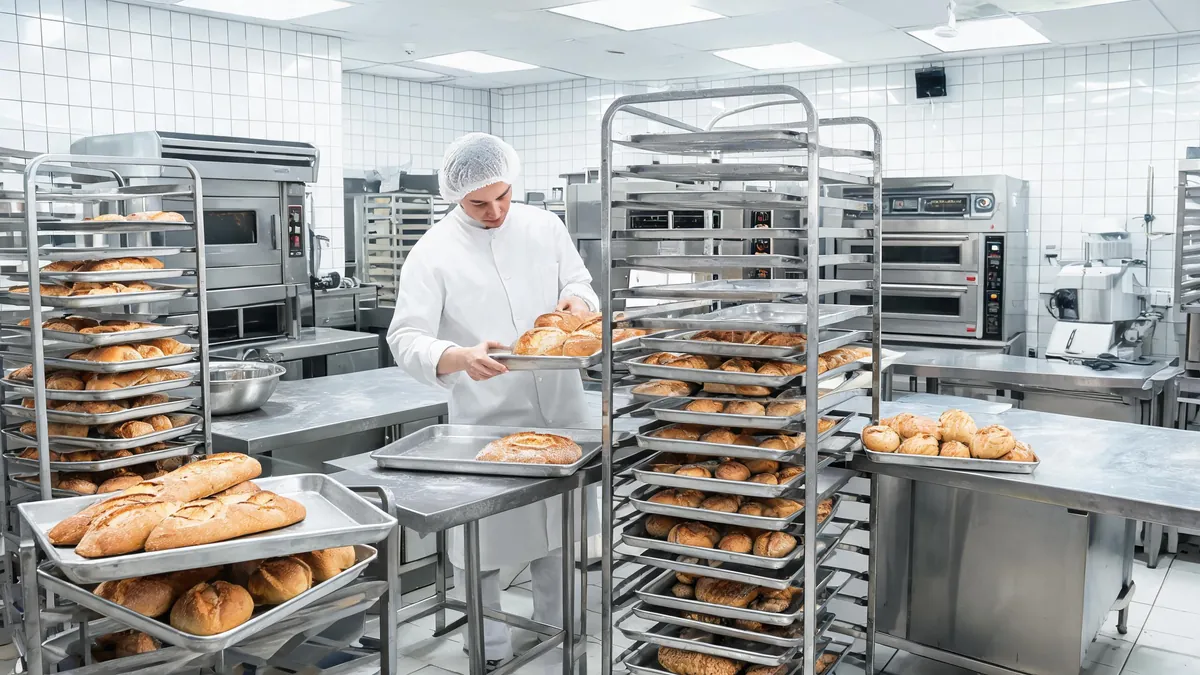
| Bakery chains and artisan bakeries | Baking trays, sheet pans, cooling racks, mixing bowls, pastry tools, portion scoops, loaf and cake pans | Head baker or production manager with central purchasing | Bulk cartons, stackable, food-contact statements for bakeware, material certificates |
| Cafés and coffee shops | Mugs and cups, saucers, serving plates, spoons and tongs, small prep tools, display stands, drinkware | Owner or operations manager | Breakage-safe cartons, smaller case counts, retail-presentable for display units |
| Coffee roasters and specialty chains | Serving ware, cupping sets, tasting accessories, branded takeaway-adjacent items | Brand and procurement team | Branded or neutral finish, consistent color across batches, low MOQ for pilot |
| Caterers and event operators | Chafing dishes, serving trays, tongs, platters, buffet tableware, transport-safe containers | Operations lead, often project by project | High-unit case packs, nesting products, durable finishes for rental-style use |
| Canteen and contract caterers | Heavy-duty tableware, stackable bowls and trays, serving lines, kitchen prep tools | Procurement with site-level input | Institutional volumes, color-coding options, replacement guarantees |
Use the map to decide where your program starts. For most importers, cafés and specialty bakeries are the most accessible entry point because they order in case quantities rather than truckloads, they pay reliably, and they need the product categories where Chinese kitchenware manufacturing is strongest — ceramic and porcelain tableware, glass and metal serving items, baking tools and smallwares. Contract catering is the hardest entry because it is dominated by established distributors, but it is also the most volume-stable once you are in.
The Assortment Building Blocks for a Café and Bakery Program
A channel program works best when you organize the assortment by operating zone, because the café owner and the bakery production manager think in zones, not in material categories. Three zones cover most of the opportunity:
Front-of-house: serving and tabletop
Mugs, cups, saucers, dessert plates, side plates, bowls for soups and salads, serving platters, cake stands, and display pieces. The buying criteria here are visual consistency across batches — a café that orders 500 mugs in one color needs the next 500 to match — and stackability for tight storage. Porcelain and stoneware dominate this zone because they present well and survive commercial dishwashers; melamine appears where breakage cost is the main concern, such as outdoor service and children’s menus. Our tableware products range covers most of these lines, and the material decisions are explained in our tableware wholesale guide for hotels and restaurants.
Production and prep: back-of-house smallwares
Baking trays, sheet pans, cooling racks, mixing bowls in graduated sizes, measuring cups, whisks, tongs, ladles, portion scoops and pastry tools. Durability is the headline requirement: gauges that resist warping in hot ovens, handles that survive repeated dishwasher cycles, and finishes that do not flake. This is also the zone where color-coding matters in larger operations — red boards for raw meat, white for dairy, green for produce — so a program that offers consistent color options across cutting boards and prep tools has a real advantage.
Beverage service: mugs, cups and drinkware
Beyond ceramic mugs, specialty coffee shops buy glass cups, double-wall glasses, and branded drinkware that carries the roaster’s identity. This is a natural adjacency if your supply base includes glass and stainless drinkware factories. For operators who want insulated tumblers and bottles as retail-adjacent merch, a specialized drinkware manufacturer is usually a better source than a general kitchenware factory; suppliers such as Frozl focus on this exact category, and adding a qualified drinkware source to your kitchenware program lets you serve the café channel without stretching your main factory into products it does not make well.
Spec Decisions That Decide Whether You Get the Reorder
Out-of-home buyers rarely test your product scientifically before the first order; they test it in service, and the reorder is the report card. A few specifications determine whether you pass:
- Dishwasher survival. Confirm the finish, glaze and decoration can survive commercial dishwasher cycles — typically hotter and more aggressive than household machines. Ask the factory for the dishwasher-test basis of the product and confirm the cycle count it was validated for; if the factory cannot state one, plan your own test before committing a large order.
- Stackability and nesting. Mugs, bowls and pans that nest or stack with safe separation save shelf space in a working kitchen and reduce breakage in transit. Specify maximum stack height and any need for protective rims.
- Edge and finish safety. Sharp rims, rough glaze points and poorly finished handles are the fastest path to a bad review from a café owner. The finish check that matters for foodservice is not the same as retail cosmetic inspection — it is about service safety.
- Thermal performance for serveware. Bowls and plates that go from hot food to cold storage need thermal-shock resistance appropriate to the product’s material; confirm the safe temperature range with the supplier rather than assuming stoneware and porcelain behave identically.
- Weight and balance. A café server lifts a stack of plates hundreds of times a shift. Lightweight, well-balanced products reduce fatigue and breakage; heavier institutional-grade products are preferred where durability is the priority. Match the weight story to the segment you serve.
Write these into a one-page channel spec sheet before you approach factories, the same way you would write a retail spec. Factories respond better to a buyer who names dishwasher cycles and stack heights than to a buyer who asks for “good quality.” If you are extending an existing kitchenware program into this channel, review the specifications you already use with the channel in mind rather than assuming the retail spec carries over — the RFQ guide shows how to turn these requirements into quotes you can compare.
Case Packs, Packaging and the Dry Store Test
For foodservice, the packaging that matters is the case pack, not the retail box. Operators store products in dry stores and on shelves behind service counters, where space is measured in centimeters. The case pack decisions that win reorders:
- Case counts matched to usage — a café that uses 12 mugs a day in service wants a case that reflects weekly replacement, not a retail display carton of 2.
- Layer packing that lets staff take one layer without disturbing the rest.
- Breakage protection for ceramics and glass that survives the distributor’s warehouse, not just the factory-to-port leg.
- Clear carton labeling — product, quantity, material, country of origin — so receiving staff can check the delivery without opening every carton.
- Neutral, disposable packaging for front-of-house items that will be displayed; branded retail packaging is usually wasted on this channel unless the operator resells the item.
For bakeware and prep items sold in quantity, bulk carton packing is normally the default, with retail-ready options only where the operator has a shop counter that sells the same items to consumers. The balance between bulk and retail-ready packaging is a decision you can make per SKU; our packaging guide walks through the trade-offs, and the same logic applies whether the end buyer is a retailer or a café chain.
Food-Contact Documentation for Foodservice Buyers
Foodservice buyers sit between you and a health inspection, which makes documentation a selling point rather than an administrative burden. The documents that matter most: food-contact material statements for the markets you serve — for the EU this usually means LFGB or EU food-contact compliance documentation, for the US it typically means FDA food-contact compliance, and the applicable standard depends on the destination market and product material; material certificates confirming grades such as food-grade stainless steel or ceramic glaze composition; and batch-level traceability so a buyer can connect a delivery to its production records if a question arises.
Do not assume one certificate covers every product and market. A glaze that complies for one market may need different documentation elsewhere, and coatings used on bakeware may have their own requirements. Ask the factory which documents it can provide for the specific SKU and destination, and confirm the document issuer — a test report from a named laboratory carries more weight than a self-declared compliance statement. Our certification guide explains how to verify these documents for kitchenware generally; the same verification steps apply when the buyer is a café chain or a caterer rather than a retailer.
For franchise operators and national chains, expect to complete supplier questionnaires and possibly a food-safety audit before you are approved. Keep a documentation file per product line — material spec, test reports, batch records, packaging specs — and keep it current, because the chain’s annual review will ask for the same documents again.
Ordering Cycles, MOQ and the Pilot-to-Rollout Path
Out-of-home ordering follows the operator’s calendar, not the retail buying calendar. Bakery and café operators order year-round with soft seasonal peaks — summer cold-beverage season, winter hot-beverage season, and holiday catering — while caterers spike around events and the holiday period. A program that aligns reorder reminders with those peaks, and that keeps core SKUs in stock through them, earns loyalty that a one-off price quote never will.
MOQs work differently in this channel. A café chain pilot might be a few hundred pieces across ten SKUs; a distributor’s first order might be a full container of twenty SKUs. The practical structure is a channel starter kit — a curated assortment of the highest-turnover items at a volume that hits a sensible MOQ — followed by replenishment orders on the items that actually move. Factories that quote category MOQs will usually let you mix SKUs within a category to reach the number; this is exactly how our buyers build their first out-of-home orders, and the mechanics are covered in our guide to building a first mixed container order.
Build the pilot with the same care you would give a retail launch: approve samples against the channel spec, run a small first batch through real service if you can, and review sell-through and breakage before the rollout order. The café channel is forgiving of a slow start — operators would rather buy a proven assortment in small quantities than a large bet on an unproven one.
Working with Channel Distributors vs Selling Direct
You have two routes into the out-of-home market: sell to the operators directly, or sell through foodservice distributors who already serve them. Direct selling works for regional café chains and specialty bakeries where your team can build relationships and your assortment is distinctive. Distributors make sense for volume products where the buying decision is price-and-availability driven, because the distributor already holds the account relationships and the delivery infrastructure.
Most importers do both, with a split that follows the product. High-margin, distinctive items — branded serveware, specialty bakeware, curated sets — justify direct sales effort. Commodity items — standard mugs, plain baking trays, basic smallwares — are distributor products. If you choose the distributor route, expect to support them with case pack flexibility, reliable stock, and documentation files they can pass to their operator customers; the distributor is your channel customer, and their reorder depends on how easy you make their job.
Channel strategy also affects your supply base. If you are building a broad out-of-home program, you may need several factories — ceramics, glass, metal bakeware, smallwares — which is a normal pattern for this channel. The discipline of managing those relationships, and the decision framework for when one supplier can cover multiple categories, is the same whether you sell to retail or foodservice; our supplier evaluation scorecard gives you a practical way to compare them.
Where Kitchenware Meets the Rest of the Fit-Out
One advantage of the café and bakery channel is that the buyer is often fitting out a space at the same time they are stocking it. A café opening needs furniture, lighting and front-of-house equipment as well as tableware — and a supplier who understands the whole opening picture can time deliveries and coordinate specifications better than one who only ships mugs. This is why kitchenware suppliers in this channel often work alongside furniture suppliers: a restaurant furniture source such as FurnitureOrigin handles the tables, chairs and counters while your program covers the tabletop and the kitchen. When you present an opening package rather than a product list, you stop being one vendor among twenty and become part of the operator’s planning team — which is exactly where you want to be when the reorder decision comes.
The channel is not a shortcut; it is a different business with different specs, different packaging, different documentation and different order cycles. Importers who treat it seriously — who build a channel assortment, write a channel spec, and prepare the documentation file before they call on their first café — find loyal, year-round buyers. Importers who simply push their retail range into the channel learn the difference the hard way, one broken mug and one rejected delivery at a time.
Color Continuity and Replacement Stock: The Quiet Reorder Engine
Ask any café owner what annoys them most about tableware suppliers and the answer will not be price — it will be color. A café that ordered 500 mugs in a sage green two years ago cannot replace broken mugs with a slightly different sage green, because the difference is visible on the shelf every single day. Color continuity across batches is the unglamorous specification that decides whether a café account becomes a five-year reorder or a one-time sale.
Color matching is harder than most importers expect. Glazes change between batches for reasons that have nothing to do with your supplier’s honesty: different raw material lots, a change in the glaze supplier, different kiln conditions, or a new production team. The same happens with coatings on metal bakeware and with the finish on wooden and silicone items. The practical control is a master sample — one approved piece kept by both you and the factory, against which every production batch is compared before packing. Ask the factory who holds the master sample, how often it is re-verified, and what happens if the batch drifts from it. A factory that cannot name its color-control process will drift; one that can is worth a premium.
Replacement stock planning is the second half of the reorder engine. Foodservice breakage is constant — dropped mugs, chipped plates, warped trays — and the operator who cannot replace a broken item in the same color and size is an operator who starts looking for a new supplier. When you plan a café or bakery program, set aside a continuity list of the SKUs most likely to need replacement, and keep reorder quantities for those items even when they are not your best sellers. The operator does not need you to hold a year of stock; they need you to be able to reorder the same item within a practical lead time. Knowing which items matter to them, and saying so in your program proposal, is a stronger sales argument than a discount.
Reorders are also the most profitable part of the channel, which is why the continuity investment pays. A reorder requires no new samples, no renegotiation of every term, and no freight learning curve — the container has been shipped before, the documents exist, and the operator knows the product. Importers who treat every order as a new negotiation give away the advantage they built with the first shipment; importers who build a simple replenishment program — the same items, the same lead time, a standing reorder date — turn a channel account into recurring revenue with very little additional effort.
Reading the Signals That a Café Account Is Ready to Scale
Not every café order deserves a full program. The practical skill in this channel is recognizing when an account is moving from one-off buying to program buying, because that is the moment to invest relationship effort and the moment a competitor can steal the account if you do not.
The signals are behavioral. A café that places its second order before the first has sold through is testing your reliability; a café that asks about volume pricing, lead times for specific colors, or branded items is planning a bigger commitment; a café that requests your catalog or asks whether you can supply their sister locations is mapping you into their growth. Each signal deserves a different response — faster confirmation on the second order, a volume quote structure on the pricing question, a presentation tailored to multiple locations on the growth question. Operators rarely announce that they are ready to scale; they show it in small requests that are easy to miss when you are busy shipping.
The other scaling signal is who makes the decision. In a single café, the owner decides. In a small chain, the operations manager or the founder decides, often with the head baker or head barista consulted. When your contact at an account changes from the owner to an operations person, the buying criteria shift — operations buyers want documentation, reliability and case pack efficiency more than they want a personal relationship. Adjust your proposal accordingly: lead with the spec sheet, the lead time table and the reorder program, and keep the friendly relationship as the background rather than the headline.
Finally, make it easy for the decision-maker to say yes. A one-page channel spec sheet — dishwasher cycles, temperature ranges, case pack counts, lead times — is worth more than a brochure of beautiful product photos, because the person deciding needs to justify the choice to someone else: the owner, the health inspector, the franchise auditor. Sample sets aimed at the actual user — a head baker who will test your baking trays in a real oven, a barista who will put your mug through a real service week — close more accounts than a showroom visit ever will. The café channel is a trust channel, and trust is built one tested batch at a time.
Frequently Asked Questions
Do cafés and bakeries really buy direct from importers, or only through distributors?
Both. Independent operators often buy direct when the importer offers a curated assortment and reliable case quantities, while national chains and contract caterers usually buy through distributors. Many importers start direct with regional operators and add distributor partnerships for volume lines.
What is the most important specification for foodservice kitchenware?
Dishwasher survival is usually the first question, followed by stackability and edge safety. An operator replaces products that fail in service, so a spec that names dishwasher cycles and finish durability is the strongest sales argument you can make.
Do I need different certificates for foodservice buyers?
Often yes. Foodservice buyers may need to show food-contact compliance documentation to health inspectors or franchise auditors, so material certificates and test reports are part of the product. Confirm the documents required for the destination market and the specific material with the factory.
What case pack should I use for café orders?
Match the case count to usage. A café that replaces a few mugs a week does not want a retail display carton; a distributor serving many operators wants higher unit counts. Layer packing, breakage protection and clear carton labeling are the practical priorities.
How do I start selling to out-of-home buyers with a small budget?
Build a channel starter kit of the highest-turnover SKUs — mugs, plates, basic bakeware, serving tools — at a volume that reaches a sensible MOQ, pilot it with two or three operators, and expand based on what actually reorders.
If you are planning a kitchenware program for cafés, bakeries or catering customers, send us your target segment and your current assortment. Our team can help you select the tableware, bakeware and serving lines that fit the channel, confirm case pack and documentation requirements, and quote a mixed program that reaches MOQ without overstocking. Request a channel quote or an assortment review.