Cookware gift sets sell on three dates a year: the pre-Christmas window, Mother’s Day and the wedding season, and the retailers who plan them win or lose the season between August and October, not in December. A cookware gift set is a boxed combination of matching pots, pans or bakeware pieces with retail packaging, and the strategy that works for a gift program is different from a normal cookware order: the set must look giftable, the packaging must survive shipping without a crushed corner, and the order must land six to ten weeks before the selling window, not four. This guide walks through the decisions a retail buyer has to make when planning a seasonal cookware gift set program, from set configuration to packaging to the QC checks that protect a holiday order.
Why cookware gift sets behave differently from regular cookware orders
A normal cookware order is about cost per piece, durability and warehouse turns. A gift set order is about perceived value, presentation and timing. The same pan that sits on a shelf for months as an open-stock item suddenly needs a box, a printed sleeve, a recipe card and a price point that feels like more than the sum of its parts. Buyers who treat gift sets as “just a bundle” usually discover the problem at the first delivery: the packaging adds weight, the set does not fit the display unit, or the gift box arrives dented and nobody at the factory owns the fix.
The practical differences show up in four places: set composition, packaging, lead time and return handling. Each one changes the way you brief a supplier, and each one has a specific check that keeps the program out of trouble.
| Planning area | Normal cookware order | Gift set program |
|---|---|---|
| Set composition | Driven by SKU cost and turns | Driven by perceived value and gifting occasion |
| Packaging | Plain carton, bulk pallet | Printed gift box, insert, sleeve, sometimes handle-tag |
| Lead time | Can flex with the container schedule | Fixed by the retail calendar, no flex at the end |
| Return handling | Single damaged piece replaced | Whole set return if the box looks opened or damaged |
Once you accept that a gift set is a packaging-led product, the sourcing conversation changes. You stop asking “what is the cheapest pan” and start asking “what set composition fits my price point and my display, and can the factory deliver the whole package to my standard”. That shift is the whole strategy.
Set composition: what actually belongs in a cookware gift set
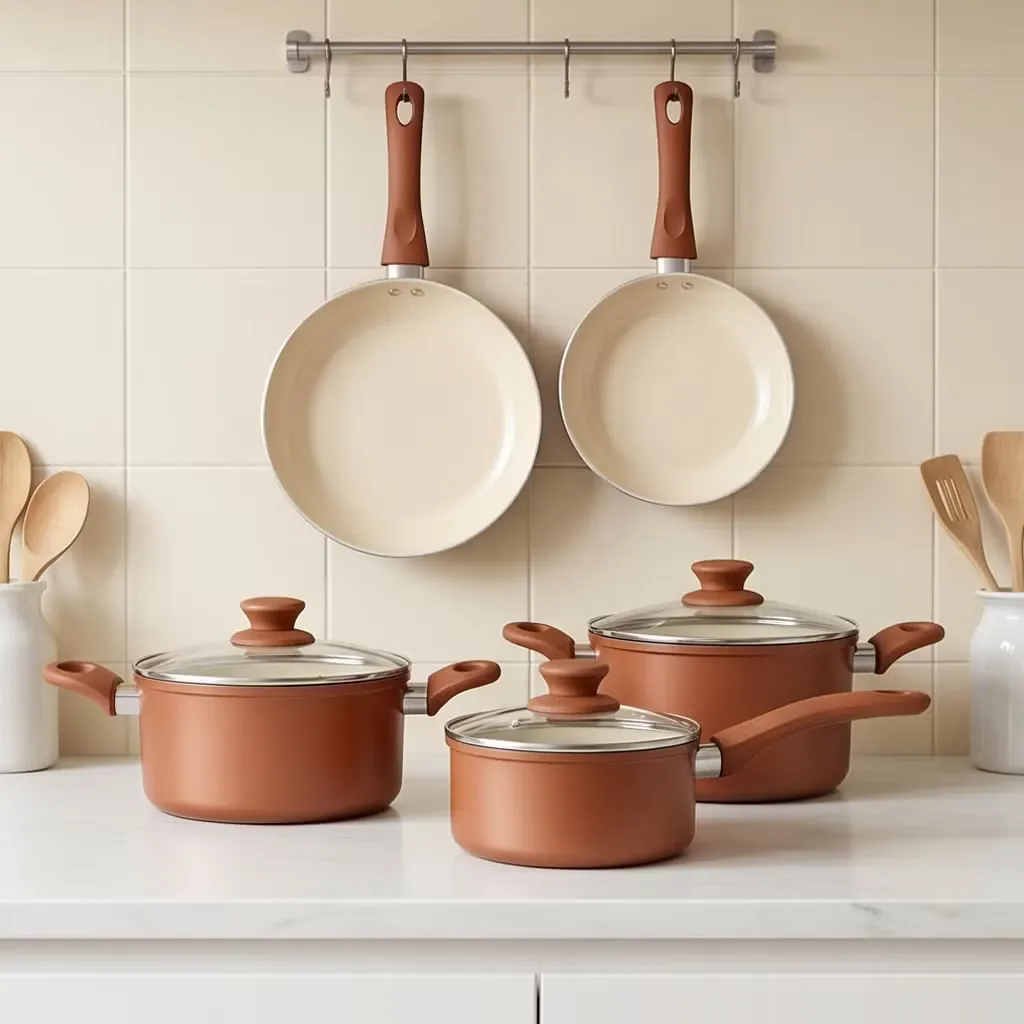
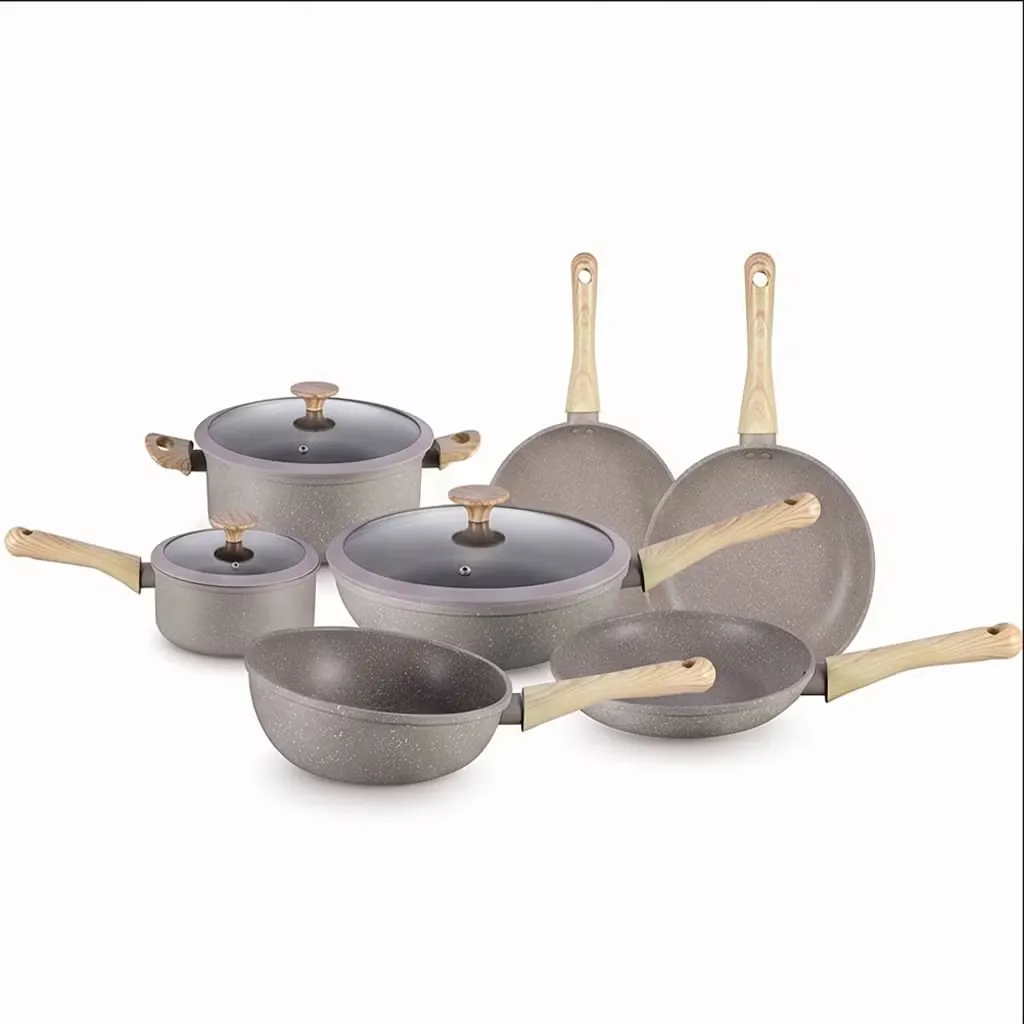
Set composition is the first decision, and it is a pricing decision more than a cooking decision. The classic structures are a 3-piece set (one frying pan, one saucepan, one lid set), a 5-piece set (two pans, two saucepans, lids), a 7-piece set (adds a stockpot or a dutch-oven style piece) and a 10-piece set that usually means the pieces are smaller or the pans are lighter. The same retail price can carry very different compositions depending on material and gauge, so the composition has to be chosen against the target price point, not against a cooking wishlist.
Three rules keep set composition realistic for a first seasonal program:
- Rule 1: match the set to the occasion, not to the kitchen. A Mother’s Day set leans toward bakeware and lighter pans; a Christmas set leans toward the full cookware kit; a wedding set can include serving pieces. Occasion-led sets sell better and justify the gift packaging.
- Rule 2: keep the piece count odd and the story simple. Odd counts (3/5/7) photograph better and read as “a set”, while even counts read as loose pieces. A simple story, like “the everyday pan trio”, is easier to print on a box than a vague collection.
- Rule 3: protect the hero piece. Every gift set has one piece the customer notices first — usually the largest frying pan or the stockpot. Specify that piece first and build the rest of the set around it, both in cost and in packaging design.
The material decision matters here too. Aluminium non-stick sets keep the price point low and the weight manageable; stainless steel sets cost more but justify a higher gift price and a more premium box; cast iron sets are heavy, which raises freight and weakens the gift-box story unless the box is designed for the weight. There is no universal answer — only a composition that matches your price point and your customer. Confirm the gauge and coating spec for every piece in writing, because a supplier can quietly downgrade the small saucepan’s gauge while keeping the hero pan correct.
Quick FAQ: How many pieces should a cookware gift set have?
There is no fixed rule, but 3, 5 or 7 pieces are the proven retail structures. Three pieces work for an entry price point, five pieces for a mid-price gift, and seven or more for a premium program. Choose the count that fits your target price and your display footprint, and keep the count odd so the set photographs as a set.
Seasonal packaging: the part of the order that becomes the product
In a gift program, the box is the product and the cookware is the content. A customer who receives a dented gift box returns the set even when every pan is perfect, so packaging specifications deserve the same detail as the pan spec. The decisions, in order of importance, are the box structure, the printed finish, the inner protection and the small extras that make the set feel giftable.
Box structure. The two main choices are a rigid two-piece gift box (lid and base, stronger, more expensive) and a folding carton with an inner tray (lighter, cheaper, still presentable). For cookware, the folding carton with a die-cut tray or a corrugated insert is usually enough, because the pans themselves provide rigidity. The critical dimension is the total weight: a heavy stainless set in a thin carton will crush in transit. Ask the supplier for the box’s edge-crush or burst rating in writing, and test a fully packed box through your own shipping test before committing.
Printed finish. The standard options are a printed paper sleeve over a plain carton, a fully printed carton, or a plain kraft box with a printed belly band. The sleeve approach is the most flexible for seasonal programs: you can print one sleeve design for Christmas, change it for Mother’s Day, and keep the same carton blank underneath. That saves tooling cost and lets you run two seasons off one box. If you want a premium feel, a matte lamination with a spot gloss logo is the common middle ground; avoid heavy foil or embossing on a first run unless the price point clearly supports it.
Inner protection. Cookware needs four protection points: the pan surface (usually a PE foam or EPE sheet between pans), the rim and edges (corner protectors), the handle (foam sleeve), and the lid. Scratched coating and chipped rims are the two most common damage claims on gift sets, and both are packaging failures, not product failures. Specify the protection material by name in the purchase order and check it at QC: a supplier that skips the between-pan sheet to save cost will produce a beautiful box full of scratched pans.
Gift extras. Recipe cards, a small utensil, a silicone scraper or a branded ribbon are cheap additions that lift perceived value far beyond their cost. They also create a packaging QC point of their own: check the card is the right language and the right seasonal message, because a Christmas card printed with a summer recipe in the wrong market is a recall-level embarrassment for a gift program.
Seasonal timing: working backwards from the selling window
Gift retail runs on a hard calendar, and the supplier’s lead time has to include everything, not just production. For a Christmas program, the practical working-backwards plan is: confirm the selling window (usually early November to mid-December for most markets), then subtract the transit time (four to seven weeks for a sea container from China to the US or EU, depending on the port), then subtract production time (three to five weeks for a standard cookware order, longer with custom packaging), then subtract the sample and approval round (two to four weeks). That lands the order placement in August or early September for a December program — which is exactly why this article is being written now, not in November.
| Program | Order placement | Production | Sea transit | In-store |
|---|---|---|---|---|
| Christmas | Aug – early Sep | Sep | Oct | Nov |
| Mother’s Day (US/EU) | Jan – Feb | Feb – Mar | Mar – Apr | Apr – May |
| Wedding season | Mar – Apr | Apr – May | May – Jun | Jun – Jul |
Two timing traps catch first-time gift buyers. The first is assuming air freight can rescue a late order: air freight rescues a sample or a top-up, not a container of gift sets, and the cost destroys the margin anyway. The second is forgetting that the factory’s own calendar fills up: every cookware supplier in China runs at capacity from September, so an order placed in October is competing for line time with bigger buyers. Place the order early, and confirm the production slot in writing with the factory — a verbal “no problem” in August is worth nothing when the line is full in October.
Quick FAQ: How long before the holiday should I place a cookware gift set order?
Work backwards from the in-store date: production three to five weeks, sea transit four to seven weeks, sampling and approval two to four weeks. For a December selling window that usually means placing the order in August or early September. If you are running a custom gift box, add two to three weeks for packaging development and always test a full production-style pack.
MOQ, pricing and the first seasonal order
A seasonal gift program is a first order with extra risk, and the MOQ discussion needs to happen early. The supplier’s MOQ for a cookware gift set is driven by three numbers: the minimum production run per piece (usually tied to coating or moulding setup), the minimum packaging run for the printed box or sleeve, and the minimum pallet or container load for economical freight. The packaging MOQ is often the binding constraint, because a printed sleeve has a plate or tooling cost that only makes sense at a certain quantity.
For a first seasonal program, the low-risk approach is to negotiate a smaller first order with a higher per-piece price, prove the selling window, then commit to the larger seasonal quantity in year two. Suppliers generally accept this if the packaging design is kept standard (a sleeve change, not a new carton structure) and if the buyer commits to a repeat. It is also worth asking the supplier to quote the set two ways: with the standard box and with the printed sleeve, so the packaging upgrade cost is explicit. If the numbers are close, take the better packaging every time — the gift box is the product.
Do not ask a supplier to hold seasonal stock for you unless you have a written agreement about storage cost and obsolescence. A Christmas set that clears customs in February is dead inventory, and the supplier will price that risk into the deal whether or not they tell you. Keep the seasonal commitment tight and make reorders the lever for growth.
What to put in the seasonal gift set RFQ
The quality of the quotes you receive depends on the quality of the brief, and a seasonal gift set brief needs fields that a normal cookware RFQ does not have. If you send only “5-piece non-stick cookware set with gift box”, you will get ten different interpretations of what that means. A complete seasonal RFQ tells the supplier the selling window, the target retail price band, the set composition by piece with material and gauge for each piece, the packaging structure (carton, sleeve or full print), the inner protection requirement, the language of the printed material, the quantity per SKU, the required certificates, and the QC standard including the drop test and the contents check.
| RFQ field | Why it matters for a gift program |
|---|---|
| Selling window and in-store date | Lets the supplier plan production and flag capacity conflicts early |
| Target retail price band | Guides the material and gauge choice before quoting |
| Piece-by-piece spec | Prevents downgrades on secondary pieces in the set |
| Packaging structure and print | Defines the box, sleeve or full print and the tooling cost |
| Inner protection spec | Names the between-pan sheet and corner protectors in the contract |
| Print language and seasonal message | Protects against wrong-language or wrong-season artwork |
| Certificates and documents | Puts food-contact and retail documents on the table before production |
| QC standard and tests | Makes the drop test, contents check and visual finish checks binding |
Send the same brief to three suppliers and compare not just the price but the questions they ask back. A supplier who asks about the retail price band, the drop test and the certificate list understands gift programs; a supplier who only asks about quantity and colour is quoting a normal cookware order with a box. The second kind can still deliver, but you will carry the packaging risk yourself.
QC checks that protect a gift program
Gift set QC is the normal cookware QC plus four packaging-specific checks. The normal checks still apply: material grade, coating quality, gauge, handle stability, induction compatibility if claimed, and food-contact documentation for the destination market. Then add the four that decide whether the gift program survives:
- Drop and crush test. A fully packed set box must survive a standard carton drop without the pans marking or the box collapsing. Run this at the factory with a production-packed sample, not with a hand-packed prototype.
- Visual finish of the printed packaging. Check colour, alignment, logo position and the seasonal message against the approved artwork. Colour drift is common in the first production run.
- Surface protection inside the box. Open several packed boxes at random and verify the between-pan protection is present and correctly placed. This is the check that catches the cost-saving substitution.
- Contents completeness. Count every piece, every lid and every insert against the packing list. A missing lid in a gift set is a full return, not a replacement part.
These checks belong in the pre-shipment inspection contract with clear pass/fail rules. The sample approval should also include one fully packed gift set, so the buyer sees exactly what the customer will see — box, sleeve, insert, pieces and extras together — before the production run starts.
Display-ready and shelf presentation
Gift programs usually sell from a display, not from a warehouse shelf, and that changes two more specifications: the outer carton and the display unit. If the sets are going to sit in a promotional display at the front of a store, the outer carton should be display-friendly — easy to open, with the printed sleeve facing the customer and no extra handling required to pull the set out. Some retailers ask for a tray or a half-carton that converts into a display, which the supplier can design if the order volume justifies the tooling. Confirm the display requirement with the retailer before finalising the packaging, because a beautiful gift box that needs to be unboxed and re-boxed at the store adds labour cost to every unit sold.
Shelf presentation also includes the barcode and the label. The EAN or UPC barcode has to be printed at the right size and position on the box, and the retail label (country of origin, material composition, care instructions) has to match the market’s labelling rules. A barcode that does not scan at the register is a store-level rejection even when the product is perfect. Send the retailer’s label and barcode requirements to the supplier with the artwork, and verify a printed sample at approval time, not in production.
Compliance notes for gift retail
Gift sets add a compliance layer because the product is sold to consumers, often through retail channels with their own supplier requirements. Food-contact compliance applies to every piece that touches food: the destination market determines the standard (FDA for the US, EU food-contact regulation and LFGB documentation for European markets, and local requirements elsewhere). The packaging material also matters for some markets, and the printed carton or sleeve should not claim food-safety properties unless the supplier can document them.
Retailers commonly ask for a children’s-safety check if the set could be seen as a child gift, a product liability insurance certificate, and barcode readiness for the retail system. Confirm with each retailer which documents they require before you place the order, and collect the certificates from the supplier before production, not after. If a certificate cannot be provided, ask the supplier which alternative documentation they can supply, and confirm with the importer of record whether it satisfies the market.
Frequently Asked Questions
Can I run a cookware gift set program with a small first order? Yes, if you accept a higher per-piece price and keep the packaging standard. Negotiate a small first run to prove the selling window, then commit to the seasonal quantity in year two. A sleeve-only packaging change keeps the tooling cost low.
What is the difference between a gift set and a regular cookware bundle? A gift set is packaging-led: it has a printed box, inner protection, inserts and a seasonal story, and it is priced and returned like a gift. A regular bundle is a cost-led combination of pieces with basic packaging. The sourcing conversation is different in each case.
What packaging mistakes cause the most returns on cookware gift sets? The top causes are scratched coatings and chipped rims from missing between-pan protection, crushed boxes from under-specified carton strength, and missing pieces or inserts. All three are preventable with a drop test and a contents check at pre-shipment inspection.
Do I need separate food-contact certificates for a gift set? The food-contact requirements follow the destination market and apply to the cookware pieces. The packaging usually does not need the same food-contact documentation, but it should not claim food-safety properties unless documented. Confirm the exact documents with each retailer and the importer of record.
When should I start planning a Christmas cookware gift set? Work backwards from the in-store date. For a December program, place the order in August or early September so production, sea transit and sampling all fit before the factory’s seasonal capacity is gone.
Building the seasonal plan with your supplier
A cookware gift set program succeeds when the buyer treats packaging as a product spec, not an afterthought. Set the composition against the price point, print the seasonal story on a sleeve, specify the inner protection by name, place the order early enough to survive a delay, and put the four packaging checks into the inspection contract. For the cookware itself, start from the piece mix that your retail program can actually sell — our cookware products range covers aluminium non-stick and stainless steel sets, and the full product range includes the bakeware and serving pieces that round out a gift story. If you are planning a seasonal program and want to confirm set composition, packaging spec and lead times before you commit, send your plan through our contact page and we will review what can be supported. For retailers who want to add a drinkware gift line alongside cookware, the Frozl range covers insulated tumblers and bottles that pair naturally with a kitchen gift basket.