A DTC cookware brand lives or dies on the first unboxing, and most first orders fail for reasons that have nothing to do with how well the pans cook: packaging that does not protect the coating, compliance documents that do not match the product, and an assortment that ignores how the brand actually sells. When you work with a cookware manufacturer as a DTC brand, the conversation should start with packaging, compliance and first-order planning, because those three decide whether your launch is a clean operation or a fire drill. This guide walks through each one, plus the questions to ask before you commit.
Why DTC cookware is a different sourcing problem
Retail cookware is sold from a shelf, where the box competes with other boxes and the customer feels the pan before buying. DTC cookware is sold from a screen, where the customer reads the listing, watches the video, and judges the product by the unboxing and the first use. That changes the sourcing priorities: visual consistency matters more, packaging has to survive a courier instead of a pallet, and the claims on the listing must match the product documentation exactly, because marketplace and social scrutiny is fast.
The manufacturer relationship also changes. A DTC brand usually orders smaller quantities per SKU than a retail chain, but with more SKUs and faster reorders. The brand needs a manufacturer who can handle mixed orders, hold packaging variations per SKU, and keep production records clean enough to support compliance claims. A factory that only does large single-SKU runs will fight your replenishment rhythm from the start.
Packaging: the part customers actually see first
For DTC, the outer box is a brand asset, not a shipping container. The standard hierarchy is a retail-ready printed box that protects the pan, with an inner fitment that stops the pan from moving and a protective layer that stops the coating from scratching. The box has to survive a courier drop, so the carton construction and the fitment quality are functional requirements, and the printing quality is a brand requirement. Skimping on either creates returns, and returns are the most expensive outcome in DTC.
Specify the packaging in the same detail as the pan: box dimensions, material, print colors and finish, the fitment design, and the inserts, care card and manual. Ask the manufacturer for a packaging sample with an actual production pan inside, then drop-test it yourself. A box that looks good in the factory photo and collapses in transit is the most common DTC packaging failure, and it is entirely preventable.
Barcode and labeling belong in the packaging spec too. DTC brands often sell through marketplaces, and marketplaces enforce labeling rules: barcode readability, country of origin, care instructions in the right language, and warning marks where applicable. Confirm the labels with the platform requirements before production, because relabeling after arrival is expensive and slow.
Compliance: match the documents to the product
Cookware is a food-contact product, and every claim on your listing should trace back to a document. The core set is: a food-contact compliance declaration for the destination market (FDA for the US, LFGB or EU 1935/2004 for Europe, and the relevant national declarations elsewhere), test reports for the coating and materials, and declarations for any specific claims like PFOA-free or induction-ready. The documents must name the actual product, the actual coating system and the actual factory, not a generic certificate.
The temperature and use claims are where DTC brands get into trouble. If your listing says oven-safe to 200 degrees, the handle material and the coating must both be certified to that limit, and the care card should say it. If the listing says dishwasher-safe, the coating system should be tested for it, not assumed. Write the claims from the documentation, not the other way around, and keep the documents updated when you change materials or suppliers.
Marketplace compliance is a moving target. Amazon and other platforms periodically ask for compliance documentation, and they delist products that cannot produce it. Set up the document flow from day one: each SKU has a folder with the food-contact declaration, the test reports, the label files and the batch traceability records, and the manufacturer knows to send updated reports when materials change. This is not bureaucratic overhead; it is the difference between a stable listing and a suspended one.
First-order planning: assortment, quantities and lead time
The first order should be planned as a learning order, not a full launch. A common pattern for DTC cookware brands is a small hero SKU set, a few supporting items, and a quantity per SKU that covers the launch plus a reorder buffer. The goal is to test the market with the smallest commitment that still fills a container economically or fits your shipping plan, then reorder based on real sell-through data.
Work the lead time backwards from your launch date. Cookware production, coating, packaging and sea freight rarely fit in a neat two-week window; a realistic first-order timeline usually runs from six to ten weeks depending on whether the SKUs are standard or customized, whether coating is in-house, and how the freight is routed. Add a buffer for sample approval, production and QC, and plan the launch date from the conservative end of that range, not the optimistic end.
Quantity planning should use the MOQ as a starting point, not the target. The first order quantity should balance three numbers: the MOQ the factory offers, the landed cost per unit at that quantity, and the sell-through you can realistically reach in the first season. Ordering the maximum to get the best unit price is the classic DTC mistake, because it converts a cash flow problem into a warehouse problem and then into a discount problem.
| Planning element | Ask before the first order | Why it matters |
|---|---|---|
| Packaging | Can I get a drop-tested packaging sample with a production pan? | Prevents transit damage and unboxing complaints |
| Labels | Are labels and barcodes validated against the marketplace rules? | Prevents relabeling costs and delisting |
| Compliance | Do the certificates name this SKU, coating and factory? | Protects listings and import clearance |
| Claims | Do the test reports support every claim on the listing? | Prevents returns and platform penalties |
| Assortment | Can the factory handle mixed SKUs and small batch reorders? | Keeps replenishment rhythm sustainable |
| Lead time | What is the realistic window from PO to arrival? | Sets a launch date you can keep |
| First quantity | What quantity balances MOQ, unit cost and sell-through? | Avoids overstock and cash flow strain |
Working with the manufacturer: samples, QC and records
Ask for production samples, not hand-made samples, and approve the packaging sample together with the pan sample. The sample approval should cover the pan, the coating, the handle, the box and the inserts, because a DTC unboxing is judged as one experience. Take photos and measurements of the approved sample and use them as the comparison standard at pre-shipment inspection.
Agree the QC checks in writing: coating adhesion and release, handle stability, dimensions, weight, packaging condition and label accuracy. For a DTC brand, add checks that matter to the unboxing: box print quality, fitment alignment, and the position of the care card. The pre-shipment inspection report should be the same document your team uses when a customer sends a return photo, so the factory knows the standard is not negotiable.
Keep batch records from the first order: production dates, material certificates, coating batch numbers and inspection reports. These records support your compliance documents, your reorder decisions and any customer dispute. A manufacturer who keeps clean records is a better long-term partner than one who is slightly cheaper but cannot trace a batch.
FAQ: What is a realistic lead time for a first DTC cookware order?
Answer: A realistic first-order window is usually six to ten weeks from purchase order to arrival, depending on whether the SKUs are standard or customized, how coating is applied, and the shipping route. Custom branding, packaging changes and sea freight add time, so plan the launch from the conservative end and keep a buffer for sample approval and QC. Confirm the schedule with the manufacturer in writing before you commit to a launch date.
Building the reorder rhythm
After the first order, the relationship shifts from project mode to program mode. The questions change: how fast can the factory replenish a hero SKU, what is the reorder MOQ, and how are production slots reserved during peak seasons. A cookware manufacturer who works with DTC brands will have answers to these questions and a slot system that protects regular customers; one who only takes large one-off orders will make your replenishment unpredictable.
Plan the reorder quantities from sell-through data, not from the original order. If a hero SKU sells out in six weeks, the reorder should cover the reorder lead time plus a safety stock, not simply double the first order. Keep the SKU count disciplined in the early phase; adding SKUs is cheaper and safer than holding deep inventory across a wide range.
The same sourcing logic applies to the wider kitchenware assortment. Many DTC kitchen brands expand from cookware into bakeware, tableware and utensils, and the manufacturer relationship that handled the first cookware order can carry the expansion if the factory has the categories. If you are planning a DTC cookware launch and want a manufacturer who can document packaging, compliance and first-order planning, send your product list and target quantities through our contact page, and we will confirm what we can support. You can also review the categories a supplier should manage across our cookware product range and the wider kitchenware assortment.
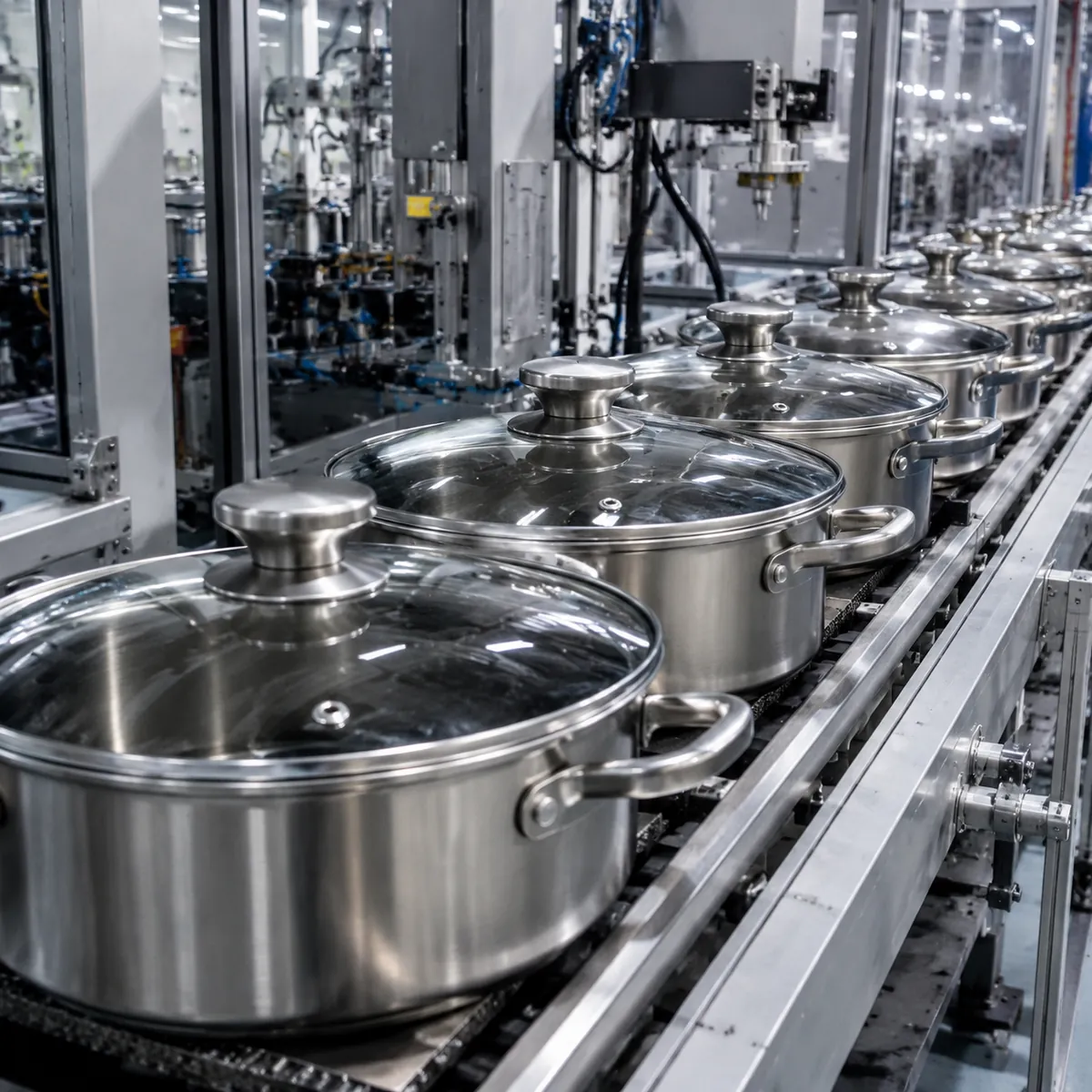
The unboxing: the first 30 seconds decide the review
For a DTC cookware brand, the first 30 seconds after the box opens are the product review. The sequence a customer experiences is: the outer box, the reveal, the pan itself, the inserts and the care card. Each step can be planned. The outer box should open cleanly without tape residue and without foam bits scattering; the pan should be protected by a fitment that keeps it still, wrapped in a layer that does not scratch the coating; the reveal should show a clean, consistent product with no fingerprints; and the inserts should tell the brand story in the few seconds the customer is willing to read.
These details sound cosmetic, but they drive real numbers. An unboxing that feels cheap generates negative reviews and photos of the mess; a clean unboxing generates the kind of photo the brand can repost. The manufacturer’s packaging spec should include the fitment material, the protective layer, the insert design and the care card content, and the pre-shipment inspection should check all of them, not just the pan. If the factory treats packaging as an afterthought, the unboxing will look like one.
The care card deserves special attention, because it is the manual for the most common complaints. Write the care card in the language of the destination market, cover the coating care, the dishwasher instructions and the temperature limits, and keep the claims consistent with the listing. A customer who reads the care card before first use is a customer who returns the pan less often, and the card is one of the cheapest complaint-reduction tools in the program.
Seasonal planning and cash flow
Cookware sells on a seasonal curve, and the first-order plan should respect it. The strongest retail windows are the fourth quarter, when gifting and holiday cooking drive demand, and the early spring, when kitchens get refreshed. A brand that wants to be in stock for Q4 needs to place its production order by late summer, because the manufacturing lead time, sea freight and the marketplace’s stock-preparation cycle do not compress. Plan the production slot with the manufacturer as early as the demand forecast allows, and confirm the slot in writing.
Cash flow planning belongs in the same conversation. The typical payment structure is a deposit at order confirmation, a milestone payment at production completion or before shipping, and the balance against the shipping documents, with the exact split negotiated per order. For a first order, the deposit is usually the largest risk, so tie the deposit to a written spec and an approved sample. Some manufacturers offer payment terms after a history of orders, but a new relationship normally starts with the standard structure, and that is a reasonable trade for a supplier who documents everything.
Plan the currency and the exchange rate exposure too. Cookware is usually quoted in USD for export, and the buyer absorbs the exchange movement between the quote and the payment. For a DTC brand with thin margins, an unfavorable move on a large order can erase the profit, so confirm the quote currency, the validity period of the quote and the payment timing in the contract. The supplier who holds a price for a defined window is easier to plan with than one who re-quotes at every milestone.
How to run the sample round for a DTC line
The sample round is where the DTC brand turns a concept into a product, and it should be run in stages. The first stage is the development sample, which confirms the product can be made to the spec; the second is the production sample, which comes from the actual line and shows what the factory will ship; the third is the packaging sample with the production pan inside, which confirms the unboxing experience. Approving all three in one round is the classic mistake, because each stage answers a different question.
When you receive each sample, test it the way a customer would: cook with it, wash it, check the weight and the handle feel, photograph the unboxing. Write down the measurements and the impressions, and compare the production sample against the development sample, because drift between the two is the first warning of a consistency problem. Keep the approved sample in a safe place and reference it in the pre-shipment inspection instruction, so the inspector compares the batch to the same standard you approved.
Plan the sample budget and timeline from the start. Development samples usually carry a fee that is credited against the production order, and the production sample may be charged separately if the factory runs a dedicated sample line. Confirm the sample cost, the credit terms and the sample lead time in writing, because the sample round is where the first delays happen. A realistic sample round for a new cookware SKU runs two to four weeks from spec to approved sample, and the production slot should be reserved while the sample is being approved, so the approval does not push the production date.
The listing and the product page: sourcing feeds the story
The sourcing decisions flow directly into the listing, and a DTC brand should plan them together. The product dimensions, the weight, the materials and the care instructions on the listing come from the spec sheet; the hero images come from the approved sample; the claims come from the test reports. When the sourcing and the listing teams work from the same documents, the listing is accurate and the claims are defensible. When they work separately, the listing drifts from the product and the first negative review exposes the gap.
Plan the listing content during the sample round, not after the container arrives. Use the approved sample for the photography, measure the actual dimensions and weight for the spec table, and write the care instructions from the factory’s documentation, adapted for the customer. Decide the compliance attributes for the marketplace, such as material, temperature rating and dishwasher safety, from the test reports, and keep the documents in the SKU folder so the platform request is answered in minutes, not weeks.
The listing also sets the demand forecast, which feeds the reorder quantity. A hero SKU with strong listing conversion needs deeper reorder coverage than a supporting item, and the reorder plan should follow the listing data, not the original order. The brand that treats the listing as the end of the sourcing process and the reorder as a separate problem pays for the disconnection twice: once in missed sales and once in overstock.
Frequently Asked Questions
What should a DTC cookware brand ask a manufacturer before the first order?
Ask about packaging and drop-testing, marketplace label compliance, food-contact documentation that names the actual SKU, realistic lead times, mixed-SKU order handling and reorder MOQ. Also ask for production samples and an agreed QC checklist. The answers tell you whether the factory can support a DTC launch or only large retail programs.
How much inventory should a DTC cookware brand order first?
Order the smallest quantity that covers the launch plus a reorder buffer, balanced against MOQ and landed cost per unit. The goal is to learn from real sell-through data before committing deeper inventory. Ordering the maximum to improve unit price usually converts a cash flow problem into a warehouse problem.
What compliance documents does a cookware brand need for marketplaces?
Typically a food-contact compliance declaration for the destination market, test reports for the coating and materials, and documentation supporting specific claims like oven-safe, dishwasher-safe, PFOA-free or induction-ready. Marketplaces may ask for these documents at any time, so keep them per SKU and updated when materials change.
Can a small brand get custom packaging from a cookware manufacturer?
Yes, custom packaging is standard, but the MOQ and lead time depend on the packaging complexity. Printed boxes, fitments and inserts usually have their own MOQs and production time. Ask for a packaging sample with a production pan inside and drop-test it before approving production.
How fast can a cookware manufacturer replenish a best-selling SKU?
It depends on the SKU, the factory’s production slots and the shipping route. Replenishment after the first order is usually faster than the first order because tooling and approvals exist, but peak seasons and coating capacity affect the timing. Ask the manufacturer for a reorder lead time per SKU and reserve production slots early for seasonal launches.
For a DTC cookware launch, plan the packaging as a brand asset, match every listing claim to a document, and size the first order as a learning order with a realistic lead time. Agree the QC standard on production samples and keep batch records from day one. If you are launching a cookware brand and want a manufacturer who supports DTC operations, send your product list and target quantities through our contact page, and we will confirm what we can support.