A cookware material claim is only as good as the document behind it. “18/10 stainless steel” printed on a box means the steel should contain roughly 18% chromium and 10% nickel – but the claim is useful only if the supplier can show the grade on a mill certificate or test report. The same logic applies to aluminum cores and coating systems: ask for the evidence, learn to read it, and keep it with the order file.
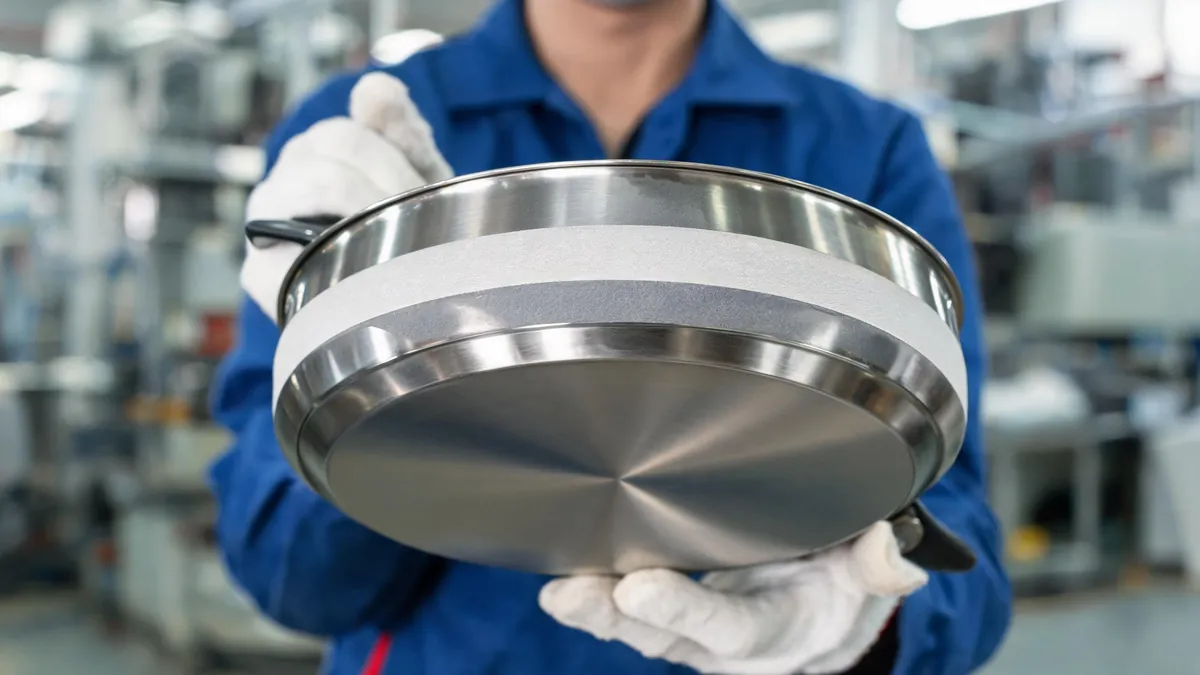
Cookware suppliers sell grades, thicknesses and coatings in every catalog, but the factory floor can differ from the brochure. The verification habit is cheap: request the material documents before production, check the numbers against your specification, and file them with the order. For a wholesale buyer, the document trail is also your protection if a customer asks about material later.
- 18/10 (also written 304): about 18% chromium and 10% nickel. Good corrosion resistance and the classic premium cookware grade.
- 18/0 (also written 430): chromium without nickel. Cheaper, magnetic, less corrosion-resistant, common on pan exteriors and induction-compatible bases.
- Ask for the mill certificate showing the grade; a stamp on the pan bottom is a claim, the certificate is evidence.
- For food-contact surfaces, check the market’s food-grade requirements – grade alone does not answer every compliance question.
Aluminum cores and base construction
Many pans are stainless outside with an aluminum core for heat spread. What matters is the core thickness and how it is bonded. A thick, evenly bonded aluminum core distributes heat; a thin one leaves hot spots. Confirm the core thickness in millimeters and, for a first order, cut-test or inspect one sample so the construction is visible.
Coating types and their test reports
| Coating claim | What to ask for | Why it matters |
|---|---|---|
| Non-stick (PTFE-based) | Coating vendor name, thickness, scratch test report | Cheap coatings degrade fast; vendor brand is a quality signal |
| Ceramic / mineral | Vendor test report, thermal shock result | Ceramic wears differently; confirm the claim with the report |
| Enamel | Enamel thickness and impact test data | Chipping is the common failure; test data shows the spec |
| PFAS-free claims | Independent lab test report | Market regulations vary; the report must match your market |
Mill certificates and independent lab checks
A mill certificate (MTC) comes from the steel mill and states the grade, heat number and composition. Ask the factory for the MTC for the steel batch used in your order, or at least the supplier’s certificate. If a claim is critical – a specific food-contact standard, a PFAS-free statement – an independent lab test of the finished product is the strongest evidence. Confirm who pays and how the sample is taken before you request it.
Building the document file before production
Collect four documents before bulk production starts: the material specification in the order, the mill certificate or supplier certificate for the batch, the coating test report (if coated), and the food-grade compliance documents for your market. If any document is missing at this stage, the factory has time to correct it – after production, it is much harder.
FAQ
Is 18/10 always better than 18/0 for cookware?
For corrosion resistance and premium positioning, 18/10 is usually better on food-contact surfaces. 18/0 is cheaper and magnetic, which is why it appears on pan exteriors and induction bases. The right choice depends on the product design and target price, not on a single grade number.
What is a mill certificate and do I need one?
A mill certificate states the composition and grade of the steel batch from the mill. You need it when a material claim matters to your buyers or your market requires traceability. For standard orders, the supplier’s certificate plus the specification in your order may be enough – confirm the expectation with the supplier.
How do I verify a non-stick coating claim?
Ask for the coating vendor and the test report – scratch resistance, layer thickness and any food-contact documentation. Coating vendors publish specifications, so a named vendor with a matching report is far stronger evidence than a brochure phrase.
Can independent lab tests replace supplier certificates?
Independent tests are stronger evidence because they are not produced by the party selling the goods, but they cost money and time. Use them selectively: for critical claims, new suppliers, or market compliance. Supplier certificates are the baseline; independent tests are the escalation.
Need a material document checklist for your cookware order?
Request a kitchenware quoteRelated reading: cookware material certificates and compliance documents · food-grade certifications for kitchenware