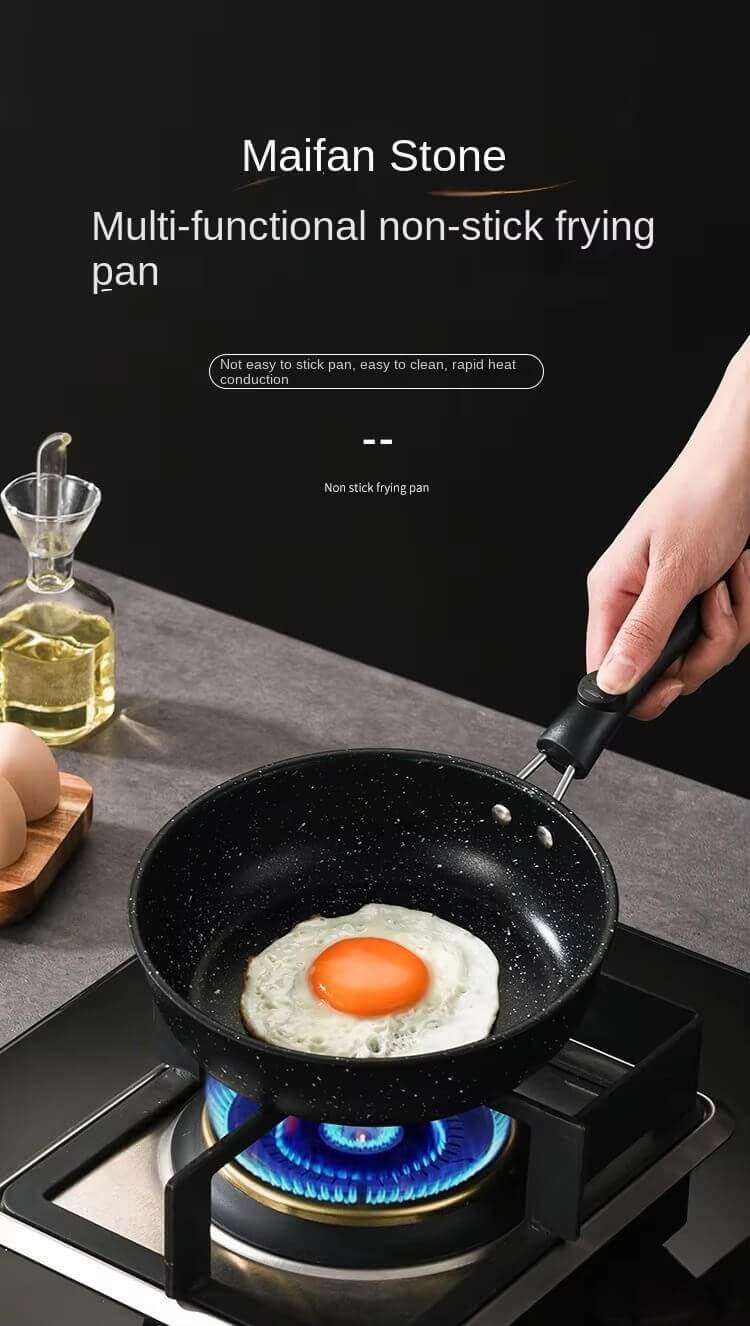
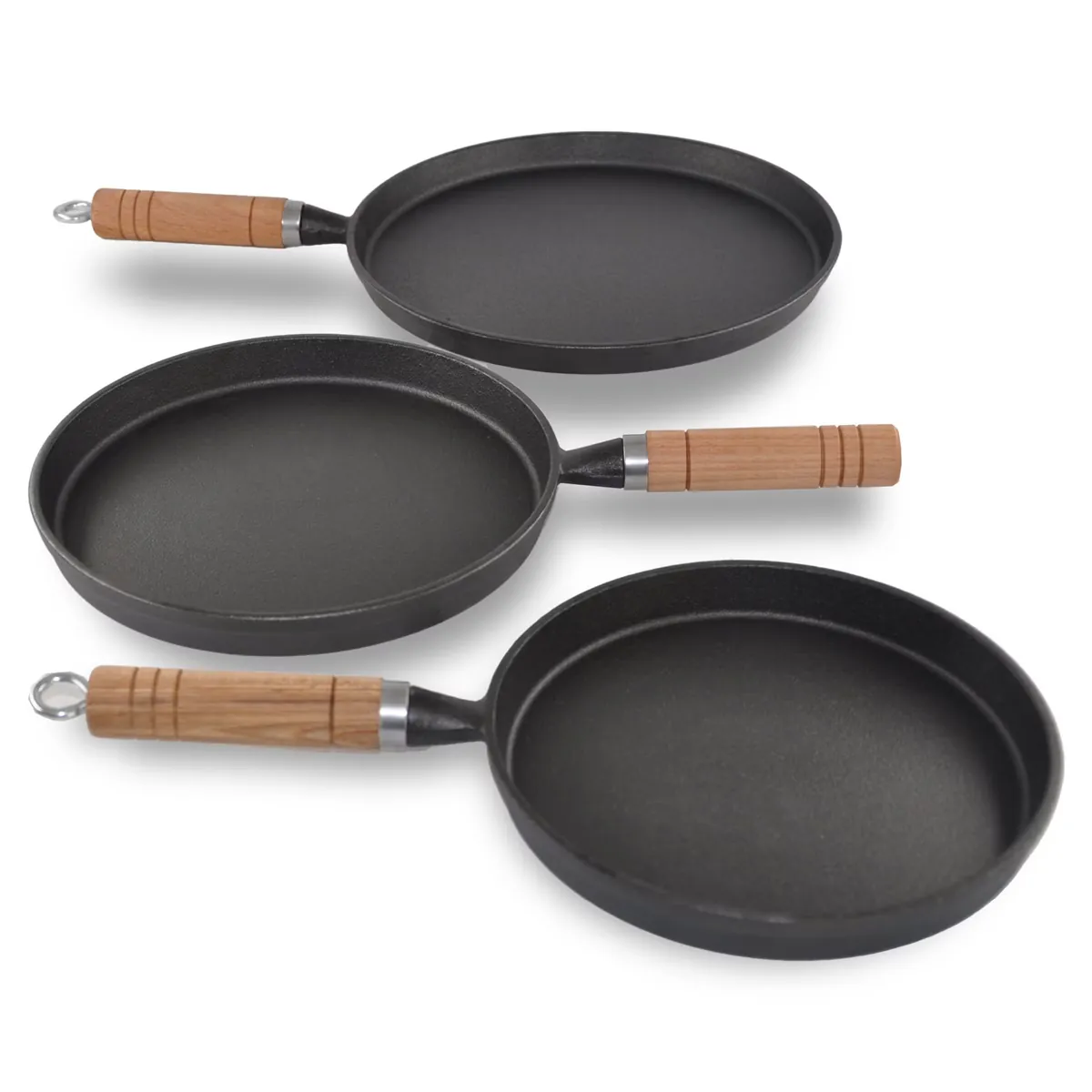
The core of a frying pan factory is four steps: blanking and forming, surface preparation, coating, and handle assembly. If a factory can walk you through each step with real production references, you have found a usable partner. If they only quote prices, keep looking. This guide explains the production process, the coating options you will be offered, and what OEM service should include before your first order.
How Frying Pans Are Actually Made
Most export frying pans start as aluminum discs. The factory stamps or die-casts them into pan bodies, trims the edges, and attaches a base plate where the handle will sit. The body then goes through surface preparation: sandblasting or chemical treatment that gives the coating something to grip. The coating is sprayed or rolled on in layers and cured in an oven. Finally, the handle is attached with rivets, screws, or spot welding, and the pan is packed.
| Step | What happens | What can go wrong |
|---|---|---|
| Forming | Stamping or die casting the pan body | Thin spots, warped rims |
| Surface prep | Sandblasting and cleaning | Poor coating adhesion later |
| Coating | Spraying and curing coating layers | Uneven thickness, peeling |
| Handle assembly | Riveting or welding the handle | Loose handles, wobble |
| QC and packing | Inspection, inner box, master carton | Cosmetic rejects, scratches |
This is the typical sequence for aluminum pans. Cast iron and stainless pans follow different routes, so confirm the process for your specific product.
Coating Options: What You Will Be Offered
The coating is the part of a frying pan that customers feel first. Two families dominate the market.
PTFE-based non-stick coatings
PTFE coatings give the classic easy-release surface. They vary in layers and brand quality. A two-layer system suits budget pans; a three-layer system with a reinforced base is common for mid-range lines. Confirm the coating brand and the number of layers in writing, because the same pan shape with different coatings can differ noticeably in durability.
Ceramic non-stick coatings
Ceramic coatings are marketed as a PFAS-free alternative and offer a different release feel. They usually cannot match PTFE’s long-term release performance, but they suit buyers whose market or brand position prefers ceramic. Confirm the temperature limits and the recommended care instructions for the retail box.
Handle and Base Details That Change the Price
Two details separate a good quote from a great one. First, the handle: bakelite and wood handles are riveted on and are cheaper; stainless steel handles with rivets or welding cost more but suit induction and oven use. Second, the base: induction-ready pans need a magnetic stainless steel disc on the bottom. Ask whether the disc is included in the quote or listed as an extra.
If your market sells heavily on induction stoves, an induction base is not optional. Confirm the base plate thickness and how it is attached, because a thin or poorly bonded disc can warp under high heat.
What OEM Service Should Include
OEM for frying pans usually means the factory produces your design, your logo, and your packaging. Confirm these points before ordering:
- Your logo printed or embossed on the pan base or handle
- Custom color or coating selection
- Your packaging design and inner box printing
- MOQ per SKU for each customization level
- Sample policy: stock sample, custom sample, pre-production sample
Quick check: Should I order a custom sample before mass production?
Usually yes for any custom coating, handle, or logo. A pre-production sample costs time but catches adhesion, handle fit, and packaging problems before they multiply across thousands of units.
FAQ: Frying Pan Manufacturer Sourcing
What gauge of aluminum should a frying pan use?
For mid-range pans, 2.0-2.6 mm aluminum is typical; budget pans may use thinner material, and premium lines go thicker. Confirm the gauge with the supplier, because it affects heat distribution and durability.
How do I know a non-stick coating will last?
Ask for the coating brand, layer count, and any abrasion test data the coating supplier provides. Test a pre-production sample in your own kitchen or lab and compare it with a known benchmark pan.
What is a typical MOQ for an OEM frying pan order?
MOQs usually range from 500 to 2000 pieces per SKU depending on the coating, handle, and packaging customization. Confirm the exact number per SKU, not just per order.
Can one factory produce both non-stick and stainless frying pans?
Some can, but verify each line separately. Stainless pans need polishing and sometimes clad bases, which are different capabilities from an aluminum non-stick line.
QC Checks for Frying Pan Orders
A frying pan QC checklist should cover dimensions, coating, handles, and packing. Measure the pan diameter and depth against the specification, check the rim for warping, and weigh a sample pan, because weight is a fast indicator of gauge compliance. Coating checks include thickness, adhesion, and the absence of pinholes or bare spots, especially around the rim where the coating tends to be thinnest.
Handle checks matter more than most buyers expect. A riveted handle must sit square and tight; a welded handle must show no gaps. Test the pan for wobble on a flat surface, because a slightly twisted base plate makes the pan spin on glass stovetops. Finally, open a few packed cartons and check the inner packaging, the polybag, and the position of the pans, because transit damage usually starts with poor packing.
For the coating, ask whether the factory runs a scratch or adhesion test on each batch. If they do not, request a pre-production sample and test the coating yourself the way your customers will: cooking, scrubbing, and dishwasher cycles. Keep a photo record of the first production batch and compare it with the pre-production sample. Minor differences in color or gloss are normal; major differences in coating coverage or handle alignment are not. Write the results into a one-page checklist so the same tests run on every repeat order.
OEM Terms to Put in Writing
When you negotiate OEM terms, put the sample policy in the same document as the MOQ. Confirm the number of free samples, the cost of a custom sample, and the timeline from design approval to sample delivery. A supplier who commits to a pre-production sample before mass production is usually more reliable than one who treats samples as an afterthought.
Also confirm the branding scope: whether your logo goes on the pan base, the handle, the packaging, or all three, and whether each branding point has its own MOQ. Print plates and packaging artwork are often the hidden cost in an OEM frying pan program, so ask for them as separate line items in the quote.
Final Recommendation
Ask for the production flow, coating details, and handle and base specifications in writing, then order a custom sample before mass production. Frying pans are a high-volume, high-return category, so the sample round is where you protect your margin.
If you are sourcing frying pans and want a review of your specification, send us the target size, coating, and quantity. Request a quote or contact us on WhatsApp for sourcing notes and lead-time estimates.
See the cookware products and kitchenware products collections for the pan styles and finishes our production partners offer.