The same kitchenware order behaves differently depending on whether you are buying from the factory that makes the goods or from a trading company that buys them from factories. The factory controls production and can answer for quality directly; the trader controls selection, consolidation and often better export experience. Your PO, inspection point and payment terms should match the supplier type – using factory terms with a trader, or trader terms with a factory, creates gaps in exactly the places problems appear.

A factory can commit to the production line, the materials and the QC steps for your order. That makes the PO more powerful: name the factory’s own production stages, tie payment to stage evidence, and inspect at the factory against the approved sample. The factory’s limitation is range – a cookware factory cannot suddenly supply your full kitchenware range, and asking it to source outside its line turns you into its customer of a trader anyway.
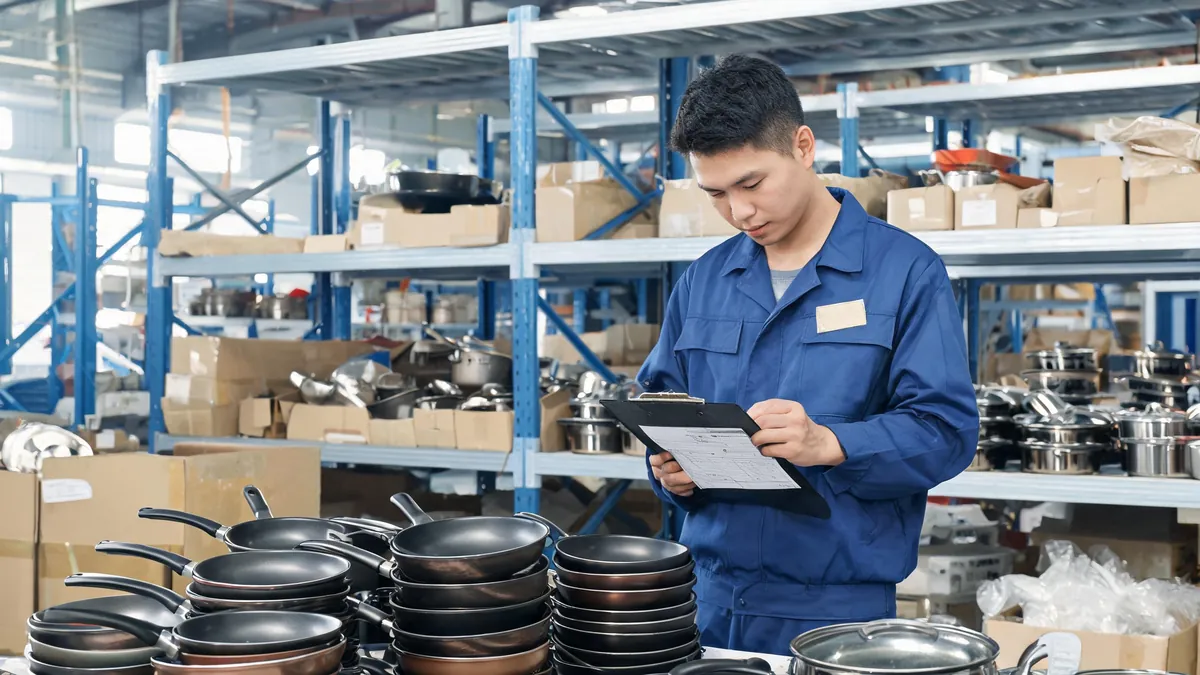
A trading company can assemble a range from several factories and usually handles export documents well. But the trader does not control production, so your PO should name the producing factory, your inspection should happen at that factory (not at the trader’s office), and your payment should be tied to evidence from the production site. The trader’s value is coordination; the risk is that coordination is mistaken for production control.
| Contract point | Buying from a factory | Buying from a trading company |
|---|---|---|
| PO entity | Factory name, factory address | Trader + named producing factory |
| Inspection point | Factory production line and warehouse | Producing factory, not the trader’s office |
| Payment evidence | Production stage photos from the line | Evidence from the producing factory |
| Quality answer | Factory’s QC team | Trader relaying the factory’s answer |
The PO terms that protect you either way
- Name the entity that actually produces the goods – factory name and address.
- Define the inspection point and who can visit it.
- Tie payment milestones to evidence you can name (photos, reports, loading records).
- Set the AQL or acceptance criteria against the approved sample.
- Agree how defects found after arrival are handled – replacement, credit or return.
With a factory these terms are direct; with a trader they work only if the trader can commit the producing factory to them. If the trader will not name the factory, that is the signal that your contract cannot reach the place where quality is decided.
Payment structure by supplier type
Factories commonly work on a deposit plus balance-before-shipment, and accept staged payments tied to production. Trading companies have the same payment preferences but the evidence that releases each payment must come from the producing factory. When a trader asks for full payment before the goods leave the factory’s warehouse, ask for the factory’s packing and loading evidence first – that protects you against paying for an order that is still sitting unproduced.
How to tell which one you are dealing with
Ask for the factory license and compare the business scope with your product; ask which production lines would make your order and for a video walk through the relevant workshop; and ask whether the invoice and the contract entity are the same as the producing factory. A factory answers these directly; a trader answers with another company’s name. Neither type is automatically better – the risk is not knowing which one you have.
Choosing by order profile instead of supplier label
The practical decision between a factory and a trader depends on the order profile: a single product at high volume fits a factory; a broad range across several factories fits a trader; a new brand testing the market may fit either with small orders and clear contracts. Rather than asking ‘which type is better’, ask which structure lets you name the producer, inspect the production and tie payments to evidence for this specific order – then choose the supplier type that can deliver that structure honestly.
FAQ
Is it safer to buy from a factory than a trading company?
Not automatically. A factory gives direct production control but limited range; a trader gives range and coordination but not production control. The safe structure is the same either way: name the producing entity, inspect at the production site, and tie payments to production evidence.
Should my contract name the producing factory when I buy from a trader?
Yes – it is the only way your quality terms can reach the place where the goods are made. If the trader will not name the factory, treat that as a risk signal.
Where should inspection happen for a trader-supplied order?
At the producing factory, against the approved sample and your AQL. Inspecting at the trader’s office or warehouse only confirms what the trader received, not what the factory produced.
Can a factory supply my whole kitchenware range?
Usually only if the range matches its production lines. Beyond that, a factory sources from other factories – at which point it is acting as a trader, and your contract should reflect that.
Unsure whether your kitchenware supplier is a factory or a trader and how to structure the order?
Ask KitchenWareSourcingRelated reading: kitchenware factory vs trading company basics · kitchenware supplier contract clauses