Most importers start with one kitchenware supplier, and most should stay that way for the first three to six months. A second supplier is not a badge of sophistication — it is a decision with real costs in samples, QC time, onboarding and minimum orders. The right question is not “how many suppliers should I have” but “what risk am I trying to remove, and is a second supplier the cheapest way to remove it?”
What Single Sourcing Actually Means
Single sourcing does not mean buying everything from one factory forever. It means concentrating your volume with one supplier per product category for a defined period — typically until that category reaches a volume where the relationship itself becomes a risk. In practice, a kitchenware importer with one cookware factory and one bakeware factory is still single sourcing within each category. The important boundary is per category, not per company.
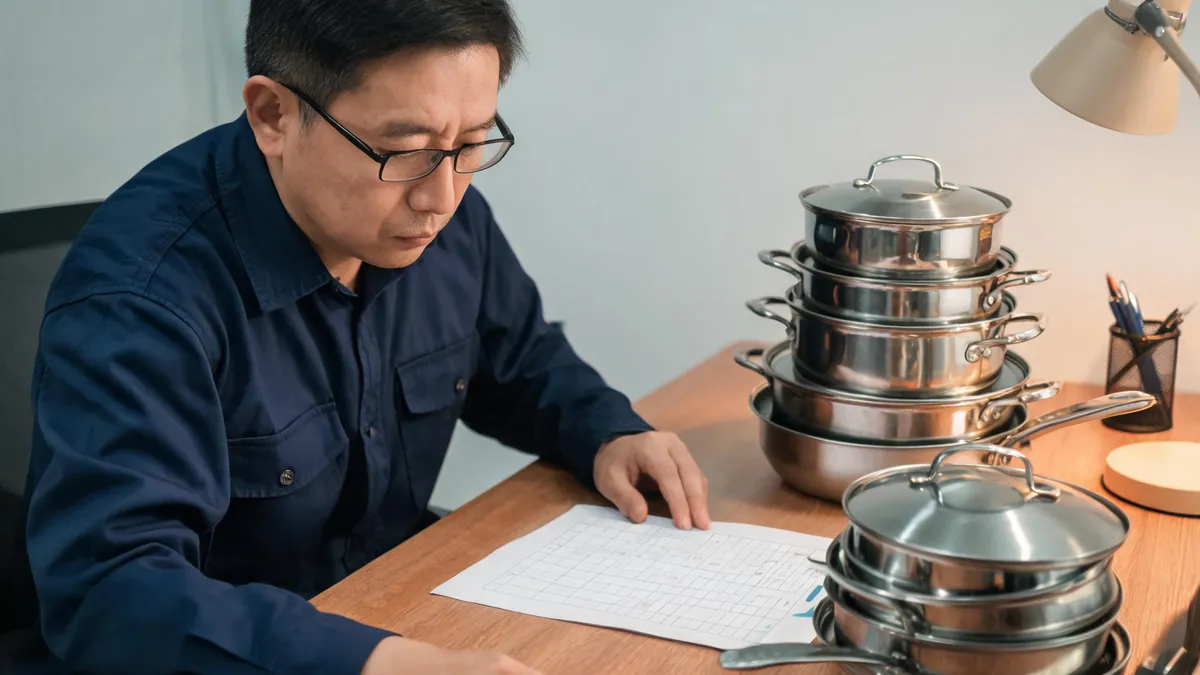
Single sourcing is the default for good reasons. It concentrates your volume, which is the main lever you have on pricing, MOQ and priority treatment. A factory that sees 60 percent of your cookware volume treats you as a key account. A factory that sees 15 percent treats you as one more customer. The difference shows up in order slots during peak season, in sample turnaround, and in how quickly problems get solved.
It also simplifies quality control. One factory means one set of specs, one set of test reports, one QC relationship, one packing standard. Every additional supplier adds a parallel quality system you have to understand and audit. For a buyer managing three or four product lines, the QC overhead of two suppliers per line multiplies quickly.
Single sourcing concentrates knowledge too. After two or three orders, your contact at the factory knows your product, your tolerances and your complaints. That institutional memory is genuinely valuable — a new supplier starts from zero every time, and the first order with a new factory is always the riskiest one.
When One Kitchenware Supplier Is Enough
There are clear situations where a single supplier per category is the right answer, and chasing a second one would be a mistake:
- Your volume per category is below two MOQs per year. At that level, splitting between two factories pushes both below the minimums that earn decent pricing.
- You are still in the first two order cycles with the factory. You do not yet know their real defect rate, their real lead times or their real communication patterns. Adding a second supplier before you understand the first is multiplying unknowns.
- Your category is highly tooled — custom silicone molds, custom embossing, branded packaging. Moving or duplicating tooling is expensive, and a second supplier may not justify the tooling duplication.
- You sell a narrow range where one factory genuinely covers the line, such as a specialized stainless steel cookware program with a single production cluster.
- Your supplier is financially stable, meets delivery dates, and has handled at least one quality dispute fairly. That is a rare combination, and it deserves your loyalty until evidence says otherwise.
None of these conditions is permanent. They are conditions under which adding a supplier is a cost, not an investment. Revisit the decision every season — the right structure changes as your volume changes.
Why Buyers Add a Second Supplier
Dual sourcing becomes attractive when the risk of relying on one factory exceeds the cost of qualifying a second. The most common triggers in kitchenware importing are:
- Capacity risk. Your peak season (typically holiday cookware and bakeware) requires more production slots than one factory can guarantee. A second factory absorbs the overflow and protects your retail launch dates.
- Financial risk. You have seen signs of instability — late samples, slow communication, changed payment terms — and you want a fallback before you need it, not after.
- Price leverage. A credible second quote keeps the first factory honest. Suppliers price differently when they know a buyer can move volume elsewhere.
- Category expansion. You are adding a product line the first factory does not make well, such as silicone bakeware next to your metal bakeware program.
- Geographic spread. Some buyers want factories in different clusters (for example one in Yongkang for cookware and one in Yangjiang for knives) to diversify against cluster-level disruptions like power cuts or material shortages.
| Factor | Single source | Dual source |
|---|---|---|
| Pricing leverage | High — all volume with one factory | Medium — volume split, but quotes stay competitive |
| MOQ flexibility | Better — factory knows your program | Each factory needs its own minimums |
| QC overhead | One system, one relationship | Two systems, two audits, more samples |
| Supply security | Single point of failure | Fallback exists if one factory fails |
| Peak-season capacity | Limited to one factory’s slots | Two factories share the load |
| Communication cost | Lower — one contact, one history | Higher — two teams, two cultures |
| Best for | New importers, narrow ranges, low volume | Seasonal peaks, unstable suppliers, wide ranges |
The table hides one nuance: dual sourcing does not have to mean 50/50. Most buyers run a primary supplier at 70–80 percent and a secondary at 20–30 percent. The secondary keeps the primary honest and provides a tested fallback, while the primary keeps most of the pricing leverage. This asymmetric split captures most of the benefit of dual sourcing with a fraction of the overhead.
Quick answer on timing: If you are considering a second supplier because of a specific risk — a missed delivery, a slow sample, a changed payment term — fix the risk first, then decide. A second supplier does not repair a broken relationship with the first; it only gives you somewhere to move.
How Dual Sourcing Changes MOQ and Pricing
Every factory prices against its own minimums and its own utilization. When you split volume, each factory sees a smaller order program, and each applies its volume-based pricing to that smaller number. The result is usually a 3–8 percent pricing penalty compared to consolidated volume — sometimes more for heavily tooled products. You need to know this number before you commit to dual sourcing, because it is the price of the security you are buying.
MOQ behavior changes in a different way. With one factory, your MOQ is a negotiation about the whole program: “I will commit to six SKUs and reorder quarterly; give me a combined minimum.” With two factories, each negotiation is smaller and each factory protects its own setup costs. Expect less MOQ flexibility from both, especially in the first year while neither has history with you.
There is one offsetting benefit: competition on the quoting side. Factories that know you have a second option quote their real price earlier in the negotiation, and they respond faster to spec questions. Over two or three order cycles, the competition effect can recover part of the volume penalty you pay. This is why the 70/30 split works — the primary factory knows the secondary exists without being forced to a 50/50 loss of scale.
One caution: never tell a factory about the second source in a way that makes your program look unstable. Present it as a capacity strategy, not as a threat. Suppliers behave differently when they believe the relationship is durable.
The Real Costs of a Second Supplier
Qualifying a second kitchenware supplier is not free, and the cost is mostly your time. Count the full list before you start:
- Samples: one to three rounds, typically 2–6 weeks total, plus sample fees on custom items.
- Documentation: business license, export records, test reports, and a re-run of the supplier evaluation you did for the first factory.
- QC setup: agreeing AQL levels, defect definitions, inspection points, and a packing standard that matches your retail requirements.
- Tooling, if applicable: new molds, new embossing, new packaging plates. Duplicated tooling is often the single largest cost of a second supplier.
- Your own learning curve: the first order with any new factory has a higher defect-discovery rate than later orders, by definition.
Add these to the volume penalty and you get the true cost of dual sourcing. Compare that with the cost of the risk you are removing: a failed season because the single factory could not deliver, or a lost deposit because the factory collapsed. For most importers, the balance tips toward dual sourcing only when one of the risk triggers is actually visible — not as a precaution against a theoretical future.
A Phased Approach: Start Single, Add a Second on Reorder
The cleanest structure for most kitchenware importers is sequential rather than parallel. Phase one: run your first two order cycles with one factory per category. Use that period to build the relationship, learn the real defect rate, and establish a baseline for pricing and lead times. Phase two: on the third or fourth order cycle, introduce a second factory with a small trial order — one or two SKUs, not the full range. Phase three: if the trial factory matches quality and delivery, allocate 20–30 percent of the next season’s volume to it while keeping the primary at 70–80 percent.
This phased approach has three advantages. First, it does not ask you to evaluate two factories at once — the highest-risk moment in sourcing is the first order with an unknown factory, and you only have one of those at a time. Second, it builds your secondary supplier’s history with real orders, so the fallback is tested rather than theoretical. Third, it protects your primary relationship: the primary factory sees the secondary as an overflow partner, not a replacement, and keeps giving you priority treatment.
When you expand the range, use the same logic. Add new categories with the factory that already knows you, then qualify a second source for the new category only when volume justifies it. This keeps the number of new relationships manageable at every stage.
If you are planning your supplier matrix now, start from your product list rather than from theory. Map each category to the factories on our kitchenware products and cookware products pages, decide which category carries the most risk, and qualify a second source there first — not in the category where everything is working.
Common Mistakes When Moving to Dual Sourcing
Importers who move to dual sourcing usually make one of these errors. Recognizing them early keeps the transition cheap:
- Splitting 50/50 from day one. You lose pricing leverage on both sides and double the QC load without any tested history on either factory. Start asymmetric.
- Using the second supplier as a punishment tool. A factory that feels threatened stops investing in your relationship. Frame the second source as capacity and risk management.
- Copying the primary’s specs without re-verification. Each factory has different tolerances, different coating vendors, different packing habits. Re-approve samples from the second factory even when the spec sheet is identical.
- Forgetting mold ownership. If you paid for tooling at the primary, your second source needs its own tooling — or the same drawings licensed. Confirm ownership and release terms in writing for both factories.
- Neglecting the reorder rhythm. Two suppliers means two production calendars, two lead-time windows and two seasonal peaks. Put both on your import calendar or one of them will quietly miss your window.
The same discipline applies if you source complementary ranges from specialist factories — for example pairing cookware from a pan specialist with drinkware from a tumbler factory such as Frozl. Specialist factories usually deliver better consistency than generalists, but each one adds its own onboarding cycle to your calendar.
How to Qualify a Second Supplier Without Disrupting Your Program
Qualifying a second kitchenware supplier is a project, and like any project it needs a plan. The goal is not to replace the primary — it is to have a tested option ready, with known quality, pricing and lead times, before a disruption forces the decision.
Start with the same documentation gate you used for the first factory. Request the business license, export records, bank reference and relevant test reports, and run the same checks you would run for any new supplier. Then order samples of the two or three SKUs you consider most likely to move to the second source. Judge the samples against your approved first-factory samples, not against the spec sheet alone — the spec sheet describes intent; the approved sample is your baseline for what your retail customers already accept.
Run a pilot order before you commit volume. A pilot of one or two SKUs at the second factory’s minimum tells you three things: whether the factory meets delivery dates in practice, whether the QC relationship works, and whether the product survives your actual retail environment. Do not skip the pilot because the samples were perfect — samples are made by the best operator in the best week; production runs are made by the whole factory under schedule pressure.
Document the pilot results in the same format you use for the primary factory: defect rates, delivery performance, packaging quality, communication response times. When the pilot passes, you have a qualified second source. When it fails, you have saved yourself a season of problems and learned something about the market’s quality range.
One practical tip: keep the second supplier’s qualification file in the same system as the first. When a disruption happens, you will not have time to search for the license, the sample photos, or the QC contact. A sourcing file that is ready to act on is worth more than a second supplier that is technically qualified but undocumented.
Category by Category: Where Dual Sourcing Actually Pays
Dual sourcing is not one decision for your whole business — it is a decision per category, and the right answer differs by product line. Kitchenware splits into several categories with very different risk profiles:
- Standard cookware (frying pans, saucepans): High volume, many qualified factories, and products that differ mainly by gauge and coating. This is the easiest category to dual source, because re-qualification is fast and the specs are portable. If you dual source anywhere, start here.
- Heavily tooled bakeware (custom silicone molds, embossed metal pans): Tooling duplication is expensive and the specs are factory-specific. Dual sourcing usually only pays if the first factory shows real risk — otherwise the tooling cost outweighs the security.
- Knives and cutlery: Production is cluster-concentrated (Yangjiang in China) and quality depends on steel sourcing and heat treatment. A second factory in the same cluster reduces single-factory risk but not cluster risk; a factory in a different cluster is harder to qualify but diversifies more.
- Stainless steel cookware sets: High MOQs and heavy packaging. Dual sourcing doubles the packaging programs and the set-configuration risk, so it pays mainly at the volume where two factories can both run efficient lines.
- Tableware: Often sourced as mixed programs from regional clusters. Dual sourcing is common because tableware programs are already multi-factory, but each factory adds a compliance file you must maintain.
Use this category map to prioritise. Put your dual-sourcing effort where the risk is real and the re-qualification cost is low — standard cookware first, tooled bakeware only when necessary. Every category you dual source should appear on your import calendar as a separate line, with its own lead times and its own seasonal peaks.
Signals That Your Single Source Is Becoming a Risk
Dual sourcing is easier to plan in a calm quarter than in a crisis, so it helps to watch for the early signals that a single-source relationship is degrading. Most of these are visible three to six months before a delivery failure:
- Delivery dates start slipping by a week or two, then by a month. Late deliveries compound — the first slip pushes your next order into peak season, where the delay doubles.
- Sample turnaround slows. A factory that used to ship samples in five days now takes three weeks. The sales team is still friendly; the production floor is not.
- Spec drift appears: the latest batch has a slightly thinner coating, a lighter handle, or a packaging change nobody mentioned. Small spec drift is how margin gets recovered when a factory is under pressure.
- Communication becomes vague. Answers to “when will the goods be ready” shift from dates to phrases like “next week, maybe.” Vague answers are the sales layer protecting a production problem.
- Payment terms tighten without a market reason, or the factory starts asking for early payment “to secure materials.” Both are cash-pressure signals.
None of these signals is a reason to panic, and none alone justifies a disruptive supplier change. But two or three together are a reason to start the qualification project described above — while there is still time to run it calmly. The buyer who qualifies a second source in a calm quarter has options; the buyer who starts looking after a missed shipment is negotiating from weakness with every factory in the market.
Frequently Asked Questions
Is one kitchenware supplier enough for a new importer?
Yes. For the first two order cycles, one factory per product category is normally the right structure. It concentrates volume for better pricing and MOQ terms, simplifies QC, and lets you learn one supplier’s real behavior before adding complexity.
When should I add a second supplier?
When you see a concrete risk — capacity shortfall in peak season, signs of financial instability, or a category expansion the first factory cannot serve well. A second supplier should remove a visible risk, not a theoretical one.
What is the best volume split for dual sourcing?
Most buyers run 70–80 percent with the primary and 20–30 percent with the secondary. This keeps most of the pricing leverage while maintaining a tested fallback.
Does dual sourcing increase my MOQ?
It usually reduces MOQ flexibility, because each factory sees a smaller program and protects its own setup costs. Expect a small pricing penalty (often 3–8 percent) and less room to negotiate combined minimums, especially in the first year.
Not sure whether your range needs a second supplier? Send us your current product list and volumes — we work across cookware, bakeware and stainless steel lines and can help you map which category carries the most supply risk. Request a sourcing consultation and we will walk through your supplier matrix with you.