Muffin pans are one of the highest-turnover bakeware lines a retailer or bakery buyer can stock, but the wholesale spec sheet matters more than the photo. Cavity count, cup size, material, gauge, coating and packaging all change what the pan costs and how it performs in a commercial oven or on a retail shelf. This guide walks through the specifications to pin down before you request a quote, and the checks that separate a pan that lasts from one that warps in the first season.
Standard Muffin Pan Sizes and Cavity Counts
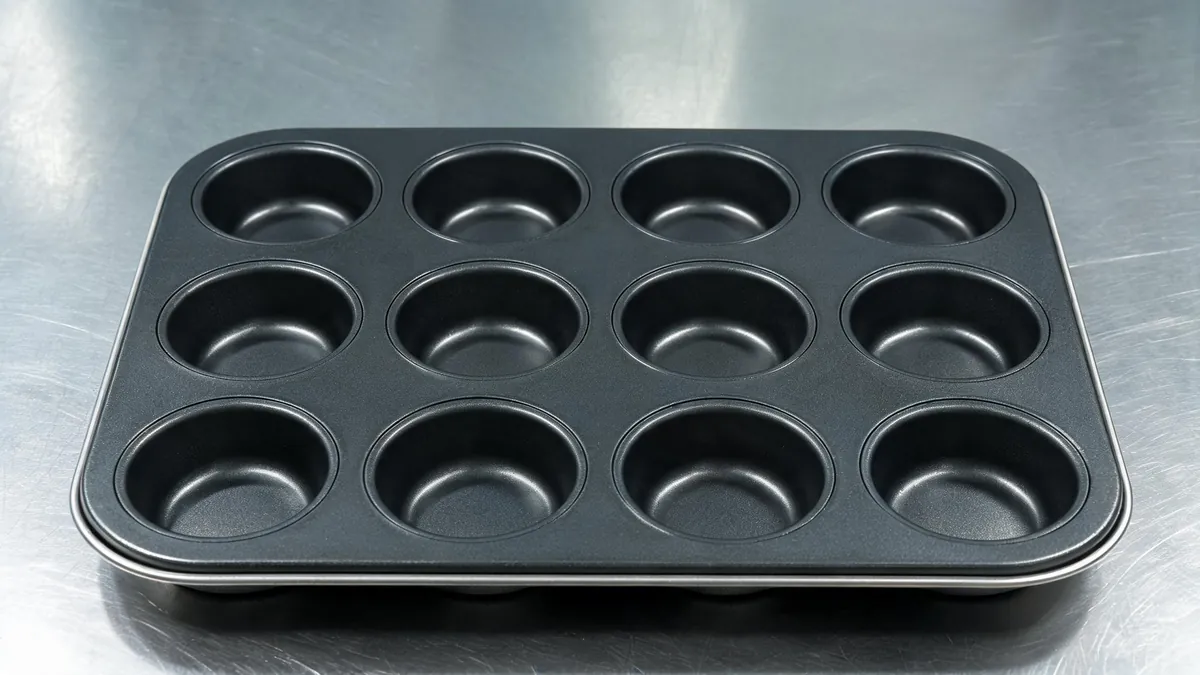
The first decision is cavity count, and it is not just a packaging question — it determines which ovens the pan fits, how the carton packs, and what your retail unit economics look like. The most common commercial formats are:
| Format | Cavities | Typical pan size | Typical use |
|---|---|---|---|
| Half-size muffin pan | 6 | ~38 × 17 cm | Home retail, small bakeries, domestic ovens |
| Standard muffin pan | 12 | ~40 × 28 cm | Home retail, standard ovens, restaurants |
| Commercial full-size sheet | 24 | ~60 × 40 cm (GN 2/1 style) | Bakery rack ovens, high-volume production |
| Mini muffin pan | 24 | ~40 × 28 cm | Retail novelty, appetizers, catering |
| Jumbo muffin pan | 6 | ~38 × 28 cm | Bakery retail, large-format muffins |
Verify pan dimensions against your target market’s standard oven and rack sizes before ordering. A 12-cup pan sized for the US market may not fit a European compact oven, and a full-size 24-cup sheet follows the GN (gastronorm) rack standard that commercial bakeries already use. If you sell into both regions, confirm the dimension on the spec sheet — “12-cup muffin pan” alone does not tell you the outside size.
Cup diameter and depth matter as much as the count. A standard cup is roughly 7 cm top diameter with a 2.5–3 cm depth, giving a standard muffin portion. Mini cups run about 3.5–4 cm. If you are importing for a bakery chain, they will almost certainly have a target baked weight per muffin — cup volume drives that, so request the cup volume in millilitres rather than just the diameter.
Quick answer on the 24-cup format: If your customer is a commercial bakery, the full-size 24-cup sheet on the GN rack standard is usually the first SKU to quote, because it matches how professional ovens are loaded. Retail-only buyers should start with the 12-cup pan, which is the format consumers recognise.
Materials: Carbon Steel, Aluminized Steel, Non-Stick and Silicone
The material determines the pan’s heat behavior, its weight, its price point and its lifecycle. Wholesale buyers should compare at least four options:
| Material | Heat behavior | Weight | Typical price position | Best for |
|---|---|---|---|---|
| Cold-rolled carbon steel (bare) | Fast, even heating; needs greasing | Heavy | Economy | Commercial baking where pans are greased anyway |
| Aluminized steel | Even heating, lighter than carbon steel | Medium | Mid-range | Retail and bakery lines with good durability |
| Non-stick coated steel | Good release, easy cleaning | Medium | Premium | Retail, home bakers, cafes |
| Platinum-silicone (food-grade) | Flexible release, moderate browning | Light | Premium | Novelty shapes, home retail, gifts |
Commercial bakeries often prefer bare or lightly oiled carbon steel because it browns consistently and survives hundreds of cycles — the coating is not there to fail. Retail buyers usually prefer non-stick because the end consumer values release and easy cleaning. Silicone pans sell well at retail for their flexibility and colors, but they bake differently: thinner crust, lighter browning, and a pan that needs a tray underneath because it is floppy when full.
Do not assume “non-stick” means the same thing from every factory. The coating system, the number of layers and the cure process vary, and so does the release performance in the first month of use. Confirm which coating system the factory uses and request the coating thickness range if it is available. If you cannot verify the coating specification, ask for a bake test on the pre-production sample and judge release with a real batter — not with the factory’s own photos.
Gauge, Thickness and Warp Resistance
Pan thickness is the spec most retail buyers skip and most commercial buyers check first. Thicker steel resists warping and distributes heat more evenly, but it costs more and weighs more, which raises freight. The typical range for muffin pans is roughly 0.4 mm to 1.0 mm steel, with heavier commercial sheets at the top end.
Warp resistance is the practical test. A thin pan that warps in a hot oven spills batter unevenly, bakes unevenly, and looks bad on a retail shelf. On the pre-production sample, ask the factory to demonstrate a heat test: place the pan in an oven at the rated temperature, then measure flatness after cooling. A pan that stays flat through a rated-temperature cycle is a pan you can sell. A pan that bows is a return problem waiting for your next season.
Reinforcement matters as much as raw gauge. Rolled or reinforced rims, and stiffening ribs on large sheets, add rigidity without adding full-gauge weight. On full-size 24-cup sheets, ask specifically about rim construction — a sheet that flexes in the middle will not hold its shape in a rack oven.
Weight also drives your freight calculation. A container of heavy carbon steel muffin pans weighs more than the same carton count of silicone pans, and landed cost per unit changes accordingly. When you compare quotes, compare landed cost per cavity, not per pan — the 6-cup and 12-cup formats share the same per-unit math only by coincidence.
Finishes: Bare, PTFE, Ceramic and Silicone-Coated
Finish selection is a retail decision as much as a baking decision. The finish determines how the product looks on the shelf, what claims you can print on the packaging, and what the consumer expects in the first bake.
- Bare carbon or aluminized steel: The workhorse finish. Looks industrial on the shelf, so it sells mainly to commercial buyers and value-conscious consumers who understand seasoning. No coating claims to manage.
- PTFE-based non-stick: The mainstream retail finish. Excellent release, easy cleaning, familiar to consumers. Verify the coating is PFOA-free if you market in regions where that claim matters, and confirm the temperature rating matches the product’s use.
- Ceramic-coated non-stick: A different release chemistry, usually marketed as a more “natural” alternative. Performance varies more by factory than PTFE does, so bake-testing the sample is essential before you commit a container.
- Silicone-coated steel: A hybrid used on some commercial sheets — easier release than bare steel without a full non-stick system. Less common at retail, more common in bakery supply.
Whichever finish you choose, the temperature rating must match the use case. A retail muffin pan rated to 230°C covers home ovens comfortably. A commercial sheet used in a bakery needs the factory’s rated temperature on paper, and the bake test should run at the temperature your customer actually uses, not the marketing temperature on the box.
Finish durability is a commercial decision. Retail pans get replaced by the consumer; commercial pans get used twice a day for years. If you sell to bakeries, ask about coating wear under repeated cycles and get the factory’s recommended care instructions in writing — your bakery customer will follow them, and the pan’s lifespan depends on it.
Commercial vs Retail Lines: Packaging and Compliance
The same pan ships very differently depending on whether it is going to a bakery or a retail shelf. The split affects packaging, labelling and your QC checklist.
| Line | Packaging | Label requirements | QC focus |
|---|---|---|---|
| Commercial / bakery | Bulk cartons, foam or paper interleave between pans, no retail sleeve | Carton marks only; spec sheet and test report for the buyer | Flatness, gauge consistency, coating adhesion over cycles |
| Retail | Individual sleeve or hang tag, color printed box, sometimes a gift format | Product name, material, size, care instructions, food-contact statement | Surface finish, no scratches or fingerprints, print quality on the sleeve |
Retail packaging adds real cost — a printed sleeve and a hang tag can add a meaningful percentage to the unit landed cost, and print approval adds two to four weeks to your timeline. Get the packaging artwork approved in the same cycle as the product sample, not after, or you will pay for two production stops.
Food-contact documentation is not optional for export. Confirm with the supplier which food-contact statements apply to the coating and material in your target market, and request the corresponding test reports. Do not rely on a generic “food safe” claim — ask for the report that backs it, and confirm the report covers the coating system actually used on your pans. If the factory cannot provide a report for the exact coating, treat the finish as unverified until a sample is tested.
Quick answer on compliance documents: Request the food-contact test report in the same email as the sample request. A factory that routinely exports bakeware produces these without delay; hesitation here usually means the coating vendor, not the factory, holds the documentation — a distinction worth knowing before you commit.
Supplier Checks Before Your Muffin Pan Order
Muffin pans look like a simple line, but the supplier checks are the same as for any cookware or bakeware program. Verify that the factory actually produces the format you are buying: a bakeware factory that makes half-sheets may not run 24-cup muffin pans on the same line, and the tooling for cavity-forming is specific to the product.
- Confirm the forming process: pressed or roll-formed cavities, and whether the factory owns the dies for your cavity size.
- Request a pre-production sample with your exact coating and finish, then bake-test it at your target temperature and judge release, browning and flatness.
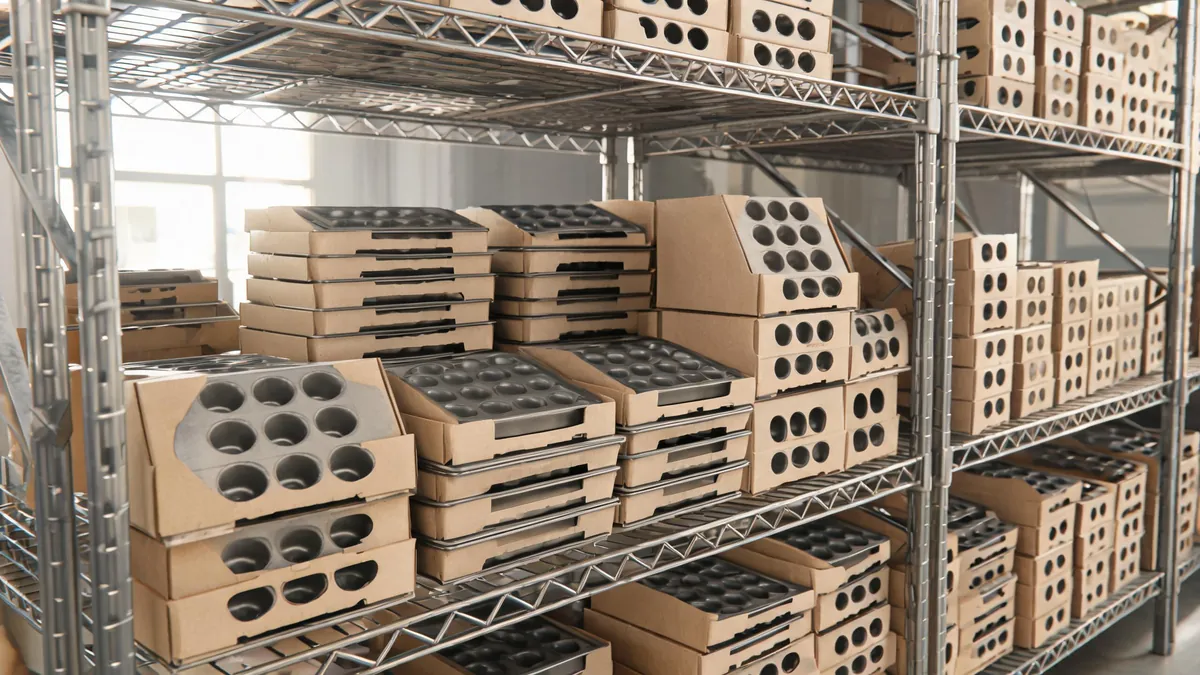
- Ask for the carton packing plan: pans per carton, interleave material, carton dimensions and gross weight. Verify the carton survives a drop test if you ship retail-ready.
- Confirm the MOQ in pans or sheets — 24-cup sheets and 12-cup pans have very different MOQ economics, and the factory’s minimum should match your sell-through plan.
- Request the food-contact test report and the coating vendor details in writing before you place the order.
Bakeware factories in the main Chinese production clusters handle all of these routinely. Our bakeware products page covers the range we source — muffin pans sit alongside sheet pans, cake pans and loaf pans in the same factory qualification system, so the checks above are the ones our own buyers run before any bakeware line is approved.
Planning Your Muffin Pan SKU Mix
A common mistake is importing one format and assuming it covers the market. Retail buyers typically need two or three: a 12-cup non-stick pan as the flagship, a mini 24-cup for variety and catering, and possibly a jumbo 6-cup for bakery-style lines. Commercial buyers usually need a single full-size 24-cup sheet in bare or coated steel, plus a mini format for appetizers.
Think about the season too. Muffin pans are a year-round line in most markets, but they spike with back-to-school and holiday baking in the autumn. If your import calendar lands the first container in October, you have already missed the retail window — plan the order for a June or July shipment for the autumn sell-through. If you also supply café and restaurant fit-out projects, the same pans can ride along with larger equipment orders, which is why bakery buyers often coordinate bakeware with furniture and fixtures suppliers on the same project timeline.
For buyers stocking a full café or bakery opening, muffin pans are one line among many — equipment, furniture and tableware arrive on separate schedules, and coordinating them avoids a café that opens with ovens but no pans, or tables but no chairs. A supplier such as FurnitureOrigin handles the restaurant furniture side of the same projects, which keeps the fit-out calendar simpler when you are managing multiple import streams.
Cup Volume, Batter Yield and Portion Control
For bakery buyers, the muffin pan specification that matters most is not the outside size — it is the cup volume, because cup volume drives portion cost and recipe consistency. A bakery that sells a standard 85 g muffin needs a cup that holds that batter weight without overflowing and without baking a flat, wide muffin that customers read as “small.”
Ask the factory for cup volume in millilitres or fluid ounces, and cross-check it with a simple water test on the sample: fill a cup to the rim and measure the water. The labeled volume and the real volume should match. When they do not, the recipe your bakery develops against the sample will not match the production pans, and the first batch from the container will look different from the approved sample — a problem that surfaces exactly when you can least afford it.
Portion consistency across the pan matters as much as total volume. A pan with one slightly shallow corner bakes uneven portions, and in retail that becomes a complaint pattern: “the end muffins are smaller.” Check cavity depth consistency on the sample with a depth gauge or a straightedge across the pan. Consistent depth across all cavities is a manufacturing quality signal — it means the die and the forming process are under control.
Batter yield planning is where the buyer turns specs into money. If the pan holds 100 ml per cup and your recipe fills 12 cups, the pan is a 1.2-litre baking tool. Compare that across supplier quotes and you will often find that “12-cup pans” from different factories are not the same size at all — one may hold 20 percent more batter, which changes your cost per muffin and your retail margin. The pan that looks cheapest per unit can be the most expensive per muffin if the cups are small.
This is also the point where commercial buyers should confirm the pan’s rating against their actual oven temperature. Bakery ovens run hot, and a retail-rated pan at 230°C may not hold up in a 260°C deck oven. Confirm the rated temperature on the spec sheet and test the sample at the temperature your kitchen actually uses.
Freight, Carton Efficiency and Landed Cost per Pan
Muffin pans are dense, awkward cargo, and the way they pack determines a meaningful part of your landed cost. A pan’s value is not the factory price per unit — it is the factory price plus freight, divided by the number of pans that fit in a container.
Carton efficiency starts with pan nesting. Bare steel pans stack efficiently because they nest tightly; non-stick pans usually need interleave paper or foam between surfaces, which increases carton volume and weight. Silicone pans are light but bulky when the packaging includes a tray or a display sleeve. Ask each factory for the carton plan — pans per carton, carton dimensions, gross weight — and compute the container utilization before comparing quotes.
Weight drives freight twice: once in the container, once in the retail parcel if you ship to end customers. A heavy commercial sheet pan costs more to freight than a lightweight retail pan, and that difference is visible in your landed cost per unit. For retail lines, the packaging weight also affects your DDP or FBA-style landed cost calculations, where every gram has a price.
There is a trade-off between durability and freight that only you can price: a heavier, thicker pan costs more to ship but lasts longer and performs better. A thin economy pan is cheap to ship but may warp, and a warped pan in a retail box generates returns that cost more than the freight saving. The right answer depends on your channel — commercial buyers usually pay for thickness; retail buyers often optimize for price and presentation.
When you compare quotes, put them on the same basis: landed cost per cavity at the container level, including the packaging plan. Only then does the “cheaper” factory stay cheaper. Our bakeware products range is planned this way — every line is quoted with the carton plan and freight basis so the comparison is honest before you commit.
Sample Approval Checklist for Muffin Pans
The pre-production sample is where most muffin pan problems can be caught, if you check the right things. Use a short checklist instead of a visual once-over:
- Dimensions: Outside pan size, cup count, cup diameter and depth against the spec sheet. Measure, do not eyeball.
- Flatness: Place the pan on a flat surface and check for rocking or bowing. A pan that does not sit flat will not bake evenly.
- Weight: Weigh the sample and compare with the quoted gauge. A significantly lighter pan is usually a thinner gauge than quoted.
- Coating: Check for even coverage, no thin spots at cup rims, no scratches. If possible, run a bake test with a real batter and judge release.
- Cup volume: Water-test a few cavities and confirm the volume matches the spec.
- Rim construction: Check rolled rims on large sheets — they should be smooth and continuous, not pinched or open at the corners.
- Food-contact documentation: Request the test report for the exact coating and material in the same package as the sample.
- Packaging sample: If retail, approve the sleeve or hang tag artwork and check the carton print quality on a real unit.
Keep the approved sample as your reference standard, not the spec sheet. When the production batch arrives, compare against the approved sample — that is the baseline your customers will judge, and the comparison that survives a quality dispute. Bakeware suppliers who routinely export understand this workflow; if a factory treats the sample approval as a formality, that is a signal about how they will treat the production run.
Frequently Asked Questions
What is the most popular muffin pan size for wholesale?
For retail, the 12-cup non-stick muffin pan is the most recognisable format. For commercial bakeries, the full-size 24-cup sheet on the GN rack standard is the highest-volume line. Most importers carry both plus a mini format.
Are silicone muffin pans better than metal for retail?
Silicone sells well for flexibility, colors and easy release, but it bakes differently — lighter browning and a softer crust — and needs a tray underneath when full. Metal pans brown better and last longer. Many retailers carry both and let the consumer choose.
What determines muffin pan price differences between suppliers?
Gauge, coating system, forming method, rim reinforcement and packaging. Two pans that look identical in a photo can differ by 30–40 percent in landed cost when you compare steel thickness and coating layers.
Do I need a food-contact test report for muffin pans?
Yes, for export you should request the food-contact test report covering the coating and material actually used on your pans. Confirm the report matches the exact finish, not a similar one, before you approve production.
Ready to build your muffin pan program? Tell us your target market and formats — 12-cup retail, 24-cup commercial, mini, or a mixed container — and we will pull the specifications, MOQ and sample plan together. Request a muffin pan quote and our bakeware team will come back with a spec sheet you can verify before you commit.