If you source non-stick cookware, the first spec decision is the coating family: PTFE-based or ceramic sol-gel. Pick PTFE when your market wants maximum release and durability at a moderate price; pick ceramic when your customers demand a PFAS-free story or cook on high heat. Everything else — pan body, gauge, handle, packaging — comes after that choice.
Most coated cookware in the export trade is aluminum or stainless steel with one of these two coating systems. They behave differently in production, in the kitchen and in front of regulators, so the coating is the part of the spec sheet you should never leave vague.
Why the coating choice drives returns and reorders
A coating that fails early produces the most expensive kind of feedback: returns. A pan that sticks after two months, or a finish that blisters on first use, usually traces back to a coating that did not match the market, not to a bad pan body. Wholesale buyers rarely see single-unit complaints; they see whole container lots rejected at retail.
The two families also follow different regulation paths. That difference decides which markets you can sell into and which documents your supplier must provide.
PTFE-based coatings: what they are and where they work
PTFE (polytetrafluoroethylene) is the chemistry behind most classic non-stick pans, sometimes marketed under brand names you already know. Modern PTFE systems used for cookware are typically PFOA-free, and this matters for EU and US buyers because the old PFOA chemistry was phased out of cookware production in those regions years ago.
PTFE coatings work best for low-to-medium heat cooking: eggs, fish, pancakes, everyday frying. They offer very good release, which is why they dominate retail cookware lines. Typical continuous-use temperature guidance for PTFE-coated cookware is around 260 °C (500 °F); brief exposure above that is usually tolerated, but empty-pan overheating is the fastest way to damage the coating. Confirm the exact rating on the supplier’s spec sheet, because systems differ.
Ceramic (sol-gel) coatings: what they are and where they work
Ceramic coatings are made from a silica-based sol-gel that bonds to the pan surface. They contain no PFAS chemistry, which makes them an easy message for retailers that advertise PFAS-free cookware. They also handle higher temperatures than most PTFE systems, often up to around 400 °C (750 °F), so they suit searing and oven-to-table pans.
The trade-off is durability. Ceramic non-stick release tends to decline faster than PTFE with daily use, especially with metal utensils and high heat. That is a fact of the chemistry, not a defect in a specific factory’s line. If your customers cook gently, ceramic performs well; if they are heavy users, expect a shorter non-stick life.
PTFE vs ceramic: a straight comparison for buyers
| Aspect | PTFE-based | Ceramic sol-gel |
|---|---|---|
| Release performance | Usually excellent, maintained longer in daily use | Good initially; typically declines faster over time |
| Heat resistance | Usually rated around 260 °C continuous use | Often rated up to 400 °C; better for searing |
| PFAS chemistry | PTFE family; modern systems PFOA-free | No PFAS chemistry |
| Best fit | Everyday frying, eggs, retail volume lines | PFAS-free positioning, high-heat cooking, premium lines |
| Typical care needs | Avoid empty overheating and metal utensils | Avoid high heat with metal utensils; gentler care |
| Cost position | Broad range, usually the volume option | Often positioned at a premium |
Use the table as a starting point, not a final answer. Coating systems vary between suppliers, and the layer structure matters as much as the chemistry name.
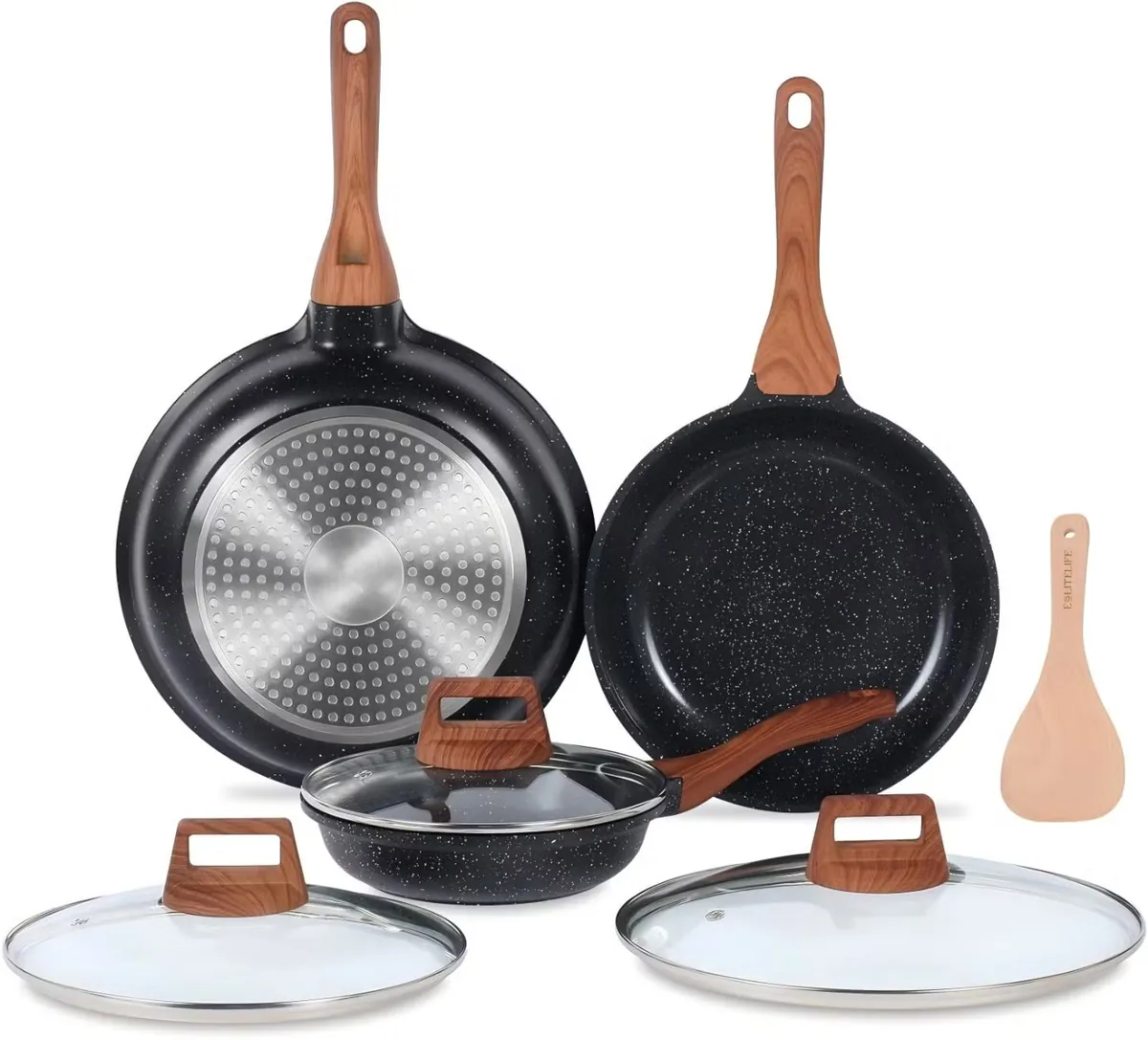
How non-stick coatings are applied
The production process explains why two pans that look identical can perform very differently. The pan body is cleaned and roughened to give the coating something to grip, then a primer layer is sprayed on, followed by one or more top coats. Each layer is cured in an oven at a controlled temperature. More layers and thicker film usually mean better durability, but they also raise cost.
| Stage | What happens | Why it matters |
|---|---|---|
| Surface preparation | Degreasing and abrasive blasting of the pan body | Poor preparation is the most common cause of early peeling |
| Primer | Base layer sprayed to bond coating to metal | Primer quality decides adhesion over time |
| Top coats | 1-3 finish layers applied | More coats generally mean longer release life |
| Curing | Oven baking at set temperature and time | Under-curing produces soft, short-lived coatings |
| Inspection | Visual check, film thickness and release test | Catch defects before they reach your container |
Ask the supplier which coating system they use, how many layers it has, and whether they will state the film thickness on the spec sheet. A supplier that answers in specifics is easier to hold accountable than one that says “non-stick”.
What to check on the coating spec sheet
- Coating family and system: PTFE or ceramic, and the specific system name or series.
- Layer count and film thickness: typical ranges vary; confirm what the quotation actually includes.
- Temperature rating: maximum continuous and brief peak temperature, from the coating maker’s data.
- PFOA/PFAS declaration: whether the system is PFOA-free or PFAS-free, and whether the supplier will put it in writing.
- Food-contact test reports: request reports covering the coating for your destination market, such as FDA 21 CFR 177.1550 for the US, EU food-contact rules under Regulation (EC) No 1935/2004 and related plastics/food-contact measures, or LFGB testing for German retail. Confirm with your buyer or importer which documents they require, because requirements differ by country and by retailer.
- Utensil guidance: whether the coating tolerates metal utensils, and the warranty or claims the supplier attaches to it.
Common mistakes buyers make with coated cookware
- Choosing coating by price alone, then discovering the film is too thin for the market.
- Assuming all PTFE is the same, when systems and layer counts vary widely.
- Ignoring destination-market food-contact rules until customs or a retailer blocks the lot.
- Testing only one pan, instead of confirming consistency across the production run.
- Accepting a verbal “food grade” without a test report or written spec.
FAQ
Is PFOA-free the same as PFAS-free?
No. PFOA-free means the specific legacy chemical PFOA is not used. PFAS-free is a broader claim covering the whole PFAS family, and ceramic coatings usually qualify while PTFE-based coatings generally do not. Confirm exactly which claim your supplier can support in writing, and which one your market actually requires.
Which non-stick coating lasts longer, PTFE or ceramic?
In typical home use, PTFE-based coatings usually maintain their release performance longer than ceramic. Ceramic coatings can be more heat-resistant, but their non-stick effect tends to fade faster. Real performance depends on the specific system, layer count and how the end user cares for the pan.
Can non-stick cookware be used on induction cooktops?
Only if the pan body is induction-compatible. The coating itself does not make a pan induction-safe; the base material and construction do. Check the base of the pan for a magnetic layer or an induction-compatible construction before ordering, and confirm it on the spec sheet.
What documents prove a coating is food-contact safe?
Suppliers usually provide test reports from laboratories covering the coating for a specific market, for example FDA compliance for the US or EU food-contact rules for Europe. Confirm which report your destination market and retailer require, because they are not interchangeable.
Should I order coated cookware with metal or wooden utensils guidance?
For ceramic coatings, recommend non-metal utensils in the packaging or care instructions, because metal utensils shorten release life. PTFE systems vary; some tolerate metal better than others. Match the guidance to the coating system you actually order.
If you are planning a coated cookware range and want a straight answer on which coating fits your market, send us your target country and product mix. We will confirm the coating system, layer structure and available test documentation before you commit. Request a quote on our contact page or message us on WhatsApp, and we can also show you compatible options across our cookware products range.