If you are importing stainless steel cookware sets into the EU, the material and safety requirements your supplier must meet are defined by EN standards and EU food-contact rules, while GB standards apply to the United Kingdom market. In practice, most European buyers specify 18/10 (304) stainless steel, ask for a food-contact test report under EU 1935/2004, and confirm that the set meets EN 12983-1 for cookware safety before they place a container order.
The reason this matters is simple: cookware sits in direct contact with food, and a set that fails a migration test or a lid-handle strength check cannot be sold to European retailers, no matter how good the finish looks. Knowing which standard applies to your target market keeps your sourcing conversation focused and shortens the sample-approval stage.
Why material standards matter when buying cookware for Europe
European retailers and importers rarely buy cookware products without documentation. The key documents are a food-contact compliance declaration and a cookware safety test report. These are not optional extras for a serious order; they are part of the technical file that a supplier should be able to provide from an existing export program.
For a stainless steel cookware set, the relevant checks cover the metal itself, the coating and any non-metal parts such as handles and lids. A supplier that has exported to Germany, France or the Nordic countries will usually have these reports ready. If a factory hesitates or asks what a food-contact report is, treat that as a signal to keep looking.
EN standards for stainless steel cookware
The main product standard for cookware sold in the EU is EN 12983-1, which covers the safety and performance of cookware for use on household stovetops. It includes checks on handles staying cool and secure, lid fit, stability, and durability during heating and cooling cycles.
For food contact, the framework is Regulation (EC) 1935/2004, supported by specific rules on metals and alloys. Stainless steel grades with higher chromium and nickel content, such as 304 and 316, normally show low migration of metals and pass the required limits. A supplier should provide a migration test report from a recognised laboratory, not just a general statement that the product is “food safe”.
GB standards and the UK market
The UK applies its own framework after Brexit. Food-contact materials sold in Great Britain must comply with retained EU law and the domestic regime, and many importers ask for the same EN 12983-1 evidence because it is the most widely recognised cookware safety standard in Europe. For goods produced in China, the Chinese standard GB 4806.9-2016 covers food-contact metal materials and articles; Chinese suppliers use it as their domestic compliance baseline and can usually supply the corresponding test report alongside an EU-style declaration.
If your customer base includes both the EU and the UK, ask the supplier for one document set that covers both: EN 12983-1 for product safety and a food-contact migration report aligned with EU 1935/2004 requirements. That combination works for most retail programs.
EN vs GB at a glance
| Aspect | EU market | UK market |
|---|---|---|
| Cookware safety standard | EN 12983-1 | EN 12983-1 is widely accepted; UKCA marking may apply |
| Food-contact framework | Regulation (EC) 1935/2004 | Retained EU law, domestic regime |
| Typical supplier evidence | Migration test report, EU declaration | Same report set, often with UK-specific documentation |
| Chinese-origin baseline | GB 4806.9 report helps | GB 4806.9 report helps |
Stainless steel grades: what to specify
Not all stainless steel is the same. For cookware, buyers usually choose between 18/10 (304), 18/0 (430), 316, and lower-cost grades such as 201. The grade affects corrosion resistance, magnetic response, and the price of the set.
| Grade | Common name | Typical use in cookware | Notes |
|---|---|---|---|
| 304 | 18/10 | Pots, pans, lids, interior surfaces | Good corrosion resistance, most common choice for European retail sets |
| 316 | 18/10 + molybdenum | Premium pots, marine or acidic cooking | Higher cost; usually not needed for standard cookware |
| 430 | 18/0 | Lids, outer layers, bakeware | Magnetic, lower cost, less corrosion resistance |
| 201 | — | Budget sets | Lower nickel content; may not suit EU buyers who insist on 304 |
When you send a specification, write “304 (18/10) stainless steel” explicitly and ask the supplier to confirm the grade in writing and on the test report. A cookware set that looks identical at a trade show can be 304 or 201 under the surface, and the price difference usually reflects that.
What to check in a cookware set before you order
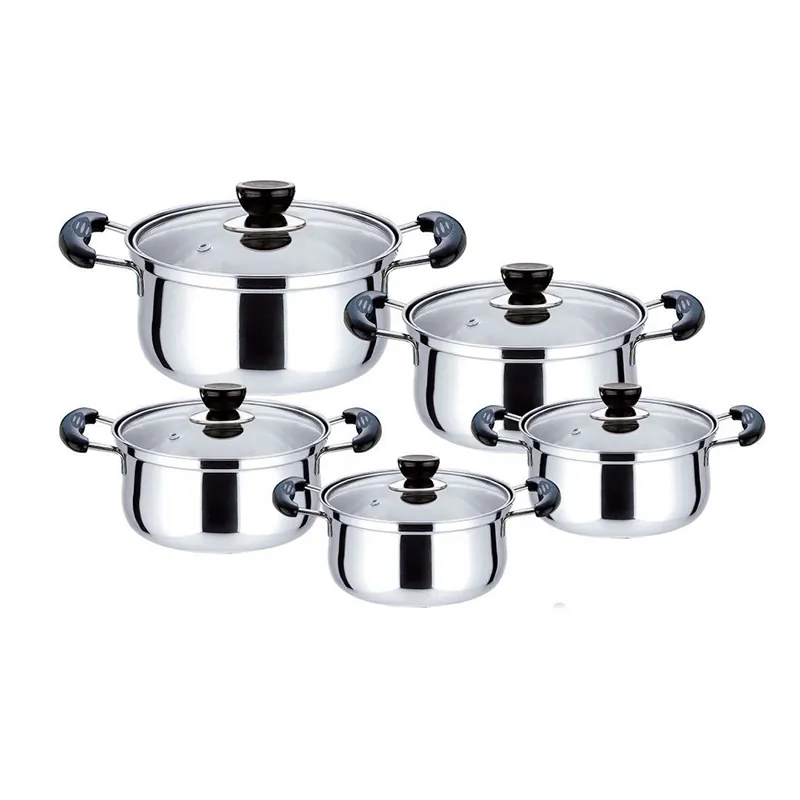
Beyond the material grade, European buyers typically check four things on a sample:
- Layer construction. Tri-ply or multi-ply bases (steel-aluminium-steel) heat more evenly. Single-layer stainless pans may develop hot spots.
- Base thickness. A thicker base usually means better heat distribution. Ask for the gauge or millimetre spec in the technical sheet.
- Induction compatibility. Most European kitchens use induction hobs. The set should state induction compatibility clearly, and a magnet test on the base is the quick way to check.
- Handles, lids and rivets. Handles should stay cool and be securely attached; lids should fit without rocking; rivets and edges should be smooth and easy to clean.
If any of these details are missing from the supplier’s data sheet, ask before sampling. Small clarifications at this stage prevent expensive surprises during container inspection.
Sourcing checklist for European importers
- Confirm the target market (EU, UK, or both) before requesting documents.
- Specify 304 (18/10) stainless steel in writing and ask for the grade on the test report.
- Request EN 12983-1 evidence and a food-contact migration report.
- Check induction compatibility and base construction on the sample.
- Ask for the exact set contents, sizes, and packaging configuration.
- Request a pre-shipment inspection checklist or a third-party inspection quote.
FAQ
Is 304 stainless steel the same as 18/10?
Usually yes. 18/10 refers to roughly 18% chromium and 10% nickel, which is the composition of grade 304 stainless steel. Some suppliers use 18/8 or 18/0 labels, so confirm the exact grade rather than relying on the name.
Do cookware sets need an EN standard certificate to be sold in the EU?
Cookware sold in the EU must meet the applicable safety and food-contact requirements. In practice, importers and retailers ask for EN 12983-1 evidence and a food-contact migration report. The exact documents depend on your buyer, so confirm the requirement list before ordering.
Is induction compatibility standard on stainless steel cookware?
Not automatically. Stainless steel is magnetic only in certain grades, and the base construction also matters. Ask the supplier to confirm induction compatibility and test the base with a magnet on your sample.
Can a Chinese supplier provide EU food-contact documents?
Most export-oriented cookware factories can, because they already supply European retailers. Ask for a migration test report and an EU declaration; the Chinese domestic baseline is GB 4806.9-2016, which covers food-contact metal articles.
What is the usual lead time for a stainless steel cookware set order?
Lead times vary by factory, order size, and whether the set is a stock design or customised. Confirm the schedule in writing, and include a realistic buffer for production and pre-shipment inspection.
Final recommendation
Start your sourcing conversation with the standards question, not the price question. A supplier that can show EN 12983-1 evidence and a food-contact migration report for a 304 stainless steel set has already solved the hardest part of selling cookware in Europe.
If you are planning a cookware program for European retailers, tell us your target market and set configuration, and we will help you shortlist suitable stainless steel cookware sets from verified production lines.
Request a quote for stainless steel cookware sets or contact our sourcing team directly.