If you sell cookware, bakeware or tableware in the UK, the fastest way to destroy a wholesale program is to import a container that does not meet British and EU food-contact rules. The good news: the checklist is shorter than most buyers expect. For UK retailers, a kitchenware order passes compliance when the materials are food-contact approved, the supplier can produce matching test reports and certificates, and the labelling and care instructions are clear enough for a consumer to use the product safely. This guide walks through the EN standards, the documents and the verification steps that matter before you commit to a wholesale kitchenware order for the UK market.
Why UK retailers get kitchenware compliance wrong
Most problems start with a misunderstanding: buyers treat compliance as a factory certification issue, when it is actually a documentation issue. A supplier can be certified to ISO 9001 and still ship a batch of melamine bowls that fails migration testing, or a non-stick pan whose coating tests above the allowed limits. The certificates describe the management system, not the specific product sitting in your container.
The second mistake is assuming that Brexit removed the EU framework. It did not. The UK retained most of the EU food-contact legislation as domestic law. Regulation (EC) 1935/2004 on materials and articles intended to come into contact with food still applies in Great Britain through the retained EU law framework, and it remains the anchor for every other food-contact rule. Northern Ireland follows EU rules directly. For a wholesaler or retailer, the practical consequence is the same: you need traceability from the material supplier through the manufacturer to your order, plus test evidence that covers the finished article.
The third mistake is ignoring the difference between a standard and a legal requirement. EN standards are voluntary harmonised standards that give you a presumption of conformity; the legal requirement is that the product is safe and that the responsible business operator can demonstrate it. When a supplier says “we meet EN standards,” ask which EN standard, for which product, and which laboratory verified it. That single question filters out most weak suppliers.
The EN and UK standards that actually apply
There is no single “kitchenware standard” you can stamp on every SKU. Different product groups sit under different harmonised standards, and UK retailers typically see the following ones cited in test reports and technical files.
| Product category | Common standard referenced | What it covers |
|---|---|---|
| Domestic cookware (stovetop pans and pots) | EN 12983-1 / BS EN 12983-1 | General requirements, performance and test methods for cookware used on hobs |
| Ovenware (glass and metal baking dishes) | EN 13834 / BS EN 13834 | Requirements and test methods for ovenware used in traditional domestic ovens |
| Cutlery and knives | ISO 8442 series | Materials and food-contact requirements, and specifications for cutlery |
| Food-contact plastics and coatings | EU 10/2011 (plastic materials) and national rules | Migration limits for materials and articles in contact with food |
| Ceramic, glass and enamel ware | Directive 84/500/EEC as retained, national limits | Lead and cadmium release limits |
| Metals and alloys (stainless, aluminium, cast iron) | Council of Europe resolution on metals and alloys | Release limits for metals from food-contact surfaces |
Read that table the way a compliance manager would: the standard names are a starting point for conversation, not a guarantee. A test report that cites the right standard for your product group, from a laboratory with the relevant scope, is worth more than a shelf full of management certificates. Ask the supplier to map each SKU family to its applicable standard before you talk about price.
For UK-specific selling, also remember that some products carry additional legal obligations that are not food-contact rules at all. Kitchen knives, for example, are age-restricted under the Offensive Weapons Act 2019: you cannot sell a knife to anyone under 18, and online sales have specific delivery and age-verification expectations. This affects packaging and fulfilment design, not just the blade steel.
Food-contact compliance: Regulation (EC) 1935/2004 and the UK retained version
Regulation (EC) 1935/2004 sets the framework: materials and articles must not transfer their constituents to food in quantities that could endanger health, change food composition unacceptably, or deteriorate taste and odour. Every kitchenware item that touches food — pans, baking trays, spatulas, cutting boards, storage containers — sits inside this framework. The UK applies it through retained EU law, and the practical expectations for importers have not relaxed since 2021.
Article 3 of the regulation requires good manufacturing practice and traceability. Article 17 requires a declaration of compliance for materials that are not yet in contact with food, and the declaration chain runs from the material producer down to the finished article. When a UK retailer imports finished cookware, the importer or first UK-based operator in the chain is the responsible business operator: they are the one who can be asked to produce the documentation. That is why you cannot outsource this to the supplier and walk away.
For specific materials the framework tightens into concrete numbers. Plastic articles and coatings fall under EU 10/2011 with overall and specific migration limits. Ceramics, glass and enamelware have lead and cadmium release limits from Directive 84/500/EEC (as retained in the UK). Metals and alloys are governed by release limits agreed in the Council of Europe resolution on metals and alloys, which is not a regulation but is widely used by laboratories and by enforcement authorities as the reference values. Stainless steel grades such as 304 and 316 are commonly treated as low-risk in this framework, while uncoated aluminium and copper alloys need closer attention because they release more readily under acidic conditions.
FAQ: Does a UK retailer need a UKCA mark on kitchenware?
Answer: Generally no. Food-contact materials are not subject to mandatory CE or UKCA marking for safety conformity the way machinery or electronics are. What you need is the declaration of compliance and supporting test evidence under the retained Regulation (EC) 1935/2004. Some products in a kitchenware assortment, such as certain electrical appliances, do fall under product safety legislation with marking requirements, so check per category rather than assuming one rule covers the whole range.
Documentation checklist before you order
When a supplier sends you a quote, ask for the documentation at the same time, not after the order is placed. A supplier who cannot produce documents on request is not necessarily hiding something, but a supplier who produces them quickly and with complete information is far easier to work with through the life of the program. Use this checklist as your minimum bar.
| Document | What to check | Red flag |
|---|---|---|
| Declaration of Compliance (DoC) for the finished article | Product name matches your SKU, material list is complete, references the right regulation, signed and dated | Generic wording with no product reference |
| Test report for food-contact migration | Issuing laboratory, report number, test standard, sample description, result values vs limits, date within a sensible window | PDF with no lab header, or a report that describes a different product |
| Certificate of conformity or factory QC records | Batch or lot number that can be traced to your order | Certificate number you cannot trace |
| Material specifications (steel grade, coating, plastic type) | Grade is stated, e.g. 304 or 201 stainless, food-grade silicone, PFOA-free coating claim | “Food grade” with no underlying specification |
| Factory licence / export registration | Company name and address match the supplier | Mismatched legal entities |
One practical point: test reports expire in the sense that they describe a moment in time, not a permanent state. A report from two years ago for a pan that was produced with a different coating supplier is weaker evidence than a recent report for the current production recipe. Ask suppliers how often they re-test, and whether the report covers the actual line that will produce your order. For a new program, a pre-production sample sent to a third-party laboratory you choose is the strongest verification, and it is a normal request in this industry.
Labelling and care instructions for the UK market
UK enforcement bodies look at labelling as part of the food-contact picture, because a product that is used wrongly because of unclear instructions can fail safety expectations. Minimum expectations for retail kitchenware in the UK include clear material identification, safe-use limits such as maximum oven temperature, dishwasher-safety indication, care instructions that prevent misuse, and the identity of the responsible business operator in the UK or EU. Symbols are common because they cross language barriers, but they should be understandable without a manual.
Care instructions matter more than most buyers realise. A non-stick pan labelled “dishwasher safe” when the coating is not will generate returns, warranty claims and negative reviews, and it can also trigger a compliance question if the claim is demonstrably wrong. Match the claim to the test. If the supplier has not tested dishwasher cycles, do not print the claim; label the product “hand wash recommended” instead and confirm with the supplier what the coating can actually withstand.
Materials that cause the most compliance problems
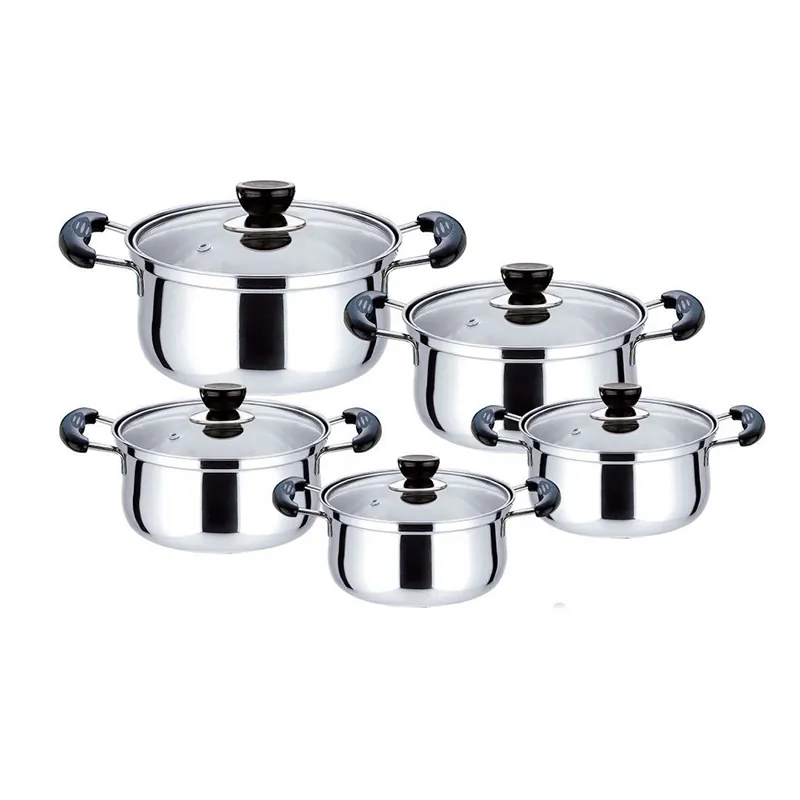
Experience across wholesale programs points to a handful of material categories that generate the most documentation failures. Melamine and plastic articles are the top category: they are cheap, popular and easy to sell, but migration limits are strict, and counterfeit or unbranded melamine can exceed limits. Ceramics and decorated glass come second, with lead and cadmium release from glazes and decorations. Uncoated aluminium and copper-alloy items come third, especially for acidic foods. Stainless steel is the least troublesome category for food-contact compliance when the grade is honestly stated — which is one reason wholesale buyers lean on stainless lines for their core assortment. You can compare the material options across the site’s stainless steel products range, but the compliance principle is identical: the claim has to be backed by a test report for the actual product.
FAQ: Can I rely on the supplier’s own in-house test report?
Answer: Use it as a starting point, not as proof. In-house reports show the factory has equipment and process control, but for import compliance you want a report from an independent laboratory, ideally one that is accredited for the relevant test methods. A common middle path: accept the supplier’s report for initial screening, then send the pre-production sample to your own third-party laboratory for the final release decision.
Step-by-step: verify a supplier against the checklist
Working through a supplier verification in a fixed order prevents gaps. First, shortlist suppliers whose product groups match your target assortment — browse the site’s kitchenware product range to see the categories a wholesale kitchenware supplier is expected to cover. Second, request the documentation set from step one before discussing price. Third, check the documents for the red flags in the table: lab headers, report numbers, product names, dates. Fourth, order samples and send one to an independent lab for migration testing on the highest-risk material in the batch. Fifth, ask for the batch traceability process in writing. Sixth, place a trial order at a volume you can absorb, then scale only after the trial batch passes the same checks.
That sequence is deliberately conservative. It takes longer than ordering from the cheapest quote, but it protects the two things a UK retail program cannot afford to lose: consumer safety and enforcement trust. A single enforcement action over a food-contact failure can freeze an entire product line while the investigation runs.
A worked example: the document set for a first UK order
To make the checklist concrete, walk through a typical first order: eight SKUs across three product groups, say a stainless steel cookware set, two sizes of non-stick frying pans, a silicone bakeware set, and a small cutlery line, all for a UK retail assortment. Before the order is placed, the buyer requests the document set for each SKU family. The cookware sets come with a food-contact test report citing the relevant migration standard, material certificates for the stainless steel grade and the coating, and a declaration of compliance naming the finished article. The silicone bakeware comes with a food-grade certification for the silicone compound and a migration report. The cutlery comes with a report referencing the cutlery standard series and a statement that the product meets the UK age-restriction rules for knife sales.
The buyer then runs the five-minute check on each report: lab name and contact, report number, product description matching the SKU, standard cited, dates within a sensible window. The highest-risk item — the coated pans — goes to an independent laboratory for confirmation testing on the pre-production sample. The trial order is sized to a volume the buyer can absorb, and the batch traceability process is confirmed in writing. Only then does the container get booked. That is the full loop, and it takes roughly the same calendar time as ordering without the checks; the difference is that the compliance evidence exists before the money moves.
FAQ: Do I need separate test reports for every colour of the same pan?
Answer: Ideally yes, because colourants can affect migration results. In practice, suppliers often test the base product and state that colour variants use the same approved colourants. For the highest-risk items, confirm with the supplier that the report covers your exact colour, or test the colour you are actually ordering.
Common compliance failures in imported kitchenware
Enforcement and market-surveillance work in the UK and EU regularly turns up the same handful of failures. Knowing them in advance helps you ask the right questions.
| Failure | Typical cause | How to prevent it |
|---|---|---|
| Migration limit exceeded | Unapproved coating, wrong plastic grade, or colourant change | Request the report for your exact SKU and re-test high-risk samples |
| No declaration of compliance | Importer assumed the supplier handled it | Ask for the DoC at quoting stage and keep it per order |
| Wrong or missing material identification | Grade swapped to reduce cost | Confirm the grade in the specification and check material certificates |
| Misleading care or safety labelling | Supplier printed generic claims | Match every label claim to a test result |
| Unverifiable test report | Report number or lab cannot be confirmed | Verify with the issuing laboratory before accepting |
The pattern behind all five is the same: a document gap that was visible at the quoting stage but was not checked. That is why the checklist is a pre-order habit, not a post-arrival exercise.
The traceability chain: from material to finished article
Food-contact law works through traceability. The material producer issues a declaration for the raw material, the component maker declares the intermediate product, and the factory declares the finished article. When you import into the UK, your supplier should hand you the finished-article declaration plus the upstream declarations that support it. If a question arises about a batch, the chain lets the responsible operator trace the problem back to the exact material lot.
Ask the supplier to show how batch numbers work: does every carton or pallet carry a batch reference that maps to the production records and the test reports? Batch traceability is not just paperwork; it is the mechanism that lets you quarantine one bad batch instead of recalling your whole product line. A supplier that cannot trace a batch is a supplier that turns a small problem into a large one.
Planning the compliance review into your buying calendar
Compliance checks need calendar time, and the calendar starts earlier than most buyers expect. Build the review into the sourcing timeline: request documents with the first quote, allow two to three weeks for the document check and any follow-up questions, order pre-production samples with enough lead time for independent testing, and freeze the compliance package before production starts. For a seasonal program, the compliance window competes with the production window, so start the document conversation even earlier.
| Timeline step | Compliance action |
|---|---|
| First quote | Request the full document set per SKU family |
| Weeks 1-3 | Five-minute check on every report; lab verification on high-risk items |
| Sample stage | Independent testing of the highest-risk material |
| Before production | Freeze the compliance package; confirm batch traceability |
| Each shipment | Attach the DoC and matching reports to the shipping documents |
Frequently Asked Questions
What EN standard applies to cooking pans sold in the UK?
Domestic stovetop cookware is commonly tested to BS EN 12983-1, which covers general requirements and test methods for cookware used on hobs. Confirm with the supplier that the report matches your actual pan model, coating and size range.
Is the CE mark required on kitchenware in the UK?
Not for food-contact safety itself. Kitchenware is generally not subject to mandatory CE or UKCA marking. The requirement is a declaration of compliance and supporting evidence under the retained Regulation (EC) 1935/2004. Electrical kitchen appliances in the same assortment may have their own marking obligations.
Does UK law still follow EU food-contact rules after Brexit?
For the most part, yes. The UK retained the EU food-contact framework as domestic law, including the framework regulation and specific measures. Northern Ireland continues to apply EU rules directly. Always confirm the current guidance with a compliance advisor before a new product launch.
How often should test reports be renewed?
There is no fixed legal interval, but treat a report as tied to the production recipe it describes. Re-test when the material, coating, colourant or production line changes, and request recent reports for new programs. Many importers re-test annually for high-volume lines.
What happens if my batch fails migration testing?
The batch should not be placed on the market. Work with the supplier to identify the cause, quarantine affected stock, and re-test after correction. Document the investigation, because enforcement bodies will ask what you did when you learned of the failure.
For UK retailers, compliance is a process, not a piece of paper. Build the document set, verify it against the checklist, test the highest-risk materials, and keep the evidence organised by SKU and batch. If you are planning a wholesale kitchenware program for the UK and want to work with a supplier who can provide the documentation up front, send your product list and target quantities to our team through our contact page and we will confirm what we can support. For adjacent categories such as custom drinkware and bottles that often sit next to kitchenware in a retail assortment, specialists like Frozl handle that line separately.