Bamboo and hardwood are the two dominant materials in the export cutting board market, and choosing between them decides your price point, your customer’s expectations and your QC program before you write a single purchase order. The short answer: bamboo is the budget-friendly, sustainable-positioned choice with good hardness and easy consistency, while hardwood, acacia and rubberwood being the most common export species, sells at a higher price with a premium feel and better knife-edge friendliness. This guide compares the two materials for OEM sourcing, so you can pick the right one per SKU and specify it correctly.
Bamboo: the volume workhorse with a green story
Bamboo cutting boards are made from strips of bamboo, usually Moso bamboo, pressed and glued into panels under heat and pressure. The material is hard, dense and naturally moisture-resistant, which makes it a practical everyday board. For export, bamboo has two big advantages: price, because the raw material is fast-growing and inexpensive, and story, because bamboo’s rapid growth gives a sustainability angle that retailers and marketplaces like.
The trade-offs are real. Bamboo is harder than most woods, which means it is tough and scratch-resistant, but it is also harder on knife edges; buyers who care about knife preservation notice the difference. The strips-and-glue construction means the board’s surface is a series of glued segments, and if the glue quality is poor or the pressing is uneven, the board can split along the segment lines, especially if it is soaked or left wet. Food-safe glue and proper pressing are the two QC points that make or break a bamboo board.
Bamboo boards also vary by construction orientation. Edge-grain bamboo shows the strip ends and is the most common, face-grain bamboo shows the wide strip faces and has a smoother look, and some boards are made from woven or compressed bamboo fiber. Each looks different on a shelf and behaves slightly differently, so the construction should be part of your specification, not an accident of what the factory had in stock.
Hardwood: acacia, rubberwood and the premium tiers
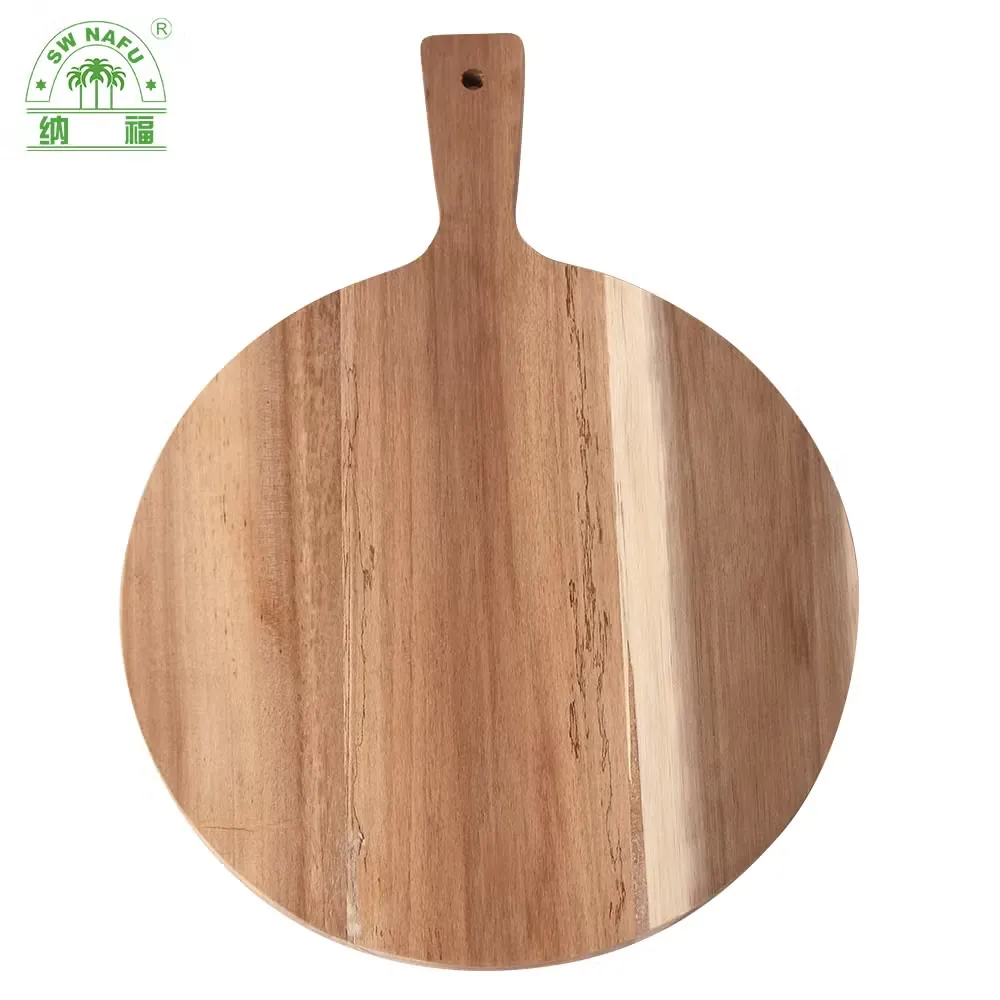
Hardwood boards for export are most commonly made from acacia and rubberwood, with walnut, teak and oak at higher price points. Acacia is dense, naturally attractive with visible grain, and relatively affordable for a hardwood, which makes it the standard choice for mid-range export boards. Rubberwood is light in color, stable and sustainable as a by-product of rubber plantations, and it machines cleanly, which makes it popular for shaped boards and handled designs.
The premium tiers, walnut and teak, command higher prices because of appearance, density and natural oil content. Teak is naturally water-resistant and classic in professional kitchens; walnut is dark, rich and the favorite of gift and premium retail lines. The choice between them is driven by the target market’s price sensitivity and the aesthetic of the brand, not by any technical superiority, because all of them perform well when properly dried and finished.
Hardwood boards are usually made from solid wood blanks or edge-glued panels. Solid blanks are cut from a single piece, which limits the size available and increases cost, while edge-glued panels join multiple pieces and allow larger boards with better dimensional stability. The glue line quality matters for edge-glued boards, and the wood’s moisture content is the single most important production control for all hardwood boards, because wood that is not dried to the right range will warp and crack after arrival.
| Material | Hardness feel | Knife friendliness | Moisture resistance | Typical price position | Best fit |
|---|---|---|---|---|---|
| Bamboo (Moso) | Hard, dense | Harsher on edges | Good, naturally | Entry to mid | Volume retail, everyday boards |
| Rubberwood | Medium-hard | Good | Good when sealed | Mid | Shaped boards, handles, mid retail |
| Acacia | Hard | Good | Good | Mid | Standard premium export boards |
| Walnut | Hard | Good | Good | Premium | Gift and premium retail lines |
| Teak | Hard | Good | Excellent, natural oils | Premium | Professional and high-end retail |
The table is a starting point, not a rule. The same species can vary noticeably between suppliers because of moisture content, drying method and finish, so the species name alone does not guarantee the board’s behavior. What matters is the finished board’s density, moisture content and finish, all of which you can check on a sample.
Moisture content: the hidden spec that decides warp and crack
Wood and bamboo both move with moisture, and the board that warps or cracks after arrival is almost always the board whose moisture content was wrong at packing. The export standard is to dry the material to a range that matches the destination climate, typically around 8-12 percent moisture content for most regions, then keep the board in that range through packaging with moisture barriers where needed.
Ask the factory for its moisture content spec and how it is controlled. A serious supplier kiln-dries the wood, measures the moisture content before and after machining, and packs with desiccant or moisture-proof wrapping for sea freight. A supplier that cannot state its moisture content range is gambling with your containers, and the damage shows up weeks after arrival when the board is already in the customer’s kitchen.
Your QC check should include a moisture meter reading on samples at the factory. The reading should be inside the agreed range, and the boards should be checked again at packing, because a board that was fine in the factory can absorb moisture during storage and packing. Add the moisture range to the purchase order and the inspection checklist, and treat out-of-range boards as major defects.
Finish and food-safety: oil, wax and what to declare
Boards are finished with food-safe oils, waxes or a combination to seal the surface and protect against moisture. The common options are mineral oil, which is the standard food-safe choice, beeswax and carnauba wax blends, and plant-based oils. The finish affects appearance, water resistance and the care instructions, so it should be specified per SKU and declared in the documentation.
For export, the finish must be food-contact safe in the destination market. Ask for the food-contact declaration for the finish material and the board as a whole, and confirm it covers the specific finish used. Some markets also have restrictions on specific substances in finishes and glues, so the documentation should match the current production, not a generic certificate from years ago.
Care instructions belong in the packaging. A simple card that says wash by hand, dry standing, and oil the board monthly prevents the majority of warp and crack complaints, because most damage comes from misuse after arrival. For retail lines, printed care instructions reduce returns; for B2B lines, they protect your relationship with the distributor who resells to the end user.
OEM specification: what to put on the order sheet
A complete wooden or bamboo board specification covers: material and species, construction (solid, edge-glued or strip-pressed), orientation for bamboo, dimensions and tolerance, thickness, edge profile and handle design, moisture content range, finish type and food-contact declaration, and packaging. Add the target market, because a board for a dry climate needs a different moisture range than one for a humid one, and the care card should match.
Sample approval should confirm the appearance and the feel: the surface smoothness, the edge rounding, the finish sheen and the weight. A board that meets every number on the spec sheet can still feel cheap if the edges are sharp or the surface is rough, so the sample is also a feel check. Keep the approved sample as the standard and compare production batches against it.
FAQ: Is bamboo or hardwood better for cutting boards?
Answer: It depends on the market and the price point. Bamboo is harder, cheaper and easier to source consistently, with a strong sustainability story, but it is harsher on knife edges and can split along glue lines if quality is poor. Hardwood, especially acacia, rubberwood, walnut or teak, feels more premium and is friendlier to knife edges, but costs more and needs stricter moisture control. Many importers run both: bamboo for the entry line and hardwood for the premium line.
QC checks specific to boards
The board-specific QC list is short but non-negotiable. Check moisture content on samples, inspect the glue lines for gaps and splits, verify the surface finish and edge rounding against the approved sample, and confirm the food-contact documentation matches the batch. Add a warp check: lay samples on a flat surface and measure any rocking, because a board that does not sit flat is a return waiting to happen.
Check the packaging too. Boards travel long distances, and a board that arrives with dents, scratches or crushed corners is unsellable at retail. The packing should protect the surface, keep boards from rubbing against each other, and include the moisture barrier for sea freight. A board program that combines correct moisture control, clean finishing and protective packing is one that survives the journey.
The same sourcing discipline applies whether you are ordering bamboo boards for a volume program or walnut boards for a premium line. If you are planning a chopping board program and want a supplier who can document moisture content, food-safe finishes and construction quality, send your product list and target quantities through our contact page, and we will confirm what we can support. You can also review the categories a kitchenware supplier should cover across our kitchenware product range.
Price architecture: where bamboo and hardwood sit in an assortment
The material choice shapes the whole price architecture of a board program. A typical export assortment runs three tiers: an entry line in bamboo or rubberwood for volume retail, a mid line in acacia for the standard premium position, and a top line in walnut or teak for gift and specialty retail. The tiers are not just different materials; they are different margins, different packaging and different customers, and the buyer who mixes them deliberately gets a program that covers the market.
Pricing discipline matters more than the material name. The entry line should be priced to win volume and defend against commodity competitors, which means tight material costs and simple, stackable packaging. The mid line earns a visible step-up in finish and presentation, so the surface quality and the packaging have to justify the price. The top line sells on story and appearance, which means the wood selection, the grain matching and the gift-ready packaging carry the margin. A program that positions all three clearly outsells one that treats every board as the same product with a different wood.
The price also depends on the yield of the raw material. Bamboo panels are produced to size, which gives predictable yields and stable pricing. Solid hardwood depends on the log, the drying loss and the cutting yield, so prices move with the raw material market and the waste rate. Ask the supplier how it prices wood movement, and confirm whether the quoted price holds for the order window or floats with the market. For a large order, a price that holds for 30-60 days is worth more than a marginally lower price that moves.
End grain vs edge grain for hardwood boards
Hardwood boards come in two main constructions that change performance and price: edge grain and end grain. Edge-grain boards are cut so the grain runs along the length of the board, which is the standard construction for most retail boards; they are stable, easy to machine and affordable. End-grain boards are cut so the grain ends face up, like a butcher block; they are self-healing under knife cuts, gentler on knife edges and considered premium by serious cooks, but they cost significantly more because the construction uses more wood and labor.
The construction choice should follow the customer. For a general retail line, edge grain is the sensible default. For a professional or premium line, end grain gives the story and the performance that justify the higher price, but the buyer has to explain the care difference, because end-grain boards need more oiling and should not be soaked. Some programs run edge-grain boards for the volume SKUs and end-grain boards for a hero item, which is a clean way to test the premium tier without committing the whole range.
Construction also affects the warp risk. End-grain boards are more stable against warping because the moisture movement is balanced, but they are heavier and need stronger packaging. Edge-grain boards are lighter and cheaper to ship, but their stability depends more on the moisture content and the grain direction. When you compare quotes, confirm the construction, not just the species, because the same wood in edge grain and end grain is priced and behaves completely differently.
Regional and regulatory notes for export
Export boards carry a few regulatory and market notes that buyers should plan for. The European market is tightening documentation on wood products, including questions about legal sourcing and, for some products, the EU deforestation regulation requirements; buyers should ask the supplier for the sourcing documentation and keep it current. The US market applies the Lacey Act declaration requirements to wood imports, and customs can ask for the genus and species of the wood, so the declaration should be accurate on the shipping documents.
Market taste differs too. North American retail favors acacia and bamboo with clean, modern shapes, while European buyers often prefer lighter woods and natural finishes, and Middle Eastern and Central Asian markets like larger boards with handles and juice grooves for family-style food preparation. The shape, the size and the finish should be matched to the destination, and the same applies to the care card, which should be translated and adapted. The board that sells in one region may be the wrong product in another, even at the same price.
How to order: quantities, packaging and samples for boards
Board programs have their own order rhythm. The MOQ is usually stated per design or per material, and it varies with the board’s size and the finish complexity; a simple bamboo board has a lower MOQ than a shaped walnut board with engraved branding. Plan the assortment around the MOQ: order enough designs to make a range, but not so many that each design sits below its minimum. A mixed order of a few hero designs at full MOQ beats a scattered order of many designs at minimum quantity.
Packaging options for boards run from simple shrink wrap to printed retail boxes with inserts, and the choice depends on the channel. Bulk boards ship economically in shrink wrap with edge protection, which suits distributors and B2B programs. Retail boards need printed boxes or cards that protect the surface and show the grain, which adds cost and MOQ. For a first order, start with the packaging that fits the launch channel, and confirm the packaging sample with a production board inside before approving production.
The sample round for boards should cover both the board and the finish. Request a production sample, check the surface smoothness, the edge rounding, the weight and the finish sheen, and run the moisture check with a meter if you have one. Keep the approved sample as the comparison standard, because the finish and the feel are harder to describe in writing than they are to compare side by side.
Boards travel well in mixed containers, which makes them an easy addition to a larger kitchenware program. A container that is carrying cookware, bakeware and utensils can add a board line without much extra freight cost, and the board MOQ can be met within the same shipment. When you plan the mixed container, confirm the packaging density and the stacking rules with the freight forwarder, because boards are light but bulky, and a container that looks full on paper can be badly packed in practice.
Frequently Asked Questions
Is bamboo cutting board better than acacia?
They serve different price points. Bamboo is harder, cheaper and easy to source consistently, with a sustainability story, but it is harsher on knife edges. Acacia is a premium-feeling hardwood with visible grain and better knife friendliness, at a higher cost. For a mixed program, bamboo works for entry lines and acacia for mid and premium lines.
What moisture content should an export cutting board have?
Most export programs target roughly 8-12 percent moisture content, matched to the destination climate. The exact range should be agreed with the supplier and stated in the purchase order. Boards packed for sea freight should also have moisture protection, because the journey itself can push moisture content out of range.
What finish is food-safe for wooden cutting boards?
Mineral oil is the standard food-safe finish, often blended with beeswax or carnauba wax for a longer-lasting seal. Plant-based oils are also used. The finish must have a food-contact declaration for the destination market, and the care instructions should tell the user how often to re-oil the board.
Why do cutting boards warp or crack after shipping?
The most common cause is moisture content outside the correct range at packing, combined with moisture absorption during transport. Wood and bamboo move with humidity, so a board that is too wet or too dry will warp or crack as it adjusts to the destination climate. Correct kiln drying, moisture checks and moisture-proof packing prevent most of this damage.
Can I mix bamboo and hardwood boards in one container?
Yes, mixed orders are common and often the best commercial structure, with bamboo for volume SKUs and hardwood for premium ones. The main requirements are separate specs per material, separate QC checks for moisture and finish, and clear packaging so the two lines do not get mixed in the warehouse. Confirm the MOQ per material with the supplier before combining the order.
Choose the board material by market and price point, then control the three things that decide whether the board survives: moisture content, food-safe finish and construction quality. Specify them in writing, verify them on production samples, and keep the care instructions simple for the end user. If you are sourcing bamboo or hardwood boards and want a supplier who documents these controls, send your product list and target quantities through our contact page, and we will confirm what we can support.