Most cookware sourcing conversations start with the frying pan and end with the set. That leaves the pots — saucepans, stockpots and casseroles — as the quiet half of the category, and quiet is exactly where specification mistakes hide. A saucepan has different jobs than a frying pan: it boils, simmers and reduces, which means its walls, its lid and its handle carry different requirements. A stockpot must hold up to commercial-style loads without flexing. A casserole must move from stovetop to oven and survive the thermal shock of that trip. When importers treat all of these as “pots, roughly like the pan,” they order the wrong gauges, the wrong lid knobs and the wrong set architecture — and discover the error only when the container lands. The direct answer: spec pots by their cooking job, verify base construction and lid systems against your market’s hobs and ovens, and put the capacity, lid-fit and handle checks into the sample approval before you commit to a cookware manufacturer.
Why Pots Are a Separate Specification from Frying Pans
A frying pan is a shallow, fast-heating surface. A pot is a vertical cooking chamber, and the physics change the product. In a saucepan, liquid surrounds the food, so heat distribution across the sidewalls matters less than even heating at the base and good simmer control. In a stockpot, the mass of liquid means the base has to take sustained heat without warping, and the pot has to be lifted when full — which puts the side-handle design and the rim strength under load. In a casserole or braiser, the pot goes into an oven, so every component — body, lid, knob, even the packaging insert — must carry the oven rating the retailer will print on the box.
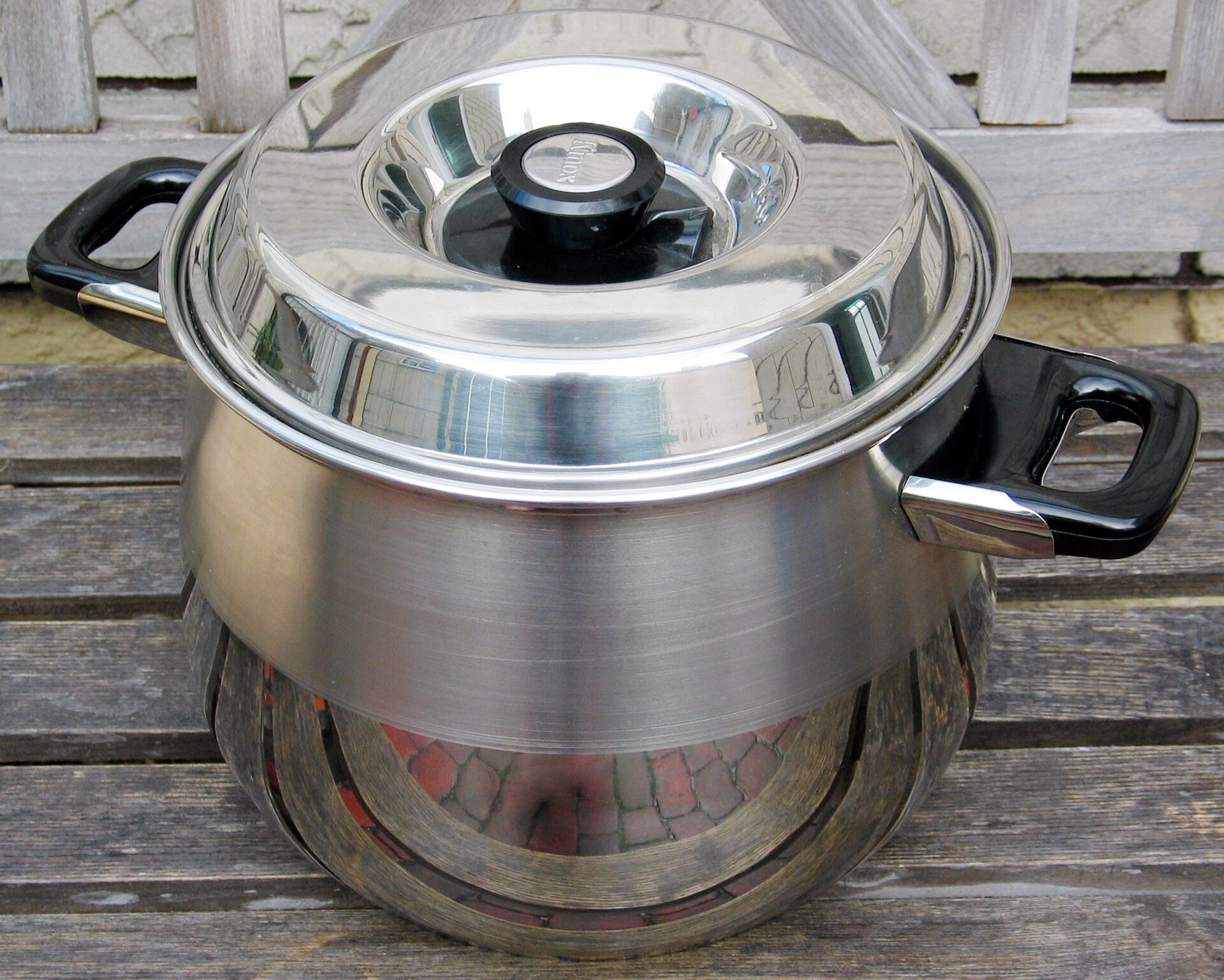
The retail consequence is that each pot family sells on different claims. Saucepan sets sell on everyday cooking and space-efficient storage. Stockpots sell on capacity and durability — the buyer is often cooking for a crowd, canning or doing batch meals. Casseroles and braisers sell on one-pot cooking and table-to-oven presentation. A cookware products range that includes pots needs each family specified against those claims, not one generic “pot” spec repeated across sizes.
The Pot Family Map: Saucepan, Stockpot, Casserole and Their Sub-Lines
Before writing an RFQ, map the pot family the way the retail shelf does. Saucepan lines usually run from small milk pans and 16 cm saucepans up to 20 and 24 cm cooking pots with lids; some ranges add a shallow “saucepan” that is really a small sauté. Stockpot lines run larger — commonly 20, 24, 28 and 32 cm diameters with capacities that rise steeply with diameter — and foodservice versions go bigger still. Casserole and braiser lines sit in the middle: wide, shallow bodies with lids, from about 20 cm up to 30 cm, designed for oven use. Egg or butter warmers, double boilers and pasta pots appear as add-ons in larger ranges.
| Pot family | Typical sizes | Main cooking job | Spec attention point |
|---|---|---|---|
| Saucepan | 14–20 cm, with lid | Boiling, simmering, sauces, small portions | Even base heating, comfortable long handle, stable lid |
| Stockpot | 20–36 cm, tall body | Soups, stocks, batch cooking, canning | Base rigidity, strong side handles, rim strength |
| Casserole / braiser | 20–30 cm, wide and low | Stovetop-to-oven one-pot cooking | Oven-safe lid and knob, thermal shock resistance |
| Specialty pots | Varies | Pasta, milk, double boiling, small tasks | Niche volume; confirm demand before committing minimums |
Most importers do not need every sub-line. A clean first pot program is usually saucepans in three sizes with lids, one or two stockpots, and a casserole in the range’s hero size. Specialty pots are add-on SKUs that can wait until the core lines prove their sell-through.
Capacity Sizing: Metric Logic, Liters and the Marks on the Pot
Pot capacity is where buyer expectations and factory habits most often diverge. A European retail buyer thinks in liters and often in metric diameters; a US buyer may think in quarts and inches; the factory may quote by diameter with an approximate liter volume that changes with wall shape. The discipline is to put both numbers in the specification — diameter and usable capacity in liters — and to verify the printed capacity mark against the actual fill level on a sample. A pot that is marked 24 cm and “4 L” but actually holds 3.6 L to the brim is a product that will generate exactly one kind of online review, and returns in a cookware program are expensive.
Capacity marks also have a marketing dimension. A set sold as “5-piece” needs an honest description of what the buyer gets: how many pots, how many lids, what sizes. The set configuration and SKU planning guide on this site covers the retail-side logic of how pot sets are structured; the factory-side conversation is about matching the marked capacity, the base size and the lid size so the printed set contents are true.
One practical note on sizing: pots that nest save warehouse cube and retail shelf space, but nesting places the base of one pot inside the body of another, which risks scratches if the interior finish is soft. If the range is designed to nest, the factory needs an interior finish and an interleaving plan that can take it — otherwise the “space-saving” feature becomes a damage source.
Base Construction: Encapsulated Disc, Full Clad and Induction Reality
The base is the part of the pot that does the work, and it is also the part buyers cannot see after the pot is packed. That makes base construction the highest-value specification question in a pot order. For stainless steel pots, the two mainstream constructions are an encapsulated disc — a thick aluminum or aluminum-and-copper disc bonded to the bottom of a thinner body — and full clad construction, where the whole body is a sandwich of stainless, aluminum and stainless layers. Both can perform well; they differ in cost, weight, heating behavior and, importantly, in how the walls heat.
Disc-bottom pots concentrate the heat at the base; the walls stay cooler, which is fine for boiling and simmering but creates a visible heat line at the base edge if the disc is poorly bonded. Fully clad pots heat up the walls too, which gives more even cooking up the side but costs more material. Most value and mid-tier retail programs use disc construction for saucepans and reserve full clad for the premium tier. The tri-ply versus disc-bottom comparison on this site works through the construction options in more detail.
Induction compatibility is not optional anymore in most European markets, where induction hobs are common and retailers treat the claim as table stakes. An induction-ready pot needs a magnetic stainless layer in the base, and the magnet test at the sample stage is the cheapest insurance in the program: put a magnet on the base, confirm it holds, then confirm the factory’s test report matches the production batch. The deeper specification — how thick the aluminum core is and how evenly the heat spreads — shows up in a heat distribution test, which is worth running on the pre-production sample for any pot that will carry an induction-ready claim on the box. The claims-check guide on this site explains how to verify oven-safe, dishwasher-safe and induction-ready claims against supplier evidence.
Body Gauge and Material: Matching the Metal to the Job
Pot bodies are commonly specified by material grade and gauge. Stainless kitchenware is often 18/10 or 18/0 chrome-nickel steel, with 18/10 the more common retail choice for corrosion resistance and appearance; aluminum bodies are used where light weight and fast heating matter and where the buyer accepts the metal’s softness; carbon steel appears mainly in commercial and specialty lines. The gauge — the thickness of the body metal — should follow the cooking job. A light saucepan for gentle stovetop use can run thinner than a stockpot that must hold up to heavy loads and high heat without flexing. Casseroles need enough body thickness to resist warping during oven temperature swings. The exact numbers vary by factory and material, so specify a minimum body gauge and confirm it on the sample rather than assuming the factory’s default is what you want.
For stockpots and casseroles, base flatness is the QC issue that matters most. A base that is slightly convex when cold can become a pot that wobbles on the hob when hot, and a base that is concave can bulge and “oil-can” under heat. Flatness checks belong in the inline QC and in the final inspection, and the sample approval should include a written flatness reading on the largest pot in the range.
Handles: Long Handles, Side Handles and the Load Question
Pots use two handle families, and each has its own failure modes. Saucepan long handles are the classic riveted or welded stick handle; they carry the pot during pouring and must stay cool enough to hold or be shaped so the hand grips away from the heat. Side handles, used on stockpots and large saucepans, carry a much heavier load — a full stockpot can weigh several kilograms with contents — so the side handle attachment, the rivet count or weld quality, and the handle’s shape for two-hand lifting are the real specification. A side handle that loosens after six months of heavy use is a safety issue, not a cosmetic one, and it is the kind of defect that turns into a retailer claim.
The rivet-versus-weld decision appears on pots just as it does on frying pans. Riveted handles are easier to inspect, replace and repair, but the rivet heads create interior cleaning points. Welded handles leave a clean interior but require consistent weld quality and are harder to fix in the field. The frying pan handle and rivet guide on this site explains the trade-offs; for pots, add the load test: a side handle on a stockpot should be torque-tested to a level that reflects real lifting, and the test record belongs in the QC file.
Oven-safe handles are a separate claim. If the pot or its lid is oven-safe, every handle and knob component must carry the same rating. A metal handle may be oven-safe but gets dangerously hot; a phenolic or plastic handle may look like metal but soften at oven temperatures. The specification should name the oven temperature each component tolerates, and the retail packaging should state it in the buyer’s units and language.
Lid Systems: Fit, Knob, Vent and the Oven Question
The lid is where pot programs quietly lose margin. Lids add cost, complexity and QC points, and importers who treat lids as an afterthought end up with the two most common pot complaints: a lid that does not seat properly and a knob that cannot take the oven temperature printed on the box.
Start with fit. The lid must seat without rocking, and the rim tolerance between pot and lid has to be consistent across the whole production batch — a lid that fits the sample but not the bulk run is a classic sample-approval gap. Check lid fit on multiple units at the factory, not on the single golden sample.
Then choose the lid system by market. Glass lids let the cook watch the food and are popular in retail cookware because they photograph well, but they add weight, breakage risk in transit and a thermal-shock question on the stovetop. Metal lids are lighter in cost and more durable, but the buyer cannot see inside. Many mid-tier sets use glass lids on saucepans and metal lids on stockpots, or glass lids only on the hero sizes.
Knob material decides the oven story. Metal knobs can go to high oven temperatures but get hot to touch. Phenolic, silicone-coated or plastic knobs stay cooler but may have a lower maximum temperature and can discolor over time. If the pot is sold as oven-safe to a specific temperature, the knob must be rated to at least that temperature, and the rating should come from the component supplier’s test data, not from the pot factory’s general optimism.
A small detail that matters in pot sets: lid storage. Set packaging usually needs a way to protect lids in the carton — lids sliding against bodies are a leading source of transit scratches. The carton insert design belongs in the sample approval, and the QC checklist should include a packed-carton drop check on the largest set before bulk production.
Set Architecture: Turning Pots into a Program
Pots rarely sell one at a time in mid-tier retail; they sell in sets, and set architecture is a purchasing decision disguised as a product decision. The classic pot set builds from a small saucepan up to a stockpot, with lids matched to sizes, and the set count — 3, 5, 7, 10 or more pieces — usually counts lids and sometimes includes a frying pan to make the set feel complete. The pieces you choose define the price band, the carton cube and the margin.
Two architecture mistakes recur. The first is including a hero frying pan in every “pot” set, which can be right for value programs but wrong when the buyer already has a pan line. The second is filling the set with odd sizes that no cook uses, purely to inflate the piece count — retail shoppers have learned to divide the piece count by two and discount the result. A set of genuinely useful sizes, honestly described, outsells an inflated set on repeat purchase, and repeat purchase is where cookware programs make money.
Set architecture also drives the SKU conversation with the factory. Each set is a SKU with its own packaging, its own carton and its own QC; a range of three sets across a supplier’s existing size matrix is easier to run than three sets that each need new tooling. Ask the supplier which pot sizes, lids and handles already exist in its catalog before designing sets around new components — catalog-based sets cost less in tooling and lead time and leave room in the budget for the packaging quality the retail shelf demands.
QC Points Specific to Pots
General cookware QC covers coating, finish and packaging, but pots deserve a short list of their own checks. Base flatness on the largest sizes, as described above. Capacity marks that match measured fill volume. Lid fit across multiple production units. Handle torque and load on side-handled pots. Knob and component oven ratings that match the packaging claim. Interior finish at the rivet or weld points, where cleaning complaints start. And a packed-carton drop test for sets with glass lids, where transit breakage can turn a profitable container into a claim file. The cookware QC guide on this site covers the inline and final inspection structure; the pot-specific checks above are the additions that keep pot lines consistent.
| Check | Where it happens | What to record |
|---|---|---|
| Base flatness | Inline on largest sizes, final inspection | Flatness reading in mm, unit and batch |
| Capacity accuracy | Sample and random bulk units | Printed capacity vs measured fill |
| Lid fit | Multiple units, not one sample | Seating tolerance, rocking check |
| Handle load and torque | Sample approval, batch spot check | Torque value, load test result |
| Oven rating components | Component test data, bulk verification | Knob and handle max temperature |
| Packed-carton drop | Sample approval, first bulk carton | Drop height, damage inspection record |
The QC file matters beyond the factory gate. Retail buyers increasingly ask for batch records that link the finished pot to its material and component tests — the batch traceability approach on this site explains how to set that up. For a pot line, the traceability file should cover the body material, the base disc or clad construction, and the lid and knob components, because a recall or a market test can hinge on any one of them.
Briefing the Manufacturer: The PO Data That Prevents Pot Problems
A cookware manufacturer can only quote what you specify. The difference between a pot order that runs clean and one that produces surprises is usually the briefing document: sizes and capacities in both metric and the buyer’s units, base construction and minimum gauge, material grade, handle type with oven rating, lid type with knob material and oven rating, induction-ready requirement with the test expectation, packaging spec including lid protection, and the QC and documentation deliverables. Send the same briefing to every factory you compare, then judge the factories on process questions — how they check flatness, how they verify lid fit, how they protect glass lids in cartons — not on the single number at the bottom of the quote.
Frequently Asked Questions
What sizes should a first saucepan and stockpot range include?
A practical first program is saucepans in three sizes with lids — typically 16, 18 and 20 cm — plus one or two stockpots from 20 to 28 cm and a casserole in the hero size of the range. Add specialty pots only when core lines prove their sell-through; every extra SKU costs warehouse space and minimum-order commitment.
Is induction compatibility required for pots in European retail?
Induction hobs are common in many European markets, and most retail cookware ranges treat induction-ready as table stakes. Confirm the magnetic base with a magnet test on the sample and verify the factory’s test report matches the production batch before shipping an induction-ready claim on the box.
Glass lid or metal lid — which should a wholesale pot range choose?
It depends on the band and the market. Glass lids sell well at mid-tier retail because shoppers can watch the food, but they add weight, transit breakage risk and a thermal-shock question. Metal lids are lighter in cost and more durable. Many ranges use glass lids on hero saucepans and metal lids on stockpots and value tiers.
What oven temperature should pot components tolerate?
The rating must match the claim on the retail packaging — usually the manufacturer specifies a maximum oven temperature for the whole pot including lid and knob, often around 180–230 °C depending on materials. Confirm the knob and handle ratings with component test data rather than accepting a general “oven-safe” statement.
How do I avoid lid-fit problems in bulk production?
Check lid fit on multiple units at the factory, not on the single pre-production sample. Specify the rim tolerance in the PO, include lid seating in the inline QC, and record fit checks per batch. A lid that fits the sample but not the bulk run is one of the most common pot-order defects.
If you are building a pot line — saucepans, stockpots, casseroles or complete sets — and want a specification review before you send the RFQ, send us your target market, sizes and price bands. Our team works with cookware manufacturers on base construction, lid systems and QC files for importers every week. Request a sourcing consultation and we will reply with a practical plan.